An oral third-generation cephalosporin antibiotic
Cefdinir
An oral cephalosporin antibiotic used for common bacterial infections such as chest, ear and skin infections.
What is Cefdinir?
Cefdinir is a third-generation cephalosporin antibiotic taken by mouth, used for common bacterial infections such as chest, sinus, throat, ear and skin infections. It is more widely used abroad than in the UK. As a cephalosporin it is related to penicillin, so people allergic to penicillin or other cephalosporins may also react to it, and an allergy history is checked first. Like all antibiotics it can cause diarrhoea, including the more serious Clostridioides difficile infection. A harmless quirk is that, if taken with iron supplements or iron-fortified foods, it can turn the stools a reddish colour.
Education and reference only. This is a plain-language guide to Cefdinir — it deliberately contains no doses. Doses depend on the person, the brand and the reason for treatment, and belong with your prescriber. Always check the BNF, the product labelling (SmPC) and follow medical advice.
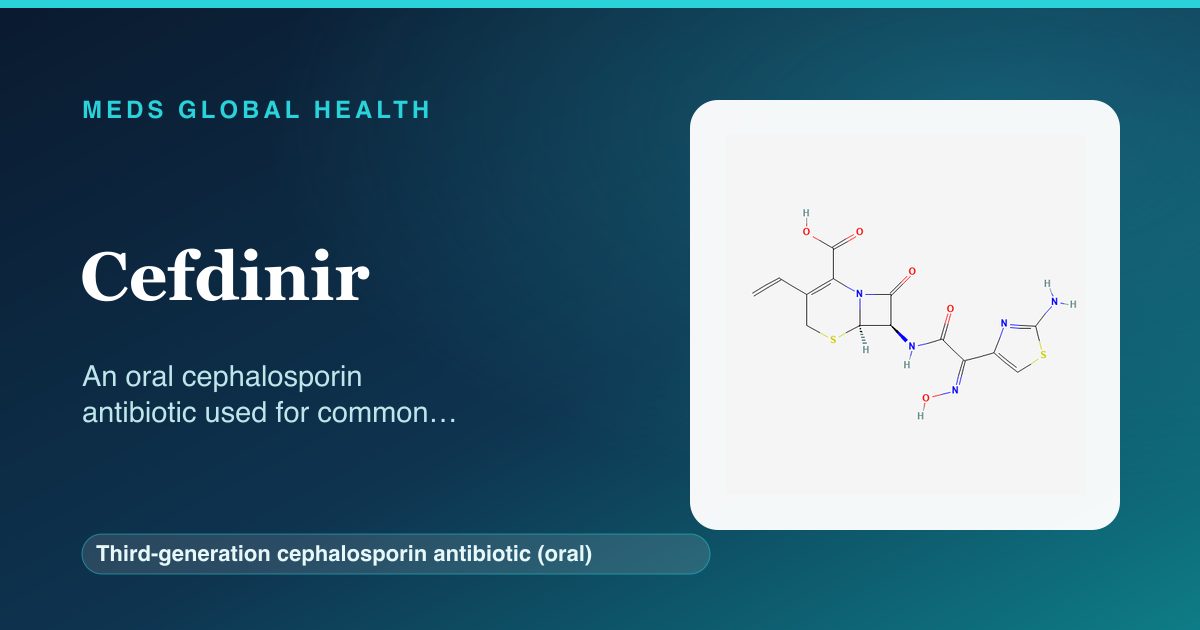
What it is
Cefdinir is an antibiotic in the cephalosporin family, classed as a third-generation cephalosporin. Unlike some other cephalosporins that must be injected, cefdinir is taken by mouth as a capsule or liquid, which makes it convenient for treating infections at home. It is used for a range of common bacterial infections, including chest, sinus, throat, ear and skin infections. It is used more commonly in some other countries than in the UK. As a cephalosporin, it is related to penicillin, which matters for people who have had reactions to penicillin antibiotics.
How it works
Cefdinir works by stopping bacteria from building their protective cell walls. Without a properly formed wall, the bacteria cannot hold themselves together and they break down and die. This makes cefdinir effective against many of the bacteria responsible for common chest, ear, throat, sinus and skin infections. Being a third-generation cephalosporin, it is active against a fairly broad range of bacteria. Because it is taken by mouth and absorbed from the gut, it can be used as a course of capsules or liquid to clear an infection over several days.
Company & origin
An oral third-generation cephalosporin antibiotic, used more widely abroad than in the UK for common bacterial infections.
Practical use
How to take Cefdinir
General, dose-free guidance — always follow your prescriber's and the leaflet's specific instructions.
- Take it by mouth as prescribed, with or without food, and complete the full course even if you feel better.
- Separate it from iron supplements and antacids by a couple of hours, as these can reduce how well it is absorbed.
- Do not be alarmed if your stools turn a reddish colour when taking it with iron; this is harmless.
- Tell your prescriber about any allergy to penicillin, cephalosporins or other antibiotics before starting.
- Report severe or persistent diarrhoea during or after the course, as it can signal a gut infection.
Weighing it up
Advantages & disadvantages of Cefdinir
Advantages
- An effective oral antibiotic for common chest, ear, sinus, throat and skin infections.
- Taken by mouth as a capsule or liquid, so it can be used at home.
- Active against a fairly broad range of bacteria.
Disadvantages
- People allergic to penicillin or other cephalosporins may also react to it.
- Like all antibiotics, it can cause diarrhoea, including the more serious Clostridioides difficile infection.
- Its absorption is reduced by iron and antacids, which need to be separated in timing.
Practical use
Good to know
The main safety point with cefdinir is allergy: it is a cephalosporin, related to penicillin, so people who have reacted to penicillin or other cephalosporins may react to it too, and the allergy history is always checked before it is prescribed. Like all antibiotics, it can disturb the gut bacteria and cause diarrhoea, sometimes from a more serious infection called Clostridioides difficile, so severe or lasting diarrhoea should be reported. A useful and reassuring thing to know is that if cefdinir is taken with iron supplements or iron-fortified foods or formula, it can turn the stools a reddish colour; this is harmless and is simply the antibiotic reacting with the iron. As with any antibiotic, it is important to finish the prescribed course even once you feel better, to clear the infection fully and help prevent resistance.
Who should not take it / use with caution
- People who have had a serious allergic reaction to cefdinir or other cephalosporins should not take it.
- It is used with great caution, or avoided, in people who have had a severe allergic reaction to penicillin, because of cross-reactivity.
- It is used with care and the dose adjusted in people with kidney problems, under medical guidance.
Monitoring
- No routine blood monitoring is usually needed for a short course.
- Watching for allergic reactions and for severe or lasting diarrhoea.
- Adjusting the dose in people with kidney problems.
Side effects
- Diarrhoea, feeling sick or stomach upset.
- A harmless reddish colouring of the stools when taken with iron supplements or iron-fortified foods.
- Allergic reactions ranging from a rash to, rarely, a serious whole-body reaction, and rarely a more serious gut infection (Clostridioides difficile).
Key interactions
- Iron supplements, iron-fortified foods and antacids reduce how well it is absorbed, so separate the timing.
- It may interact with certain other medicines, so tell your prescriber everything you take.
- It can affect the results of some laboratory tests, which your team can allow for.
Available as: Capsules and a liquid taken by mouth.
Answers
Cefdinir: frequently asked questions
What is cefdinir used for?
It is an oral cephalosporin antibiotic used for common bacterial infections such as chest, sinus, throat, ear and skin infections.
Can I take it if I'm allergic to penicillin?
Cephalosporins like cefdinir are related to penicillin, so people with a penicillin allergy may also react; your allergy history is checked, and a severe allergy may mean a different antibiotic is used.
Why have my stools turned reddish?
If cefdinir is taken with iron supplements or iron-fortified foods, it can turn the stools a reddish colour; this is harmless and simply the antibiotic reacting with the iron.
Should I take it with iron tablets?
Iron supplements and antacids can reduce how well cefdinir is absorbed, so they should be separated from it by a couple of hours.
Do I need to finish the course?
Yes. Like any antibiotic, it is important to complete the full prescribed course even once you feel better, to clear the infection fully and help prevent resistance.
The wider class
About Third-generation cephalosporin antibiotic (oral)
Cefdinir belongs to the third-generation cephalosporin antibiotic (oral) class. For how the class as a whole works, its shared safety principles and monitoring, see the full guide.
Browse by body system
Authoritative sources
- BNF
- NICE CKS
Building a medicines information resource?
We create evidence-led, dose-free drug and formulary references for teams.