A third-generation cephalosporin
Ceftriaxone
A long-acting third-generation cephalosporin given by injection for serious infections.
What is Ceftriaxone?
Ceftriaxone is a third-generation cephalosporin antibiotic given by injection or drip (IV/IM), often only once a day because it is long-acting. It treats serious infections such as meningitis, pneumonia and gonorrhoea. It must not be mixed with or given alongside calcium-containing fluids in newborns, and it can cause gallbladder sludge.
Education and reference only. This is a plain-language guide to Ceftriaxone — it deliberately contains no doses. Doses depend on the person, the brand and the reason for treatment, and belong with your prescriber. Always check the BNF, the product labelling (SmPC) and follow medical advice.
What it is
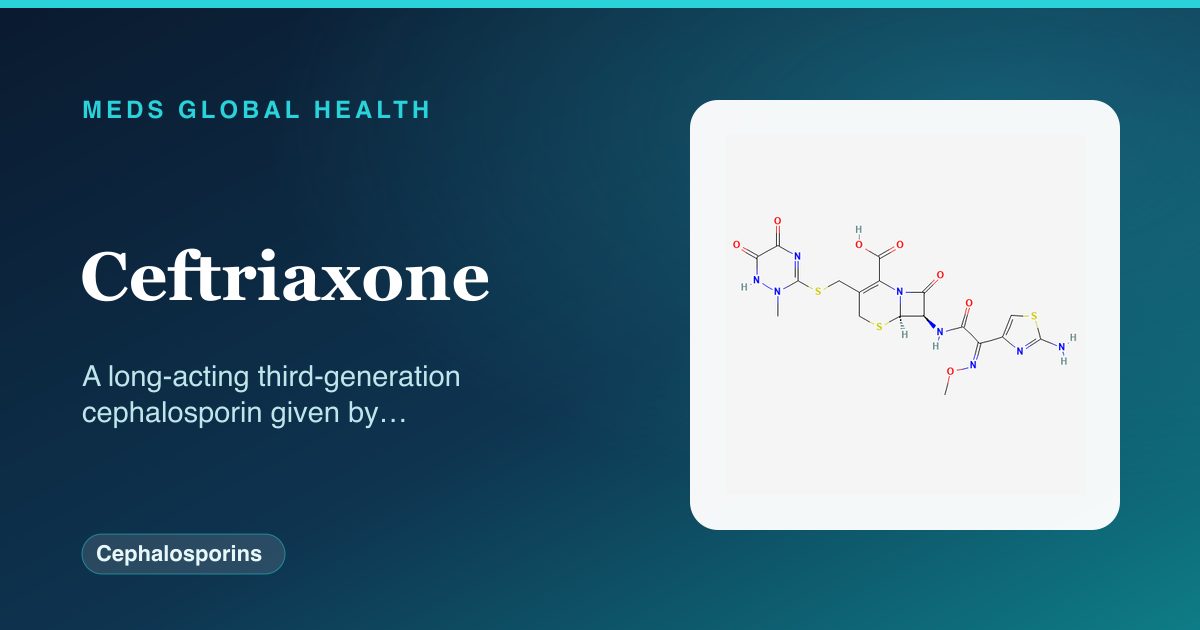
Ceftriaxone is a third-generation cephalosporin antibiotic, related to the penicillins, given by injection or drip. Because it lasts a long time in the body, it can often be given just once a day, which makes it convenient in hospital and some community settings. It is used for a wide range of serious infections, including meningitis and gonorrhoea.
How it works
Like other cephalosporins, ceftriaxone stops bacteria building their protective cell walls. The weakened wall cannot withstand internal pressure, so the bacteria burst and die. It reaches many parts of the body, including the fluid around the brain, which is why it is a key treatment for bacterial meningitis.
Company & origin
Originated / developed by: Originally developed by Roche; available as a generic medicine..
Developed in the early 1980s as a long-acting third-generation cephalosporin antibiotic.
Practical use
How to take Ceftriaxone
General, dose-free guidance — always follow your prescriber's and the leaflet's specific instructions.
- It is given by injection into a vein or muscle by a healthcare professional.
- It is often given just once a day because it stays in the body a long time.
- Tell the team about any allergy to penicillins or cephalosporins before it is given.
- In newborns it is never given with or near calcium-containing fluids.
- Report any severe, watery or bloody diarrhoea, or significant tummy pain, promptly.
- Complete the full course even once you feel better.
Weighing it up
Advantages & disadvantages of Ceftriaxone
Advantages
- Long-acting, so it can often be given just once a day.
- Penetrates well into the fluid around the brain, making it a mainstay for meningitis.
- Works against a broad range of bacteria and is available as a generic medicine.
Disadvantages
- Given only by injection or drip, so it needs a clinical setting.
- Must not be combined with calcium-containing fluids in newborns, which limits its use there.
- Can cause gallbladder sludge and, like other broad antibiotics, C. difficile diarrhoea.
Practical use
Good to know
Ceftriaxone is given by a healthcare team, often once a day because it is long-acting. Tell staff about any penicillin or cephalosporin allergy, as cross-allergy can occur. In newborn babies it must not be mixed with or given at the same time as calcium-containing fluids, as this can be dangerous. It can cause sludge in the gallbladder, which may cause tummy pain. Report any severe diarrhoea, as broad antibiotics can trigger C. difficile.
Who should not take it / use with caution
- People who have had a serious allergic reaction to cephalosporins.
- Newborn babies who need calcium-containing fluids, or premature babies in certain situations.
- People with a severe penicillin allergy should be assessed carefully because of cross-reactivity.
Monitoring
- Whether the infection is responding to treatment.
- Kidney and liver function where relevant.
- Any sign of allergic reaction, gallbladder problems or C. difficile diarrhoea.
Side effects
- Diarrhoea, feeling sick or stomach upset.
- Rash or other allergic reactions.
- Gallbladder sludge, which may cause tummy pain.
- C. difficile-associated diarrhoea (uncommon but important).
Key interactions
- Calcium-containing fluids, especially dangerous in newborns.
- Other medicines that can affect the kidneys, used together with caution.
- It may affect the results of some blood and urine tests.
Available as: Available as a powder made up into an injection or infusion (drip).
Answers
Ceftriaxone: frequently asked questions
Why is ceftriaxone often given just once a day?
It is long-acting and stays in the body for a long time, so a single daily dose is usually enough to keep working. This makes treatment simpler in hospital and some community settings.
Why can't it be given with calcium in newborns?
In newborn babies, ceftriaxone can react with calcium-containing fluids to form harmful deposits. For this reason it must never be mixed with or given alongside calcium-containing fluids in newborns.
What is gallbladder sludge?
Ceftriaxone can sometimes cause a sludge-like material to form in the gallbladder, which may cause tummy pain. It usually settles after the antibiotic is stopped, but report any significant pain.
Can I have it if I am allergic to penicillin?
Cephalosporins can occasionally cause a reaction in people allergic to penicillin. Tell the team about any antibiotic allergy so they can decide whether it is safe for you.
What is it used for?
It treats serious infections such as meningitis, severe pneumonia, blood infections and gonorrhoea. It is often started while tests confirm the exact bacteria.
The wider class
About Cephalosporins
Ceftriaxone belongs to the cephalosporins class. For how the class as a whole works, its shared safety principles and monitoring, see the full guide.
Browse by body system
Authoritative sources
- BNF
- NICE CKS
Building a medicines information resource?
We create evidence-led, dose-free drug and formulary references for teams.