An oral third-generation cephalosporin antibiotic
Cefditoren
An oral third-generation cephalosporin antibiotic used in some countries, with a few specific cautions.
What is Cefditoren?
Cefditoren is an oral third-generation cephalosporin antibiotic used in some countries to treat infections such as chest, throat, sinus and skin infections. Like all cephalosporins it can cause allergic reactions, and people with a serious penicillin allergy may also react to it. It can upset the gut and, rarely, cause a serious bowel infection (Clostridioides difficile). Two specific points are worth knowing: it is taken as an ester (cefditoren pivoxil) that can lower the body's carnitine levels, so it is avoided in long courses and in people with carnitine problems, and it should not be used by people with milk-protein allergy because the tablets contain milk-derived casein.
Education and reference only. This is a plain-language guide to Cefditoren — it deliberately contains no doses. Doses depend on the person, the brand and the reason for treatment, and belong with your prescriber. Always check the BNF, the product labelling (SmPC) and follow medical advice.
What it is
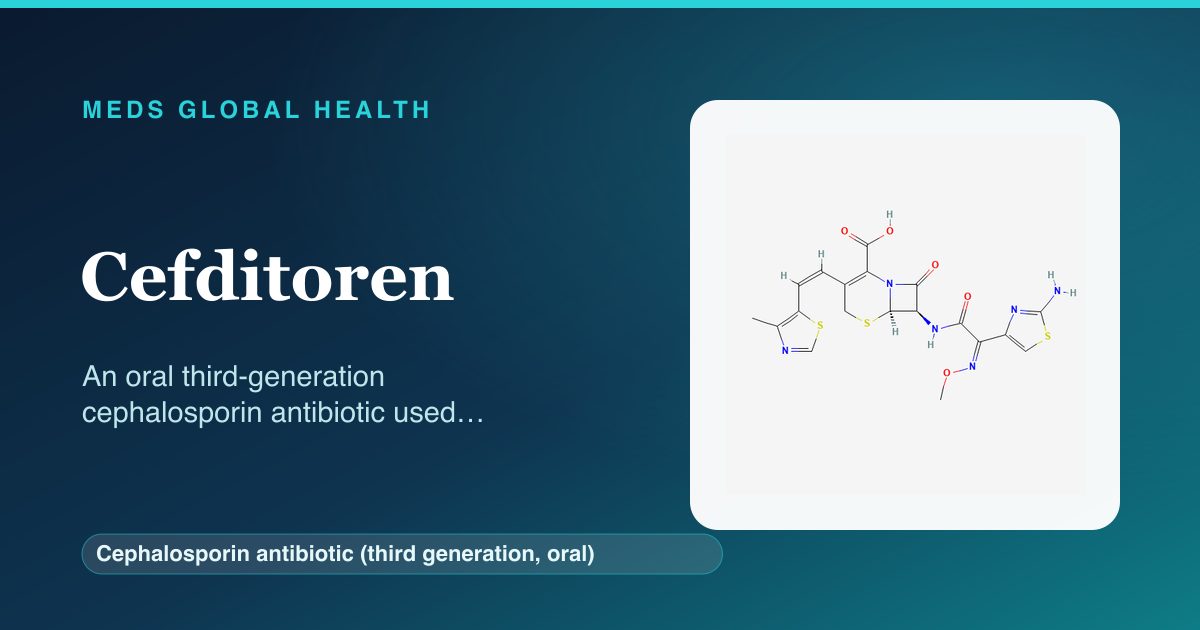
Cefditoren is a cephalosporin antibiotic, related to penicillin, given by mouth to treat a range of common bacterial infections such as those of the chest, throat, sinuses and skin. It belongs to the third generation of cephalosporins and is taken as cefditoren pivoxil, an ester form that helps it be absorbed and is then converted to the active medicine in the body. It is used in some countries but is not a standard treatment in the UK. It has a few particular cautions linked to how it is formulated.
How it works
Cefditoren works like other cephalosporins by stopping bacteria from building a strong cell wall, so the bacteria cannot survive and the infection clears. To get it absorbed from the gut, it is given as an ester called cefditoren pivoxil; once absorbed, the body splits off the active antibiotic. The pivoxil part is broken down in a way that uses up carnitine, a natural substance the body needs, which is why long or repeated courses can lower carnitine levels. This explains one of its specific cautions and why it is not suitable for prolonged use.
Company & origin
An oral third-generation cephalosporin antibiotic used in some countries for infections such as chest, throat and skin infections; it is not a standard treatment in the UK.
Practical use
How to take Cefditoren
General, dose-free guidance — always follow your prescriber's and the leaflet's specific instructions.
- Take it by mouth with food, which helps it be absorbed properly.
- Tell your prescriber about any allergy to cephalosporins or penicillin before starting.
- Tell your prescriber if you have a milk-protein allergy, as the tablets contain milk-derived casein and should be avoided.
- Complete the course as prescribed, and do not use it for longer than advised because of the effect on carnitine.
- Report severe or watery diarrhoea, which could be a sign of a bowel infection.
Weighing it up
Advantages & disadvantages of Cefditoren
Advantages
- An oral third-generation cephalosporin effective against a range of common infections.
- Taken by mouth, which suits treatment outside hospital where it is available.
- Works by the reliable cephalosporin action of attacking the bacterial cell wall.
Disadvantages
- Can lower the body's carnitine levels, so it is not suitable for long courses.
- Should not be used by people with milk-protein allergy, as the tablets contain casein.
- Like other cephalosporins, can cause allergy, gut upset and, rarely, a serious bowel infection.
Practical use
Good to know
Cefditoren has a few particular points worth understanding. As a cephalosporin it can cause allergic reactions, and there is a chance of cross-reaction in people with a serious penicillin allergy, so allergy history matters. The medicine is formulated using milk-derived casein (a milk protein), so it should not be used by people with milk-protein allergy, although it is fine for people who are simply lactose intolerant. Because it is taken as the pivoxil ester, it can gradually lower the body's carnitine levels, so it is not used for long courses and is avoided in people who already have carnitine problems. It is best absorbed when taken with food. As with all antibiotics, it can upset the gut and, rarely, cause a serious bowel infection (Clostridioides difficile).
Who should not take it / use with caution
- People who have had a serious allergic reaction to a cephalosporin should not take it.
- People with milk-protein allergy should not take it, as the tablets contain milk-derived casein.
- It is used with caution in people with a serious penicillin allergy, because of possible cross-reaction.
- It is avoided in people with carnitine deficiency and is not used for long courses.
Monitoring
- Checking for cephalosporin or penicillin allergy, and milk-protein allergy, before starting.
- Checking the infection responds and watching for gut side effects.
- Avoiding prolonged courses because of the effect on carnitine.
Side effects
- Diarrhoea, nausea or stomach upset.
- Allergic reactions, from rashes to, rarely, severe reactions.
- Headache or, in women, thrush, as with some antibiotics.
- Rarely, a serious bowel infection (Clostridioides difficile) causing severe or watery diarrhoea.
Key interactions
- Antacids and acid-lowering medicines can reduce how well cefditoren is absorbed, so separate the timing.
- Other medicines that affect carnitine may add to its effect on carnitine levels.
- Tell your prescriber about all your medicines and any antibiotic allergies.
Available as: Tablets taken by mouth.
Answers
Cefditoren: frequently asked questions
What is cefditoren used for?
It is an oral third-generation cephalosporin antibiotic used in some countries for infections such as chest, throat, sinus and skin infections; it is not a standard treatment in the UK.
Why does it lower carnitine?
It is taken as the pivoxil ester, which is broken down in a way that uses up carnitine, so long or repeated courses can lower carnitine levels and it is not used for prolonged treatment.
Why can't people with milk allergy take it?
The tablets are made using milk-derived casein, so they are not suitable for people with a milk-protein allergy, although they are fine for people who are simply lactose intolerant.
Should I take it with food?
Yes, taking it with food helps it be absorbed properly.
Can people with penicillin allergy take it?
Cephalosporins can cross-react with penicillin, so anyone with a serious penicillin allergy should tell their prescriber, and it is used with caution or avoided.
The wider class
About Cephalosporin antibiotic (third generation, oral)
Cefditoren belongs to the cephalosporin antibiotic (third generation, oral) class. For how the class as a whole works, its shared safety principles and monitoring, see the full guide.
Browse by body system
Authoritative sources
- BNF
- NICE CKS
Building a medicines information resource?
We create evidence-led, dose-free drug and formulary references for teams.