A second-generation cephalosporin (cephamycin), often for surgical prophylaxis
Cefotetan
An injected cephalosporin often used for surgical prophylaxis, notable for an alcohol reaction and a bleeding risk.
What is Cefotetan?
Cefotetan is a second-generation cephalosporin antibiotic, of the cephamycin type, given by injection. It is good against bacteria found in the gut and pelvis, so it is often used to prevent infection during abdominal and pelvic (bowel and gynaecological) surgery, as well as to treat some infections. Like all cephalosporins it can cause allergic reactions, with possible cross-reaction in serious penicillin allergy, and it can upset the gut. Because of its chemical side chain it can cause a disulfiram-like reaction with alcohol and can increase the risk of bleeding.
Education and reference only. This is a plain-language guide to Cefotetan — it deliberately contains no doses. Doses depend on the person, the brand and the reason for treatment, and belong with your prescriber. Always check the BNF, the product labelling (SmPC) and follow medical advice.
What it is
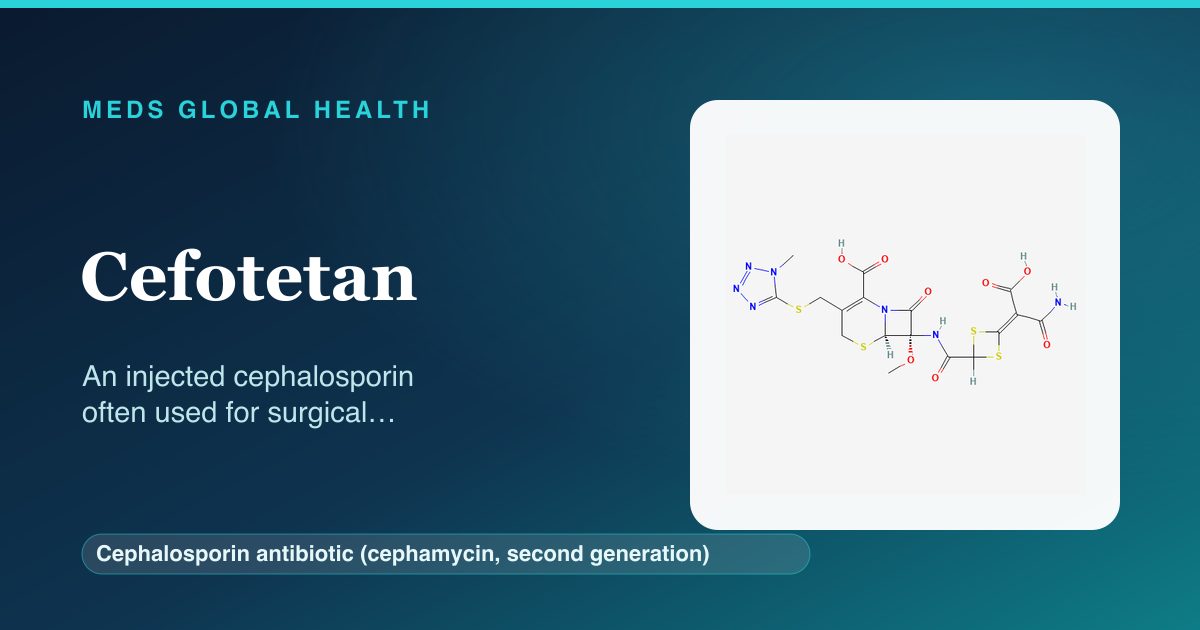
Cefotetan is a cephalosporin antibiotic belonging to a subgroup called cephamycins, given by injection or infusion. It is particularly active against the kinds of bacteria found in the bowel and pelvis, including some that survive without oxygen, which makes it useful for preventing infection during abdominal and gynaecological surgery and for treating some infections in those areas. It is related to penicillin and shares the general cautions of cephalosporins, plus two specific ones from its chemical structure. It is not a routine routine choice in the UK, where other antibiotics are usually preferred.
How it works
Cefotetan kills bacteria in the usual cephalosporin way, by blocking their ability to build a strong cell wall so they cannot survive. Its particular value is broad cover against gut and pelvic bacteria, including anaerobes (those that live without oxygen), which is why it suits surgery on the abdomen and pelvis. Like cefamandole, its molecule contains a side chain that, separately from its antibiotic action, interferes with how the body handles alcohol and with vitamin K. This is why it can cause an unpleasant reaction with alcohol and can increase the risk of bleeding.
Company & origin
A second-generation cephalosporin (cephamycin) given by injection, often used to prevent infection during abdominal and pelvic surgery; it is not a routine routine choice in the UK.
Practical use
How to take Cefotetan
General, dose-free guidance — always follow your prescriber's and the leaflet's specific instructions.
- It is given by injection or infusion under medical supervision, often as a single dose before surgery.
- Tell the team about any allergy to cephalosporins or penicillin before it is given.
- Do not drink alcohol during treatment or for a few days afterwards, as it can cause a flushing-and-sickness reaction.
- Report any unusual bruising or bleeding, as it can affect blood clotting.
- Tell the team about blood-thinning medicines, as the bleeding risk can add up.
Weighing it up
Advantages & disadvantages of Cefotetan
Advantages
- Good cover against gut and pelvic bacteria, making it useful for abdominal and gynaecological surgery.
- Can be given as a single dose to prevent infection around surgery.
- Works by the reliable cephalosporin action of attacking the bacterial cell wall.
Disadvantages
- Causes a disulfiram-like reaction with alcohol, with flushing and sickness.
- Can interfere with blood clotting and increase the risk of bleeding.
- Like other cephalosporins, can cause allergy, gut upset and, rarely, a serious bowel infection.
Practical use
Good to know
Three safety points stand out with cefotetan. First, as a cephalosporin it can cause allergic reactions, with a chance of cross-reaction in people with a serious penicillin allergy, so allergy history must be checked. Second, its side chain can cause a disulfiram-like reaction with alcohol: drinking during treatment and for a short time afterwards can cause flushing, headache, a fast heartbeat and sickness, so alcohol should be avoided. Third, the same side chain can interfere with vitamin K and increase the risk of bleeding, especially in people who are unwell, poorly nourished or also on blood-thinning medicines, so bleeding signs are watched and vitamin K may be given. Because it is often used as a single dose to prevent infection around surgery, these issues are usually short-lived, but they still matter. As with all antibiotics, it can upset the gut and, rarely, cause a serious bowel infection (Clostridioides difficile).
Who should not take it / use with caution
- People who have had a serious allergic reaction to a cephalosporin should not receive it.
- It is used with caution in people with a serious penicillin allergy, because of possible cross-reaction.
- It is used with caution in people with bleeding problems or poor nutrition, because of the bleeding risk.
- Alcohol should be avoided during and shortly after treatment.
Monitoring
- Checking for cephalosporin or penicillin allergy before it is given.
- Watching for bleeding or bruising, with blood clotting tests where needed.
- Checking the infection responds and watching for gut side effects.
Side effects
- Allergic reactions, from rashes to, rarely, severe reactions.
- A disulfiram-like reaction (flushing, headache, fast heartbeat, sickness) if alcohol is drunk.
- Bleeding or bruising from its effect on blood clotting.
- Diarrhoea or stomach upset and, rarely, a serious bowel infection (Clostridioides difficile).
Key interactions
- Alcohol can cause a disulfiram-like reaction, so it should be avoided during and shortly after treatment.
- Blood-thinning medicines such as warfarin can add to the bleeding risk.
- Tell the team about all your medicines and any antibiotic allergies.
Available as: A powder made up into a solution for injection or infusion.
Answers
Cefotetan: frequently asked questions
What is cefotetan used for?
It is a second-generation cephalosporin (cephamycin) given by injection, often used to prevent infection during abdominal and pelvic surgery and to treat some infections; it is not a routine routine choice in the UK.
Why must I avoid alcohol with it?
Its side chain can cause a disulfiram-like reaction, so drinking alcohol during or shortly after treatment can cause flushing, headache, a fast heartbeat and sickness.
Can people with penicillin allergy take it?
Cephalosporins can cross-react with penicillin, so anyone with a serious penicillin allergy should tell the team, and it is used with caution or avoided.
Does it affect bleeding?
Yes, it can interfere with vitamin K and blood clotting and increase the risk of bleeding, especially in people who are unwell or on blood thinners.
Why is it used for surgery?
It covers the gut and pelvic bacteria that can cause infection after abdominal and gynaecological operations, so it is often given as a single dose to prevent infection.
The wider class
About Cephalosporin antibiotic (cephamycin, second generation)
Cefotetan belongs to the cephalosporin antibiotic (cephamycin, second generation) class. For how the class as a whole works, its shared safety principles and monitoring, see the full guide.
Browse by body system
Authoritative sources
- BNF
- NICE CKS
Building a medicines information resource?
We create evidence-led, dose-free drug and formulary references for teams.