A very potent topical corticosteroid
Clobetasol
A very potent topical steroid used for short courses on stubborn inflamed skin.
What is Clobetasol?
Clobetasol is a very potent topical corticosteroid used for short courses to treat stubborn, severe inflammatory skin conditions such as resistant eczema and psoriasis. It works strongly to calm redness, scaling and itch when milder steroids have not been enough. Because it is very potent, it is used sparingly, for short periods, and is usually kept off the face and skin folds.
Education and reference only. This is a plain-language guide to Clobetasol — it deliberately contains no doses. Doses depend on the person, the brand and the reason for treatment, and belong with your prescriber. Always check the BNF, the product labelling (SmPC) and follow medical advice.
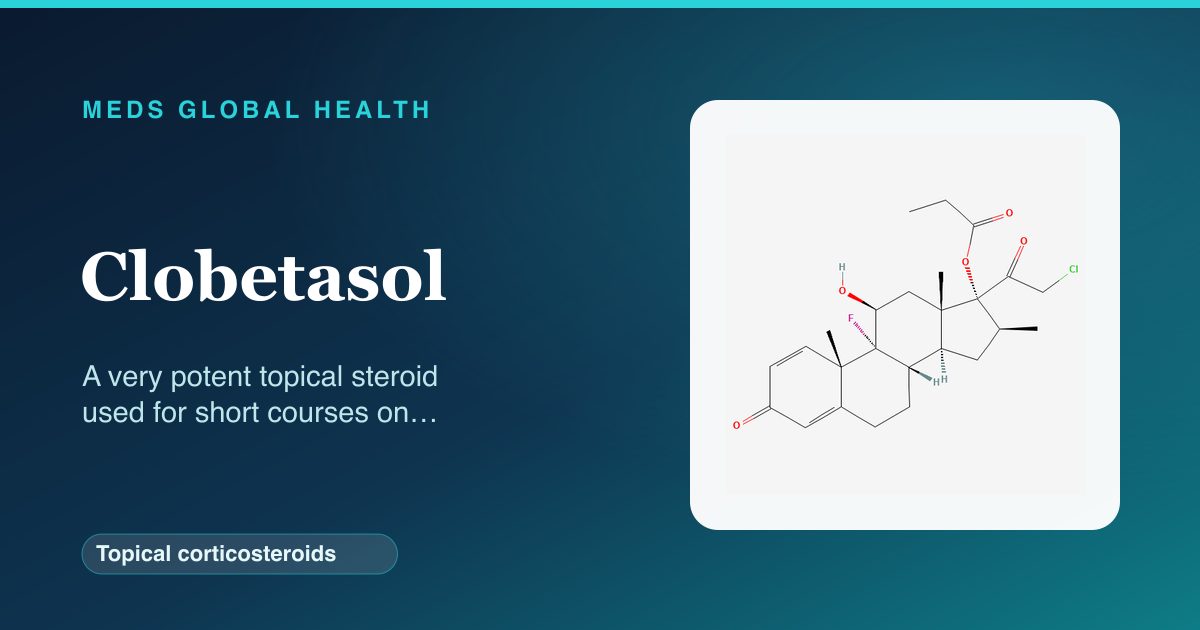
What it is
Clobetasol is a very potent topical corticosteroid — one of the strongest steroids applied to the skin — reserved in UK practice for severe or stubborn inflammatory skin conditions such as resistant eczema, psoriasis and certain other dermatoses. It is brought in when milder or moderately potent steroids have not controlled a flare. Because of its strength it is used carefully: thinly, for short, defined periods, and under guidance, before stepping down to a weaker treatment.
How it works
Like other topical steroids, clobetasol damps down the inflammatory response in the skin, reducing the redness, swelling, scaling and itch of a flare and allowing the skin barrier to recover. As a very potent steroid it has a powerful effect, which is helpful for stubborn disease but also means more is absorbed and the risk of skin side effects is higher, so it is used sparingly and briefly.
What it treats
Conditions Clobetasol is used for
Practical use
How to take Clobetasol
General, dose-free guidance — always follow your prescriber's and the leaflet's specific instructions.
- Apply a thin layer to the affected skin only, using a fingertip unit as a guide, and use it sparingly.
- Use it only for the short course advised, not continuously, and follow how often to apply it.
- Keep it off the face, eyelids and skin folds unless specifically directed, as these areas are most prone to thinning with a very potent steroid.
- Step down to a milder steroid or a moisturiser as the skin improves rather than stopping abruptly during a flare.
- Wash your hands after applying, unless treating the hands, and do not use it long-term without review.
Weighing it up
Advantages & disadvantages of Clobetasol
Advantages
- Very potent, so it can control severe or stubborn flares that milder steroids have not settled.
- Useful for resistant eczema, thick psoriasis plaques and certain other difficult skin conditions.
- Allows a short, intensive burst of treatment before stepping down to a gentler option.
Disadvantages
- As a very potent steroid, it carries the highest risk of skin thinning, stretch marks (striae) and other local effects, especially on the face and in skin folds.
- Only suitable for short, supervised courses and limited areas, not for routine or long-term use.
- More of the steroid can be absorbed into the body when used heavily, over large areas or under dressings.
Practical use
Good to know
It is applied as a thin layer to the affected area only, often guided by the fingertip unit, and is meant for short courses rather than ongoing use. Because it is very potent, it is usually kept off the face and skin folds (such as the groin and armpits), where the skin is thinner, absorbs more and is more easily damaged. Treatment is normally stepped down to a milder steroid or a moisturiser once the flare is under control.
Who should not take it / use with caution
- Anyone with untreated skin infection at the site, unless it is being treated alongside.
- Avoid on the face, eyelids and skin folds for routine use, and in rosacea and acne where it can worsen the skin.
- Used with great caution, and usually avoided, in young children and over large areas because of higher absorption.
Monitoring
- Mainly clinical — close review of the skin's response and any thinning, stretch marks or infection, given its potency.
- Regular review to keep courses short and step down to the mildest effective treatment.
- Particular care and review when used in children or over larger areas.
Side effects
- Burning or stinging on application, which usually settles.
- Thinning of the skin, stretch marks, visible small blood vessels, or easy bruising at the treated site, particularly with longer use.
- Rarely, flare of a hidden skin infection or skin changes around the mouth; with heavy or prolonged use over large areas, effects from the steroid being absorbed into the body.
Key interactions
- Few important interactions when used correctly, but its very high potency means more can be absorbed than with milder steroids.
- Covering the area with dressings, or treating large or broken areas, markedly increases absorption and the risk of side effects.
- Used alongside, not instead of, regular moisturisers, applied at separate times.
Available as: Creams, ointments, and scalp applications.
Answers
Clobetasol: frequently asked questions
How potent is clobetasol?
Clobetasol is a very potent topical steroid — among the strongest applied to the skin. It is reserved for severe or stubborn skin conditions when milder steroids have not worked, and is used sparingly and for short courses because of its strength.
Why must clobetasol be kept off my face and skin folds?
The skin on the face, eyelids and in folds such as the groin and armpits is thinner, absorbs more and is more easily damaged. With a very potent steroid like clobetasol this raises the risk of thinning, stretch marks and other effects, so it is normally kept off these areas unless specifically directed.
Can clobetasol thin my skin?
It can, more so than milder steroids, because it is very potent. The risk rises with longer or heavier use, especially on the face and in skin folds. Using it thinly, only for the short course advised, and stepping down as the skin improves keeps this risk low.
How long can I use clobetasol for?
It is intended for short, defined courses rather than ongoing use, and should be reviewed regularly. Once the flare is under control, treatment is usually stepped down to a milder steroid or a moisturiser. Do not keep using it long-term without your prescriber's review.
What is the difference between clobetasol and Dermovate?
They are the same medicine — clobetasol is the generic (active-ingredient) name and Dermovate is the original brand name. Generic clobetasol contains the identical active ingredient.
The wider class
About Topical corticosteroids
Clobetasol belongs to the topical corticosteroids class. For how the class as a whole works, its shared safety principles and monitoring, see the full guide.
Browse by body system
Authoritative sources
- BNF: Clobetasol propionate.
- NICE CKS: Clobetasol for skin.
- NICE guidance on topical corticosteroids.
Building a medicines information resource?
We create evidence-led, dose-free drug and formulary references for teams.