A mild topical corticosteroid
Hydrocortisone (skin cream)
A mild steroid cream used in short bursts to calm the redness and itch of eczema, insect bites and minor skin inflammation.
What is Hydrocortisone (skin cream)?
Hydrocortisone skin cream is a mild topical corticosteroid, or steroid cream, used to calm inflamed, itchy skin. It is used for short periods to treat conditions such as eczema, dermatitis and insect bites.
Education and reference only. This is a plain-language guide to Hydrocortisone (skin cream) — it deliberately contains no doses. Doses depend on the person, the brand and the reason for treatment, and belong with your prescriber. Always check the BNF, the product labelling (SmPC) and follow medical advice.
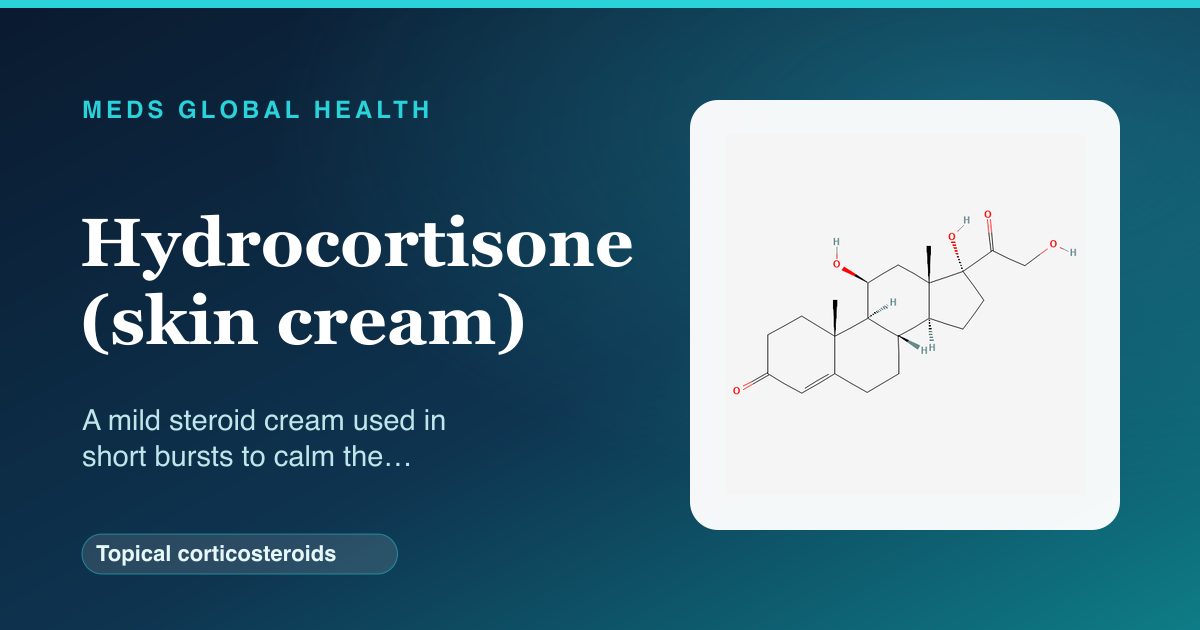
What it is
This page is about hydrocortisone as a skin cream or ointment — a mild topical corticosteroid (steroid) used to calm inflamed, itchy skin. It is used for short courses to settle flare-ups of eczema and dermatitis, insect bites and other minor skin irritation, and the milder strengths are available to buy over the counter. It is sold as generic hydrocortisone and under brand names such as Dermacort in the UK and Cortizone-10 in the US. Importantly, hydrocortisone is also given in a completely different way — as tablets or injections (a systemic steroid) — for conditions such as adrenal hormone replacement and severe allergic reactions; that systemic use is separate from this skin cream and is covered elsewhere.
How it works
Inflamed skin in eczema or after a bite is red, swollen and itchy because of an over-active local immune response. Hydrocortisone is a mild steroid that calms this response in the skin: it damps down the inflammatory chemicals and the immune cells driving the redness, swelling and itch, so the skin settles. Because it is applied directly to the affected patch and is a mild strength, its action is mostly confined to the skin where it is needed.
Company & origin
Originated / developed by: Merck & Co..
Hydrocortisone (cortisol) was first isolated and characterized in the 1930s-1940s; Merck & Co. chemist Lewis Sarett achieved the first synthesis of cortisone/hydrocortisone in the late 1940s, and it entered clinical use in the early 1950s. Topical hydrocortisone creams became widely available and are now generic.
What it treats
Conditions Hydrocortisone (skin cream) is used for
Practical use
How to take Hydrocortisone (skin cream)
General, dose-free guidance — always follow your prescriber's and the leaflet's specific instructions.
- Apply a thin layer to the affected skin only, usually once or twice a day as directed.
- Wash and dry your hands after applying, unless your hands are the area being treated.
- Use it for the shortest time needed, as advised, rather than continuously.
- Avoid using it on the face or broken skin unless a doctor or pharmacist has told you to.
- Stop and seek advice if the skin becomes worse, infected or does not improve.
Weighing it up
Advantages & disadvantages of Hydrocortisone (skin cream)
Advantages
- Quickly relieves itching and inflammation in many skin conditions.
- Mild strength, and lower-strength versions are available from pharmacies for minor problems.
- Easy to apply and works directly on the affected area.
Disadvantages
- Prolonged or excessive use can thin the skin, especially on delicate areas.
- Not suitable for some infected or weeping skin conditions.
- Treats the flare rather than preventing the condition returning.
- Should be used cautiously on the face and in young children.
Practical use
Good to know
Use it thinly on the affected area only, in short bursts rather than continuously, and stop once the skin has settled. Steroid strength should be matched to the body site — milder on delicate areas like the face and skin folds, and only under advice there, because stronger or prolonged use can thin the skin. It is not for use on broken or infected skin or on acne. If a patch of eczema is not improving, is weeping or spreading, see a pharmacist or GP rather than continuing to apply more. Where an emollient (moisturiser) is also used, leave a little time between applying each.
Who should not take it / use with caution
- On skin that is infected (for example with bacteria, a fungus or cold sores), or on acne or rosacea, unless advised.
- On the face for more than a few days, or on children, without advice — delicate skin is more prone to thinning.
- On broken or weeping skin, or over large areas for long periods, without medical guidance.
Monitoring
- Improvement of the skin within the short course
- For skin thinning or signs of infection with longer use
- A review if the rash is not settling, spreading or recurring
Side effects
- Usually well tolerated in short courses; occasionally mild burning or stinging when first applied.
- With prolonged or excessive use, thinning of the skin, stretch marks, or visible small blood vessels, especially on the face or skin folds.
- Rarely, worsening of an unnoticed skin infection, or an allergic reaction to an ingredient — stop and seek advice if the skin worsens.
Key interactions
- Few interactions with this skin form, as little is absorbed when used correctly.
- It is not used to treat infected skin; an infection usually needs a different or additional treatment.
- If you use other creams (such as a moisturiser) on the same area, leave a short gap between them so each can work.
Available as: Creams and ointments (mild topical strengths), some available to buy from pharmacies.
Answers
Hydrocortisone (skin cream): frequently asked questions
How long can I use hydrocortisone cream for?
Use it in short bursts — generally a few days to a week for a flare-up — and stop once the skin settles, rather than applying it continuously. If you are buying it over the counter and the problem has not improved within about a week, or keeps coming back, see a pharmacist or GP for review.
Can I use hydrocortisone cream on my face?
Only with care and ideally on advice, and not for long. Facial skin is delicate and more prone to thinning, and hydrocortisone can also worsen some facial rashes such as rosacea. For short, occasional use a pharmacist can guide you; for ongoing facial problems, get it properly assessed.
Is this the same as hydrocortisone tablets or injections?
It is the same active ingredient but used in a very different way. This page is about the skin cream, which calms local skin inflammation. Hydrocortisone is also given as tablets or injections for conditions such as hormone replacement or severe allergic reactions — that systemic use is separate, with its own important precautions, and is covered elsewhere.
How much should I apply, and how often?
Apply a thin layer to the affected area only, smoothing it in, and use it just on the patches that need it rather than all over. Follow the directions on the pack or from your pharmacist. Using more than needed does not help faster and, over time, raises the risk of skin thinning.
What is the difference between hydrocortisone cream and brands like Dermacort or Cortizone-10?
They contain the same active ingredient — hydrocortisone is the generic name, while Dermacort (UK) and Cortizone-10 (US) are brand names. Generic hydrocortisone cream of the same strength contains the identical active ingredient.
The wider class
About Topical corticosteroids
Hydrocortisone (skin cream) belongs to the topical corticosteroids class. For how the class as a whole works, its shared safety principles and monitoring, see the full guide.
Browse by body system
Authoritative sources
- BNF: Hydrocortisone (topical).
- electronic Medicines Compendium (SmPC): Hydrocortisone cream.
- NICE CKS: Hydrocortisone for skin.
Building a medicines information resource?
We create evidence-led, dose-free drug and formulary references for teams.