A proton pump inhibitor (the S-isomer of omeprazole)
Esomeprazole
A proton pump inhibitor that strongly reduces stomach acid for reflux and ulcers — closely related to omeprazole, and best taken before food.
What is Esomeprazole?
Esomeprazole is a proton pump inhibitor (PPI), a medicine that strongly reduces the amount of acid the stomach makes. It is used for acid reflux and heartburn, stomach and gut ulcers, and to protect the stomach in people taking medicines that can irritate it.
Education and reference only. This is a plain-language guide to Esomeprazole — it deliberately contains no doses. Doses depend on the person, the brand and the reason for treatment, and belong with your prescriber. Always check the BNF, the product labelling (SmPC) and follow medical advice.
What it is
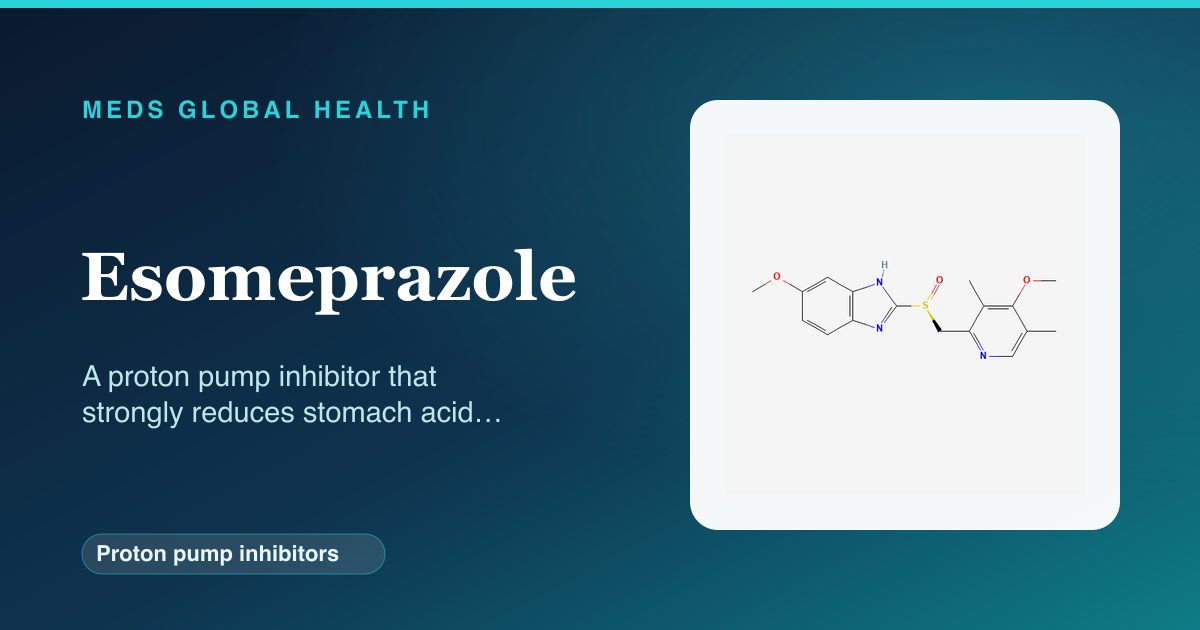
Esomeprazole is a proton pump inhibitor (PPI), a medicine that strongly reduces the amount of acid the stomach makes. It is used for acid reflux and heartburn (GORD), to heal and prevent stomach and duodenal ulcers, and to protect the stomach in people who need anti-inflammatory painkillers. It is closely related to omeprazole — chemically it is the "S-isomer", essentially the purified mirror-image half of omeprazole — and works in the same way, so the two are very similar in practice. It is the active ingredient in Nexium.
How it works
The stomach lining contains tiny "proton pumps" that pour acid into the stomach. Esomeprazole switches these pumps off, sharply cutting acid production. With less acid, an inflamed food pipe can heal and reflux symptoms ease, ulcers are given the chance to repair, and the stomach is protected from the irritant effect of anti-inflammatory painkillers. Because the pumps work hardest around meals, esomeprazole is best taken before food so it is ready when acid production ramps up.
Company & origin
Originated / developed by: AstraZeneca.
Esomeprazole is the (S)-enantiomer of omeprazole, developed by AstraZeneca (Sweden) as a chiral-switch successor. It was launched around 2000-2001 and approved by the US FDA in 2001, marketed as Nexium.
What it treats
Conditions Esomeprazole is used for
Practical use
How to take Esomeprazole
General, dose-free guidance — always follow your prescriber's and the leaflet's specific instructions.
- Usually taken once a day, often in the morning before food.
- Swallow the tablet or capsule whole with water; if you cannot, ask your pharmacist how to take it.
- It works best taken regularly, and the full benefit may build over a few days.
- Use it for the length of time advised rather than indefinitely without review.
- Tell your doctor if symptoms persist, you have difficulty swallowing, or you notice unintended weight loss.
Weighing it up
Advantages & disadvantages of Esomeprazole
Advantages
- Very effective at reducing stomach acid and relieving reflux and ulcer symptoms.
- Helps heal ulcers and protects the stomach when taking irritant medicines.
- Taken once daily for most people.
Disadvantages
- Long-term use has been linked to lower magnesium and vitamin B12 levels and a small increase in some infections.
- Can cause headache, diarrhoea or stomach upset.
- Stopping after long-term use can cause a temporary rebound in acid symptoms.
- Should be reviewed periodically rather than continued indefinitely without need.
Practical use
Good to know
It works best taken before a meal, usually in the morning, so it is active when the stomach gears up to make acid. Many people only need a short course, and it is good practice to use the lowest amount for the shortest time that controls symptoms and to review long-term use. Long-term PPI use is generally safe but carries some considerations — possible lowering of vitamin B12 and magnesium over time, a small effect on bone strength, and "rebound" excess acid if it is stopped suddenly after long use, so tailing off can help. Persistent heartburn, difficulty swallowing or weight loss should always be checked rather than just suppressed.
Who should not take it / use with caution
- People who have had an allergic reaction to esomeprazole, omeprazole or another PPI.
- Used with caution alongside the blood-thinner clopidogrel — like omeprazole, esomeprazole may reduce how well clopidogrel works, so pantoprazole or lansoprazole are often preferred in people taking it.
- Care in significant liver disease, and a check is needed for "alarm" symptoms (such as difficulty swallowing, unintended weight loss, or signs of bleeding) before settling on long-term acid suppression.
Monitoring
- Whether symptoms are controlled and the medicine is still needed (review long-term use)
- Magnesium and vitamin B12 on prolonged use
- For any "alarm" symptoms that need investigation
Side effects
- Often none. Headache, diarrhoea or constipation, wind and tummy discomfort are the most common.
- Nausea and, occasionally, dizziness.
- With long-term use, possible low magnesium or vitamin B12, a small increase in certain gut infections, and a modest effect on bone strength; rarely, allergic or skin reactions.
Key interactions
- Clopidogrel — esomeprazole may blunt its anti-clotting effect, so a different PPI (pantoprazole or lansoprazole) is often chosen instead.
- Reducing stomach acid changes the absorption of some medicines, such as certain antifungals (ketoconazole, itraconazole), some HIV treatments, and others that need acid to be taken up.
- Care with methotrexate, digoxin, and with warfarin where bleeding markers may need closer watching.
Available as: Tablets and gastro-resistant capsules, granules for an oral suspension, and an injection used in hospital.
Answers
Esomeprazole: frequently asked questions
How is esomeprazole different from omeprazole?
Esomeprazole is the "S-isomer" of omeprazole — essentially the purified mirror-image half of the same molecule. The two are very closely related and work in the same way to reduce stomach acid. In practice they are largely interchangeable, and the choice often comes down to what is available, cost and prescriber preference.
When is the best time to take it?
Before food, usually in the morning, because the stomach's acid pumps work hardest around meals and esomeprazole needs to be on board to switch them off. Taking it on an empty stomach a little while before eating tends to give the best effect. Follow the advice on your specific product.
Is it safe to take long term?
For many people it is, but long-term use is best reviewed periodically rather than continued automatically. Over time it can slightly lower vitamin B12 and magnesium, modestly affect bone strength, and stopping suddenly after long use can cause a temporary "rebound" of excess acid — so tailing off can help. Use the lowest amount that controls symptoms.
I take clopidogrel — can I use esomeprazole?
It is generally avoided in that situation. Like omeprazole, esomeprazole may reduce how well the blood-thinner clopidogrel works, so prescribers often choose pantoprazole or lansoprazole instead for people on clopidogrel. Tell your prescriber and pharmacist about all your medicines so the safest acid-reducer can be picked.
What is the difference between esomeprazole and Nexium?
They are the same medicine — esomeprazole is the generic (active-ingredient) name and Nexium is the brand. Generic esomeprazole contains the identical active ingredient and works the same way; it is usually cheaper.
The wider class
About Proton pump inhibitors
Esomeprazole belongs to the proton pump inhibitors class. For how the class as a whole works, its shared safety principles and monitoring, see the full guide.
Browse by body system
Authoritative sources
- BNF: Esomeprazole.
- electronic Medicines Compendium (SmPC): Esomeprazole (Nexium).
- NICE: Gastro-oesophageal reflux disease and dyspepsia.
Building a medicines information resource?
We create evidence-led, dose-free drug and formulary references for teams.