A proton pump inhibitor (PPI)
Omeprazole
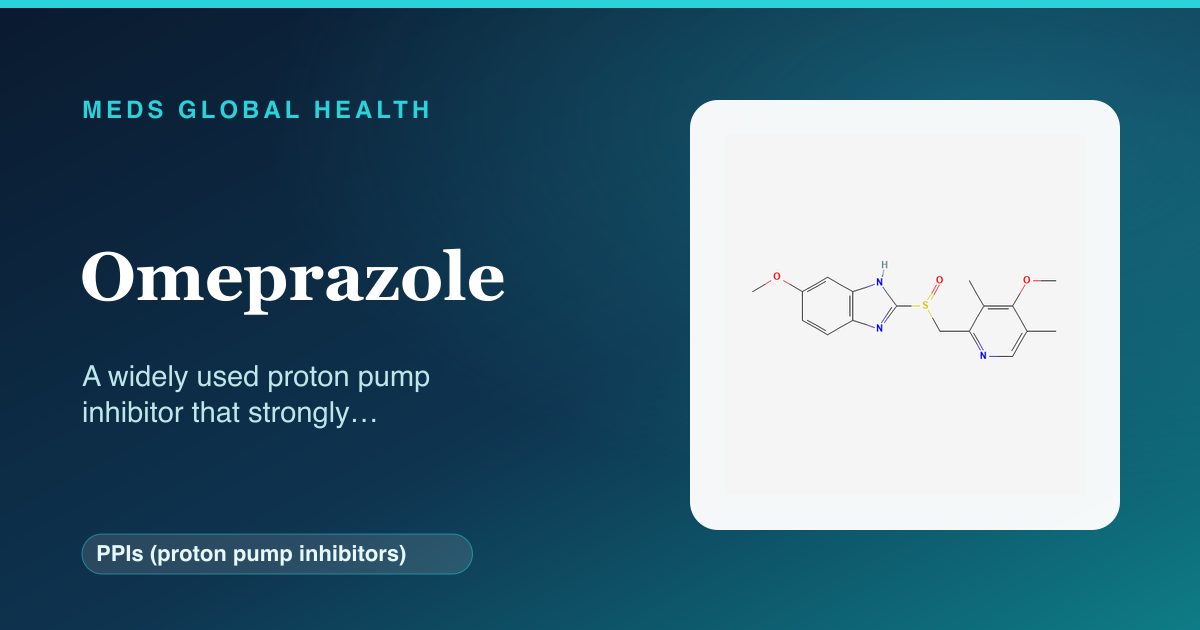
A widely used proton pump inhibitor that strongly reduces stomach acid, for reflux, ulcers and stomach protection.
What is Omeprazole?
Omeprazole is a proton pump inhibitor (PPI) that strongly reduces the amount of acid the stomach makes. It is used for acid reflux and heartburn, to treat and prevent stomach and duodenal ulcers, and to protect the stomach in people taking medicines that can irritate it.
Education and reference only. This is a plain-language guide to Omeprazole — it deliberately contains no doses. Doses depend on the person, the brand and the reason for treatment, and belong with your prescriber. Always check the BNF, the product labelling (SmPC) and follow medical advice.
What it is
Omeprazole is one of the most commonly prescribed proton pump inhibitors (PPIs) in the UK. It strongly reduces the amount of acid the stomach makes, and is used for acid reflux (GORD) and heartburn, to heal and prevent stomach and duodenal ulcers, and to protect the stomach lining in people taking anti-inflammatory painkillers (NSAIDs) who are at risk of ulcers. It is taken as a once-daily capsule or tablet, often only for a defined course rather than indefinitely.
How it works
Omeprazole switches off the "proton pumps" in the cells lining the stomach — the final step that secretes acid. By blocking these pumps directly, it cuts acid production far more completely than older acid-reducers, which lets an inflamed gullet or an ulcer heal and eases reflux symptoms. The pumps it blocks are most active when triggered by food, which is why a PPI works best when taken shortly before a meal.
Company & origin
Originated / developed by: AstraZeneca (originated at Astra AB).
Omeprazole was the first proton pump inhibitor, developed by the Swedish company Astra AB (now AstraZeneca) in the late 1970s and 1980s. It was first launched in 1988 and approved by the FDA in 1989, marketed as Losec/Prilosec and becoming one of the best-selling drugs worldwide.
What it treats
Conditions Omeprazole is used for
Practical use
How to take Omeprazole
General, dose-free guidance — always follow your prescriber's and the leaflet's specific instructions.
- Usually taken once a day, and it works best taken before a meal, often in the morning.
- Swallow the capsule or tablet whole; if swallowing is hard, some forms can be opened or dispersed — check with your pharmacist.
- If you miss a dose, take it when you remember unless it is nearly time for the next one, then skip it.
- For short-term heartburn it is taken as a limited course rather than indefinitely.
- If you have taken it long-term, ask your doctor before stopping, as symptoms can briefly rebound.
Weighing it up
Advantages & disadvantages of Omeprazole
Advantages
- Very effective at reducing stomach acid and healing ulcers.
- Simple once-daily dosing.
- Cheap, well-established generic and available over the counter for short-term use.
- Protects the stomach for people who need anti-inflammatory painkillers.
Disadvantages
- Long-term use is linked to lower magnesium and vitamin B12 and possibly weaker bones.
- Can interact with some medicines, including certain heart and antifungal drugs.
- May slightly increase the risk of some gut infections.
- Should be reviewed regularly rather than continued indefinitely without reason.
Practical use
Good to know
As a principle, omeprazole is best taken before food (often before breakfast) so it is on board when the acid pumps are switched on by eating. It is often used for a set course; for long-term use the need should be reviewed periodically, because prolonged acid suppression carries a few considerations — possible effects on vitamin B12 and magnesium levels, a small association with bone fractures, and a chance of "rebound" acid symptoms when it is stopped, which can be eased by stepping down rather than stopping abruptly. Red-flag symptoms such as difficulty swallowing, unintended weight loss or black, tarry stools need proper assessment, not just more acid suppression.
Who should not take it / use with caution
- People who have had an allergic reaction to omeprazole or other PPIs.
- Used with review in significant liver disease, and where red-flag symptoms (difficulty swallowing, weight loss, vomiting blood or black stools) suggest something that needs investigation first.
- In pregnancy and breastfeeding it is used when clearly needed and after weighing it up — discuss with your prescriber.
Monitoring
- Symptom response and whether ongoing treatment is still needed (periodic review)
- Magnesium and vitamin B12 with long-term use, as advised
- Any red-flag symptoms, which prompt review rather than dose changes
Side effects
- Often well tolerated. Headache, and digestive changes such as wind, constipation or diarrhoea, are the most common.
- Nausea or abdominal discomfort in some people.
- With long-term use, occasionally low magnesium or vitamin B12, and a small association with bone fractures and gut infections — which is why the need is reviewed periodically.
Key interactions
- Clopidogrel — omeprazole specifically can reduce how well clopidogrel works, so an alternative acid-reducer is often chosen for people taking it.
- Medicines whose absorption depends on stomach acid (e.g. certain antifungals and some HIV medicines) can be affected.
- Care with methotrexate, digoxin and warfarin; always check new medicines with a pharmacist.
Available as: Capsules and tablets; a dispersible form and a liquid are available for people who cannot swallow them.
Answers
Omeprazole: frequently asked questions
When should I take omeprazole?
As a rule, before food — often before breakfast. The acid pumps it blocks are switched on by eating, so taking it shortly beforehand lets it work most effectively.
Is it safe to take omeprazole long-term?
Many people take it long-term safely, but the need should be reviewed from time to time. Prolonged acid suppression has a few considerations — possible effects on vitamin B12 and magnesium, a small association with bone fractures, and rebound acid if it is stopped suddenly. Your prescriber can help you use the shortest effective course or step down.
Can I take omeprazole with clopidogrel?
Omeprazole specifically can reduce how well clopidogrel (a blood-thinning medicine) works. If you need stomach protection alongside clopidogrel, your prescriber will usually choose a different PPI, such as lansoprazole, instead.
Why do my symptoms come back when I stop?
Stopping a PPI suddenly can cause a temporary "rebound" surge in acid, so symptoms may briefly return even if the original problem has settled. Stepping the dose down gradually, rather than stopping abruptly, makes this less likely — ask your pharmacist how.
Is Losec the same as omeprazole?
Yes — omeprazole is the generic (active-ingredient) name and Losec is a brand name; both contain the same active ingredient.
The wider class
About PPIs (proton pump inhibitors)
Omeprazole belongs to the ppis (proton pump inhibitors) class. For how the class as a whole works, its shared safety principles and monitoring, see the full guide.
Browse by body system
Authoritative sources
- BNF: Omeprazole.
- electronic Medicines Compendium (SmPC): Omeprazole.
- NICE CKS: Omeprazole.
Keep reading
Related articles
Building a medicines information resource?
We create evidence-led, dose-free drug and formulary references for teams.