An antimalarial that clears the liver stage
Primaquine
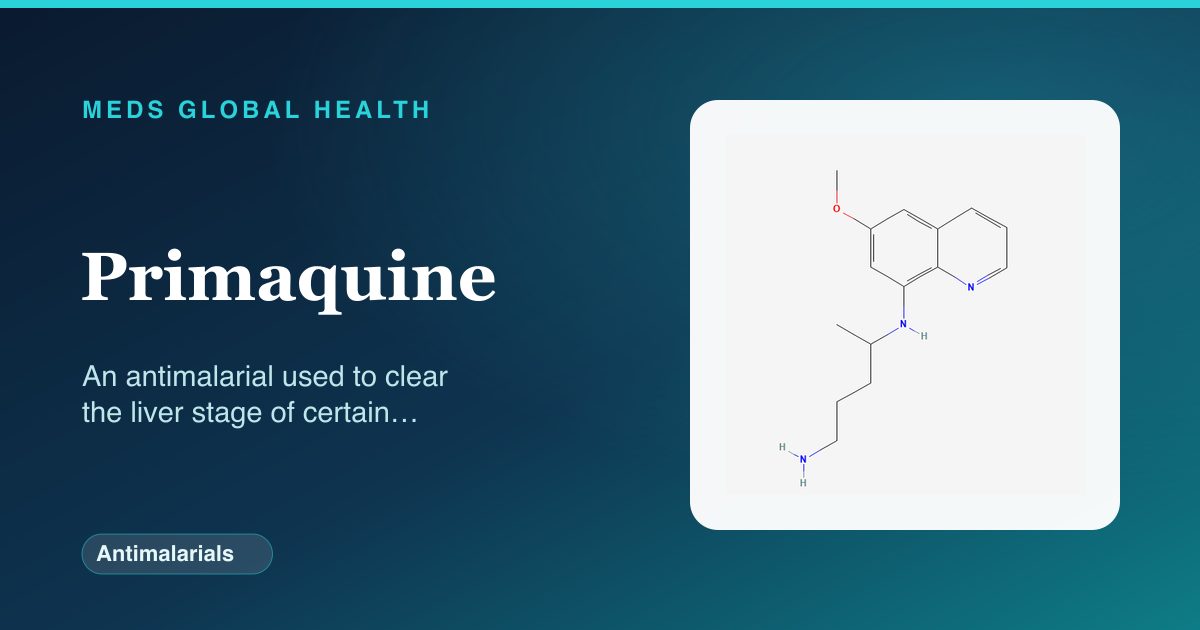
An antimalarial used to clear the liver stage of certain malaria and prevent relapses.
What is Primaquine?
Primaquine is an antimalarial medicine with a special role: it clears the dormant form of certain malaria parasites (such as Plasmodium vivax and ovale) that hide in the liver and can cause the illness to come back weeks or months later. By removing this hidden liver stage, it helps prevent relapse after the main infection is treated. Before it is given, a blood test must check for a condition called G6PD deficiency, because in people who have it primaquine can cause serious breakdown of red blood cells. It is taken with food, usually as a short course, and any fever after malaria treatment should still be reported.
Education and reference only. This is a plain-language guide to Primaquine — it deliberately contains no doses. Doses depend on the person, the brand and the reason for treatment, and belong with your prescriber. Always check the BNF, the product labelling (SmPC) and follow medical advice.
What it is
Primaquine is an antimalarial medicine that targets a part of the malaria life cycle other medicines miss: the dormant forms that some malaria parasites leave hiding in the liver. These hidden parasites can wake up later and cause the illness to return, so primaquine is used to clear them and stop relapses, usually after the main bloodstream infection has been treated with another medicine. It is taken by mouth as a tablet with food. Because of an important safety check it needs, it is always given under medical supervision.
How it works
Primaquine attacks the dormant liver forms (called hypnozoites) that certain malaria parasites leave behind after the first illness. Other antimalarials clear the parasites in the blood but not these sleeping forms, which is why malaria can relapse weeks or months later without primaquine. By destroying the liver stage, primaquine provides what is called a radical cure, reducing the chance of the infection returning. The way it works also stresses red blood cells, which is harmless in most people but dangerous in those with G6PD deficiency, so testing comes first.
Company & origin
An antimalarial used in the UK to clear the dormant liver stage of certain malaria parasites and prevent the infection coming back.
Practical use
How to take Primaquine
General, dose-free guidance — always follow your prescriber's and the leaflet's specific instructions.
- Only take it after a blood test has checked you for G6PD deficiency, as this is an essential safety step.
- Take it with food to reduce stomach upset, exactly as prescribed and for the full course.
- Take it alongside or after the main malaria treatment as your team directs, to clear the hidden liver stage.
- Stop and seek urgent help if you notice dark urine, unusual tiredness, breathlessness or yellowing of the skin.
- Tell your prescriber if you are pregnant or breastfeeding, as it is generally avoided then.
- Report any fever after malaria treatment so it can be checked.
Weighing it up
Advantages & disadvantages of Primaquine
Advantages
- Clears the dormant liver stage that other antimalarials leave behind, helping prevent relapse.
- Provides a radical cure for certain types of malaria, such as vivax and ovale.
- Usually only a short course is needed.
Disadvantages
- Can cause dangerous breakdown of red blood cells in people with G6PD deficiency, so testing is essential first.
- Cannot generally be used in pregnancy, because the baby's G6PD status is unknown.
- Requires a blood test and medical supervision before and during use.
Practical use
Good to know
The single most important point with primaquine is that everyone must be tested for G6PD deficiency before starting it, because in people who lack this enzyme primaquine can cause serious breakdown of red blood cells (haemolysis), leading to anaemia, dark urine and, if severe, a medical emergency. Where G6PD status allows, it is usually a short course taken with food to reduce stomach upset, alongside or after the main malaria treatment. It is avoided in pregnancy because the unborn baby's G6PD status is unknown. Tell your team straight away if you notice dark urine, marked tiredness, breathlessness or yellowing of the skin. As ever, any fever after malaria should be reviewed.
Who should not take it / use with caution
- People with G6PD deficiency, in whom it can cause serious red-cell breakdown, must not take usual doses.
- It is generally avoided in pregnancy, as the unborn baby cannot be tested for G6PD deficiency.
- Anyone who has had a serious allergic reaction to primaquine.
Monitoring
- Testing for G6PD deficiency before starting, which is essential.
- Watching for signs of red-cell breakdown, such as dark urine, tiredness or breathlessness.
- Reviewing blood counts during treatment where needed.
Side effects
- Stomach upset, nausea or tummy pain, which taking it with food can ease.
- Breakdown of red blood cells (haemolysis) in people with G6PD deficiency, causing dark urine and tiredness.
- Rarely, changes in blood pigments or, very rarely, more serious blood problems.
Key interactions
- Other medicines that can stress red blood cells add to the risk, especially in G6PD deficiency.
- Medicines that affect heart rhythm should be used with care alongside it.
- Tell your prescriber about all your medicines, as some can increase blood-related side effects.
Available as: Tablets taken by mouth.
Answers
Primaquine: frequently asked questions
What is primaquine used for?
It clears the dormant liver forms of certain malaria parasites (such as vivax and ovale) that other medicines leave behind, helping prevent the illness from coming back later.
Why do I need a blood test before taking it?
The test checks for G6PD deficiency, because in people who have it primaquine can cause serious breakdown of red blood cells, so this safety step always comes first.
What are the warning signs to watch for?
Dark urine, unusual tiredness, breathlessness or yellowing of the skin can signal red-cell breakdown and need urgent medical attention.
Can I take it during pregnancy?
It is generally avoided in pregnancy because the unborn baby's G6PD status cannot be checked; your team will discuss alternatives.
Why is it given as well as my other malaria treatment?
Other antimalarials clear the parasite in the blood but not the sleeping liver forms, so primaquine is added to provide a radical cure and prevent relapse.
The wider class
About Antimalarials
Primaquine belongs to the antimalarials class. For how the class as a whole works, its shared safety principles and monitoring, see the full guide.
Browse by body system
Authoritative sources
- BNF
- NICE CKS
Building a medicines information resource?
We create evidence-led, dose-free drug and formulary references for teams.