An antimalarial medicine (part of Malarone)
Proguanil
An older antimalarial medicine, usually combined with another drug, to help prevent malaria.
What is Proguanil?
Proguanil is a long-established antimalarial medicine used to help prevent malaria in travellers. It is rarely used on its own nowadays; instead it is usually combined with another medicine, most commonly with atovaquone to make Malarone. It is generally well tolerated, with mild stomach upset and occasional mouth ulcers being the main effects. As with all antimalarials, it is started before travel and continued for a period afterwards, no tablet is fully protective so bite-avoidance still matters, and any fever after travel needs urgent checking.
Education and reference only. This is a plain-language guide to Proguanil — it deliberately contains no doses. Doses depend on the person, the brand and the reason for treatment, and belong with your prescriber. Always check the BNF, the product labelling (SmPC) and follow medical advice.
What it is
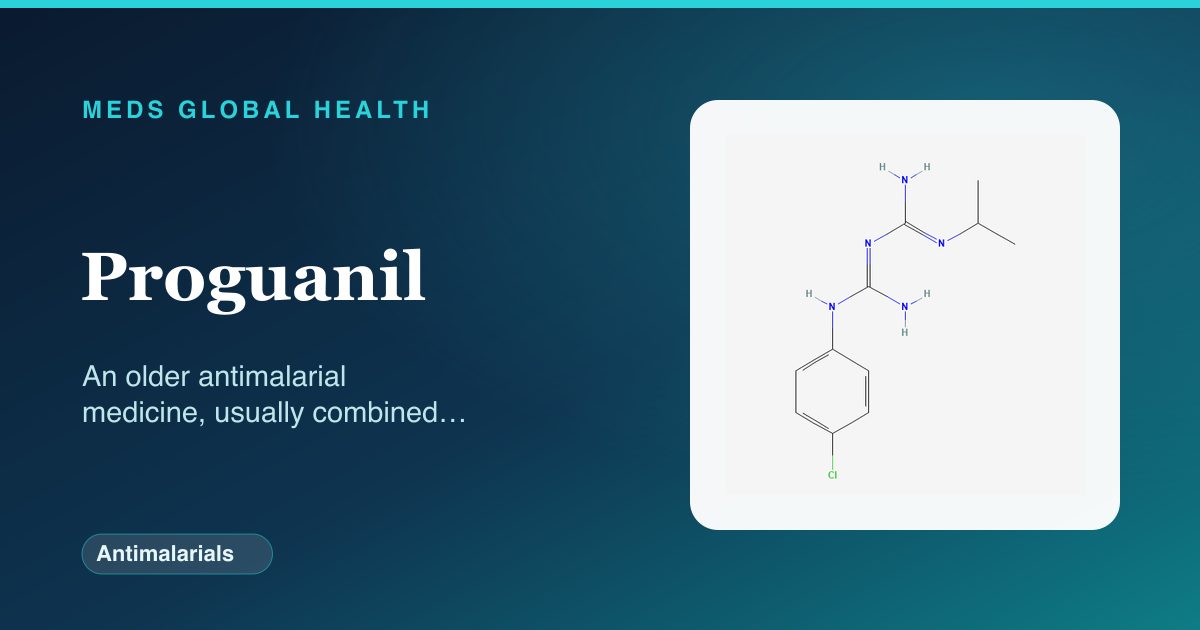
Proguanil is one of the older antimalarial medicines, sold on its own as Paludrine but most often used today as part of the combination tablet Malarone, where it is paired with atovaquone. It is also sometimes combined with chloroquine. It is used mainly to help prevent malaria in people travelling to areas where the disease is found. It is taken by mouth as a tablet, ideally with food.
How it works
Proguanil is changed in the body into an active form that blocks an enzyme the malaria parasite needs to make its genetic material, stopping the parasite from multiplying. When it is paired with atovaquone, the two medicines attack the parasite in different ways, which makes the combination more effective and helps overcome resistance. Taken for prevention, it helps stop the parasite establishing itself after a mosquito bite. It is taken regularly before, during and after travel to keep enough in the body.
Company & origin
A long-established antimalarial used in the UK, usually combined with another medicine such as atovaquone (Malarone) or chloroquine to prevent malaria.
Practical use
How to take Proguanil
General, dose-free guidance — always follow your prescriber's and the leaflet's specific instructions.
- Take it with food, ideally at the same time each day, to reduce stomach upset.
- Start it before you travel, continue it every day while away, and keep taking it for the period after you return as advised.
- If you are using the Malarone combination, follow the schedule for that single tablet rather than separate medicines.
- Keep up mosquito-bite protection such as repellent, covering up and a net, because no tablet is fully protective.
- Tell your prescriber about any kidney problems, as the dose or choice may need to change.
- Seek urgent medical help for any fever or flu-like illness during or after travel, mentioning where you have been.
Weighing it up
Advantages & disadvantages of Proguanil
Advantages
- Generally well tolerated, with mostly mild side effects.
- Works well combined with atovaquone (Malarone), attacking the parasite in two ways.
- A long-established medicine with decades of experience behind it.
Disadvantages
- Rarely effective on its own now because of widespread resistance.
- Needs to be taken every day, which is easy to forget.
- May need a different choice or adjusted dose in people with kidney problems.
Practical use
Good to know
Proguanil is rarely used alone now because the parasite has become resistant in many places, so it is usually combined with another medicine such as atovaquone (Malarone) or chloroquine. It is best taken with food to reduce stomach upset and is generally well tolerated, though mouth ulcers and mild indigestion can occur. People with reduced kidney function may need a different choice or dose. As with every antimalarial, the tablets are only part of protection: covering up, repellent and a mosquito net still matter, and any fever during or after travel must be treated as possible malaria and checked urgently.
Who should not take it / use with caution
- People with significant kidney problems may need a different antimalarial or an adjusted dose.
- Anyone who has had a serious allergic reaction to proguanil.
- It should be used in pregnancy or breastfeeding only on medical advice, often alongside folic acid.
Monitoring
- Checking kidney function before prescribing, especially in older people.
- Reviewing that doses are taken with food and at the right times before and after travel.
- Watching for any fever after travel, which must be investigated urgently for malaria.
Side effects
- Mild stomach upset, nausea and indigestion are the most common effects.
- Mouth ulcers and mouth soreness in some people.
- Rarely, hair thinning, skin rash or, very rarely, blood problems.
Key interactions
- It can affect warfarin control, so anticoagulant monitoring may be needed.
- Antacids and some indigestion remedies can reduce how much is absorbed if taken too close together.
- Combined with atovaquone, the same interactions as Malarone apply, such as with rifampicin.
Available as: Tablets taken by mouth, often combined with atovaquone as Malarone.
Answers
Proguanil: frequently asked questions
Why is proguanil usually combined with another medicine?
The malaria parasite has become resistant to proguanil alone in many places, so it is paired with another medicine such as atovaquone (Malarone) to make it effective.
Is Paludrine the same as Malarone?
Paludrine is proguanil on its own; Malarone is proguanil combined with atovaquone in one tablet, which is the form most travellers use now.
Should I take it with food?
Yes, taking it with food at the same time each day helps reduce stomach upset and is the recommended way to take it.
Do I still need mosquito protection?
Yes. No antimalarial tablet is completely protective, so covering up, using repellent and sleeping under a net remain essential.
What if I get a fever after travelling?
Treat any fever during or after travel as possible malaria and seek urgent medical help, mentioning where you have been, even if you took your tablets.
The wider class
About Antimalarials
Proguanil belongs to the antimalarials class. For how the class as a whole works, its shared safety principles and monitoring, see the full guide.
Browse by body system
Authoritative sources
- BNF
- NICE CKS
Building a medicines information resource?
We create evidence-led, dose-free drug and formulary references for teams.