A keratolytic skin treatment
Salicylic acid (skin treatment)
A keratolytic skin treatment that softens and removes thickened, scaly or hardened skin, and is widely used to treat warts and verrucas.
What is Salicylic acid (skin treatment)?
Salicylic acid is a keratolytic, meaning it softens and breaks down thickened, scaly or hardened skin so it can be gently removed. On the skin it is used to treat warts, verrucas, corns, calluses and some scaly conditions, and it is also found in some acne washes and gels. It is applied directly to the affected skin and is not meant for the face, broken or infected skin, or large areas, especially in young children.
Education and reference only. This is a plain-language guide to Salicylic acid (skin treatment) — it deliberately contains no doses. Doses depend on the person, the brand and the reason for treatment, and belong with your prescriber. Always check the BNF, the product labelling (SmPC) and follow medical advice.
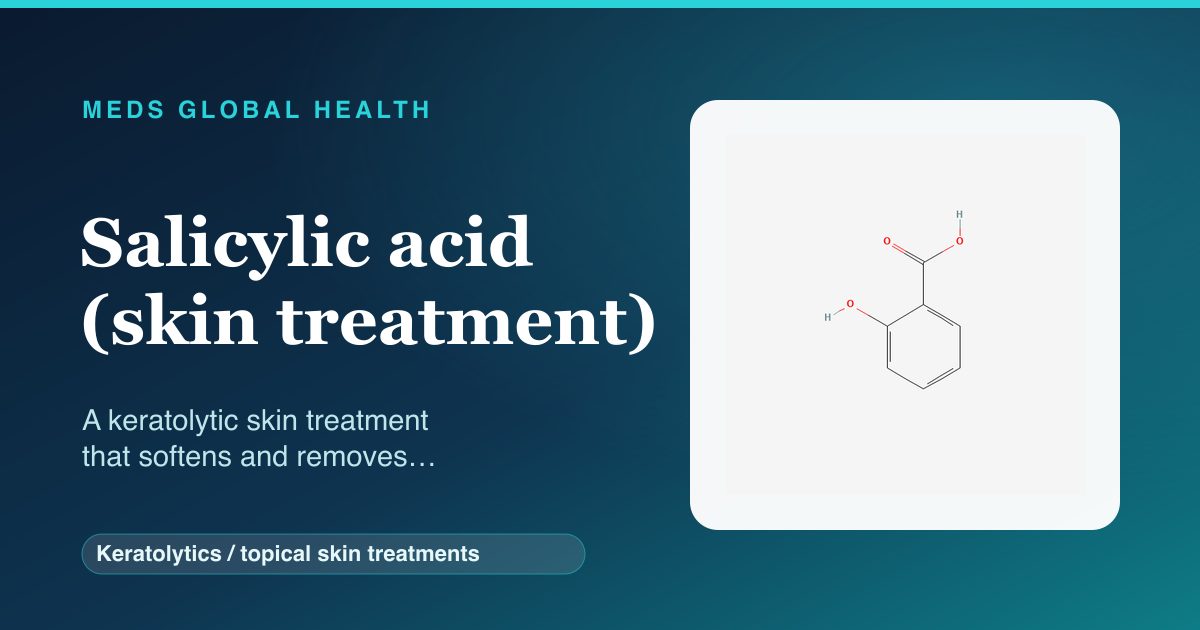
What it is
Salicylic acid is a keratolytic skin treatment, which means it works by loosening and softening the outer, hardened layers of skin. On the skin it is most commonly used to treat warts and verrucas, and also corns, calluses and some patches of thickened or scaly skin. Lower-strength forms also appear in some acne washes and gels. Many salicylic acid products can be bought from a pharmacy without a prescription.
How it works
The outer layer of skin is made largely of a protein called keratin. Salicylic acid breaks down the bonds that hold these dead, hardened skin cells together, so the thickened or scaly layer gradually softens and can be rubbed or peeled away. With warts and verrucas, repeatedly removing this layer over several weeks helps clear the affected skin. In acne products it helps unclog pores by clearing away dead skin and debris.
Company & origin
Originated / developed by: A long-established topical skin treatment.
A keratolytic agent used on the skin for many years in the UK to soften and lift away thickened or scaly skin, warts and verrucas.
What it treats
Conditions Salicylic acid (skin treatment) is used for
Practical use
How to take Salicylic acid (skin treatment)
General, dose-free guidance — always follow your prescriber's and the leaflet's specific instructions.
- Apply it only to the affected skin, usually once a day, following the directions on the pack.
- Protect the surrounding healthy skin, for example with soft paraffin or a plaster with a hole cut in it.
- For warts and verrucas, gently rub away the softened skin between applications, and be patient as it can take several weeks.
- Do not use it on your face, or on broken, inflamed or infected skin, unless advised by a professional.
- Wash your hands after applying it, and keep it away from the eyes, mouth and other sensitive areas.
Weighing it up
Advantages & disadvantages of Salicylic acid (skin treatment)
Advantages
- Can be bought from a pharmacy and used at home for common warts, verrucas, corns and calluses.
- Works directly on the problem skin without needing tablets or injections.
- Well established and inexpensive, with a long history of use.
Disadvantages
- Needs regular, patient use over several weeks and warts may still return.
- Can irritate or burn surrounding healthy skin if it is not protected.
- Not suitable for the face, broken or infected skin, or for self-treating feet in people with diabetes.
Practical use
Good to know
Salicylic acid is usually applied directly to the affected area, often once a day, and treatment of a wart or verruca can take several weeks of patient, regular use. It should be kept to the problem skin and not spread onto the surrounding healthy skin, which can be protected with a little soft paraffin or a plaster. It is not suitable for the face, or for broken, inflamed or infected skin, unless a professional advises otherwise. People with diabetes or poor circulation should not treat their own feet with it without first getting advice, and it should not be used over large areas, especially in young children, because too much can be absorbed.
Who should not take it / use with caution
- People with diabetes or poor circulation should not treat warts, verrucas or corns on their feet themselves without advice, as foot problems need extra care.
- Not for use on the face, moles, birthmarks, or on broken, inflamed or infected skin.
- Avoid using it over large areas, particularly in young children, because too much salicylic acid can be absorbed through the skin.
Monitoring
- Whether the wart, verruca or scaly skin is gradually improving over the weeks of treatment.
- The condition of the surrounding skin, watching for excessive soreness or burning.
- Any signs of infection, and stopping to seek advice if the area becomes hot, swollen or painful.
Side effects
- Mild stinging, redness or peeling of the treated skin is common.
- If too much is applied or it spreads onto healthy skin, it can cause soreness or a chemical burn.
- Rarely, an allergic reaction such as a rash, itching or swelling can occur — stop using it and seek advice.
Key interactions
- As a skin treatment it has very few interactions with medicines you take by mouth.
- Take care if you use other skin treatments on the same area, as combining them can increase irritation.
- Tell your pharmacist about other creams, gels or acne products you are using before starting it.
Available as: Liquids, gels, ointments, plasters and medicated pads, as well as some acne washes and gels.
Answers
Salicylic acid (skin treatment): frequently asked questions
What is salicylic acid used for on the skin?
It is most often used to treat warts and verrucas, and also corns, calluses and some scaly skin. Lower-strength forms are also found in some acne washes and gels.
How long does it take to clear a verruca?
It often takes several weeks of patient, regular use. Warts and verrucas can be stubborn and may need ongoing treatment, and they sometimes come back.
Can I use it on my face?
Strong wart and verruca products are not for the face. Some gentle acne washes contain salicylic acid, but follow the pack and ask your pharmacist if you are unsure.
I have diabetes — can I treat a verruca on my foot?
Get advice first rather than self-treating. People with diabetes or poor circulation need extra care with foot problems, and a pharmacist, GP or podiatrist can guide you.
Why does it sting the skin around the wart?
Salicylic acid softens and breaks down skin, so it can irritate healthy skin it touches. Protecting the surrounding skin with soft paraffin or a plaster helps prevent this.
The wider class
About Keratolytics / topical skin treatments
Salicylic acid (skin treatment) belongs to the keratolytics / topical skin treatments class. For how the class as a whole works, its shared safety principles and monitoring, see the full guide.
Browse by body system
Authoritative sources
- BNF
- NICE CKS
Building a medicines information resource?
We create evidence-led, dose-free drug and formulary references for teams.