An injectable dopamine agonist for Parkinson's
Apomorphine
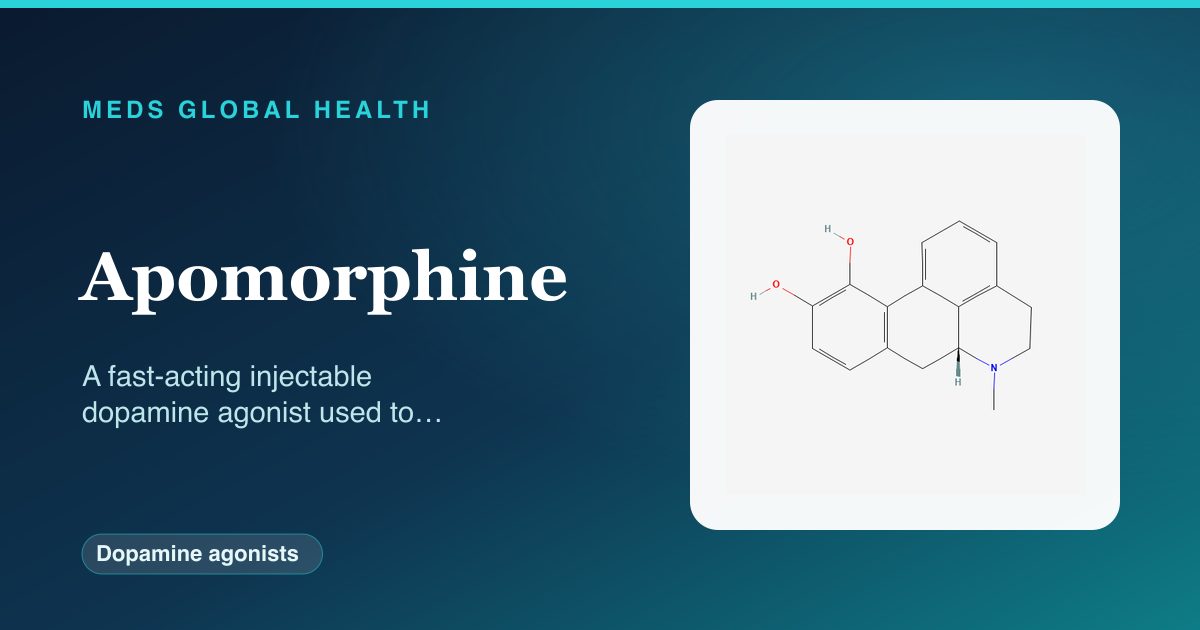
A fast-acting injectable dopamine agonist used to rescue or prevent severe 'off' periods in advanced Parkinson's disease.
What is Apomorphine?
Apomorphine is a dopamine agonist given by injection or continuous infusion for Parkinson's disease. It acts quickly to treat severe 'off' periods, when symptoms suddenly return, and can be used as needed or as a steady pump infusion. Despite its name it is not an opioid and is not used for pain.
Education and reference only. This is a plain-language guide to Apomorphine — it deliberately contains no doses. Doses depend on the person, the brand and the reason for treatment, and belong with your prescriber. Always check the BNF, the product labelling (SmPC) and follow medical advice.
What it is
Apomorphine is a powerful, fast-acting dopamine agonist used in advanced Parkinson's disease. Because it cannot be taken as a tablet, it is given under the skin, either as an injection to rescue someone from a sudden 'off' period or as a continuous pump infusion through the day. Despite its name it is unrelated to morphine in its action and is not a painkiller. It is a specialist treatment, usually started in hospital or a specialist clinic.
How it works
Apomorphine strongly stimulates dopamine receptors in the brain, mimicking dopamine to support movement. Given under the skin it acts within minutes, which makes it useful for quickly switching someone back 'on' during a severe 'off' period. As a continuous infusion it provides steadier dopamine stimulation through the day to reduce the swings between 'on' and 'off'.
Company & origin
Originated / developed by: Marketed in the UK by Britannia Pharmaceuticals (STADA)..
Derived from morphine in the 19th century, and later established as a fast-acting injectable dopamine agonist for advanced Parkinson's disease.
What it treats
Conditions Apomorphine is used for
Practical use
How to take Apomorphine
General, dose-free guidance — always follow your prescriber's and the leaflet's specific instructions.
- It is given by injection under the skin, or as a continuous pump infusion, not as a tablet.
- An anti-sickness medicine (domperidone) is usually started beforehand to control nausea.
- Do not use it with ondansetron, as the combination can cause a serious drop in blood pressure.
- Rotate injection sites and care for the skin to reduce firm lumps (nodules).
- Report sudden episodes of falling asleep, or new urges around gambling, shopping, eating or sex.
Weighing it up
Advantages & disadvantages of Apomorphine
Advantages
- Acts within minutes to rescue someone from a severe 'off' period.
- Can be used as a continuous infusion for steadier symptom control.
- Useful in advanced Parkinson's when tablets alone are no longer enough.
Disadvantages
- Causes strong nausea and needs a separate anti-sickness medicine.
- Repeated injections can cause firm skin lumps (nodules).
- Can cause sudden sleep attacks, low blood pressure and impulse-control disorders.
Practical use
Good to know
Apomorphine causes strong nausea, so people are usually started on an anti-sickness medicine (domperidone) beforehand. It must not be combined with the anti-sickness drug ondansetron, as together they can cause a dangerous drop in blood pressure. Repeated injections can cause firm lumps (nodules) under the skin, so injection sites are rotated and the skin is cared for. Like other dopamine agonists it can cause sudden sleep attacks and impulse-control disorders, which should be watched for.
Who should not take it / use with caution
- People with significant breathing problems, certain serious mental health conditions, or severe liver impairment.
- People taking ondansetron, because the combination can cause a dangerous fall in blood pressure.
- Anyone whose specialist advises against it after assessing their heart, breathing and mental health.
Monitoring
- Blood pressure, including checks for dizziness on standing.
- Injection sites for nodules and skin reactions.
- Watch for excessive sleepiness, sudden sleep attacks and impulse-control problems.
Side effects
- Strong nausea and vomiting, especially without an anti-sickness medicine.
- Firm lumps (nodules) and irritation at injection sites.
- Sudden sleep attacks and daytime drowsiness.
- Low blood pressure, hallucinations, and impulse-control problems.
Key interactions
- Ondansetron — must be avoided, as the combination can cause a severe drop in blood pressure.
- Other medicines that lower blood pressure — combined effect can cause faints.
- Dopamine-blocking medicines (such as some antipsychotics) — can oppose its effect.
- Sedating medicines and alcohol — can add to drowsiness and sleep attacks.
Available as: Injection (pre-filled pen and cartridges) and continuous under-the-skin infusion.
Answers
Apomorphine: frequently asked questions
Is apomorphine an opioid like morphine?
No. Despite the similar name, apomorphine acts on dopamine receptors, not opioid ones. It is a Parkinson's medicine and is not used for pain.
Why do I need an anti-sickness medicine with it?
Apomorphine commonly causes strong nausea, so an anti-sickness medicine (usually domperidone) is started beforehand to make treatment tolerable.
Why can't I use ondansetron for the sickness?
Because ondansetron combined with apomorphine can cause a dangerous fall in blood pressure. A different anti-sickness medicine, such as domperidone, is used instead.
What are the lumps at my injection sites?
Repeated injections can cause firm lumps (nodules) under the skin. Rotating injection sites and caring for the skin helps to reduce them.
Can apomorphine make me fall asleep suddenly?
Yes. Like other dopamine agonists it can cause sudden sleep attacks and daytime drowsiness, which is why these should be reported and care taken with driving.
The wider class
About Dopamine agonists
Apomorphine belongs to the dopamine agonists class. For how the class as a whole works, its shared safety principles and monitoring, see the full guide.
Browse by body system
Authoritative sources
- BNF
- NICE CKS
Building a medicines information resource?
We create evidence-led, dose-free drug and formulary references for teams.