An ergot dopamine agonist
Pergolide
An older ergot dopamine agonist for Parkinson's, now rarely used because of heart-valve problems.
What is Pergolide?
Pergolide is an older medicine for Parkinson's disease from the ergot family of dopamine agonists, which act like the brain chemical dopamine that is lacking in Parkinson's. It helps the slowness, stiffness and tremor of the condition. It is now rarely used because long-term use has been linked to thickening of the heart valves, which can cause leaking, so anyone on it needs regular heart scans. Like other dopamine medicines, it can cause sudden sleepiness and impulsive urges such as gambling. Newer treatments are usually preferred today.
Education and reference only. This is a plain-language guide to Pergolide — it deliberately contains no doses. Doses depend on the person, the brand and the reason for treatment, and belong with your prescriber. Always check the BNF, the product labelling (SmPC) and follow medical advice.
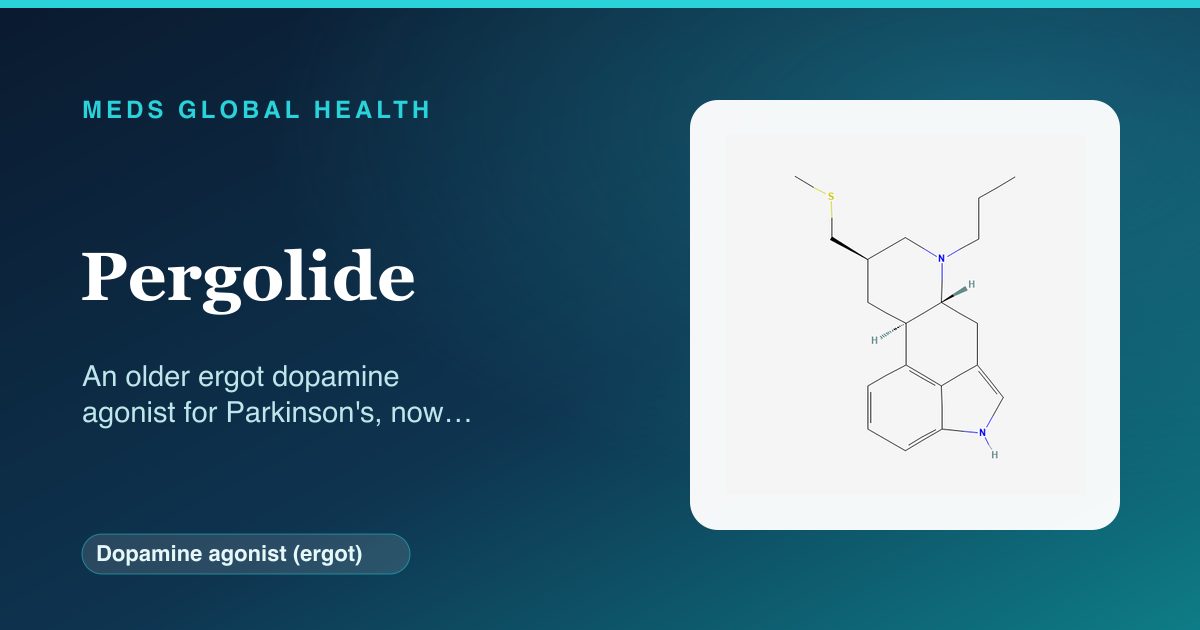
What it is
Pergolide is a dopamine agonist, a medicine that mimics dopamine, the brain chemical that is in short supply in Parkinson's disease. It belongs to the older 'ergot' family, derived from a natural fungus. It was used to ease the movement symptoms of Parkinson's — slowness, stiffness and tremor — often alongside levodopa. It is taken by mouth. Today it is rarely chosen, because long-term use of ergot dopamine agonists has been linked to heart-valve problems, and safer alternatives are generally preferred.
How it works
In Parkinson's disease, the brain loses cells that make dopamine, the messenger that helps control movement. Pergolide acts directly on dopamine receptors in the brain, standing in for the missing dopamine and improving slowness, stiffness and tremor. Unfortunately, ergot dopamine agonists like pergolide can also act on receptors in the heart valves, encouraging them to thicken and become stiff or leaky over time, which is the main reason it is now rarely used and needs heart monitoring.
Company & origin
An older ergot-derived dopamine agonist once used in the UK for Parkinson's disease; now rarely used because of heart-valve risks.
What it treats
Conditions Pergolide is used for
Practical use
How to take Pergolide
General, dose-free guidance — always follow your prescriber's and the leaflet's specific instructions.
- Take it exactly as your specialist directs, usually built up slowly from a low strength to reduce side effects.
- Attend all your heart scans and check-ups, as these look for valve problems linked to long-term use.
- Be very cautious about driving or using machinery, as it can cause sudden, unexpected sleepiness.
- Tell your prescriber and family to watch for impulsive urges such as gambling or excessive shopping, which can develop without you noticing.
- Do not stop it suddenly; any change should be made gradually under specialist supervision.
Weighing it up
Advantages & disadvantages of Pergolide
Advantages
- Can ease the slowness, stiffness and tremor of Parkinson's disease.
- Acts directly on dopamine receptors, so it can help alongside or instead of levodopa.
- Long-acting effect on movement symptoms in people who respond to it.
Disadvantages
- Long-term use is linked to heart-valve thickening that can cause leaking, needing regular heart scans.
- Can cause sudden sleepiness and impulse-control problems such as gambling.
- Now rarely used, as newer non-ergot agonists and other treatments are generally safer and preferred.
Practical use
Good to know
The most important thing to understand about pergolide is the heart-valve risk: long-term use of ergot dopamine agonists has been linked to thickening of the heart valves (fibrosis), which can make them leak, so anyone taking it needs regular heart scans (echocardiograms) and check-ups. Because of this, newer non-ergot agonists or other treatments are usually preferred, and pergolide is now seldom started. Like all dopamine medicines, it can cause sudden, irresistible sleepiness, including falling asleep without warning, so care is needed with driving, and it can trigger impulse-control problems such as gambling, excessive shopping or changes in sexual behaviour. It can also cause similar fibrosis around the lungs and kidneys. It should not be stopped suddenly, as this can cause a serious reaction; any change is made gradually under specialist guidance.
Who should not take it / use with caution
- People with existing heart-valve disease or fibrosis around the heart, lungs or kidneys should not use it.
- It is avoided in people with a history of these fibrotic problems or who cannot have heart-monitoring scans.
- People with certain serious psychiatric conditions or impulse-control problems need careful specialist assessment.
Monitoring
- Regular heart scans (echocardiograms) to look for valve thickening or leaking.
- Watching for breathlessness, swelling or pain that could suggest fibrosis around the lungs or kidneys.
- Reviewing daytime sleepiness, mood and any impulsive behaviour, with family encouraged to report changes.
Side effects
- Nausea, dizziness, light-headedness on standing and tiredness, especially at first.
- Sudden sleepiness or falling asleep without warning, and impulsive urges such as gambling, shopping or changed sexual behaviour.
- More seriously, thickening of the heart valves or tissue around the lungs and kidneys with long-term use, causing breathlessness or swelling.
Key interactions
- Medicines that block dopamine, such as some antipsychotics and anti-sickness drugs, can oppose its effect on Parkinson's.
- Other medicines that lower blood pressure can add to dizziness on standing.
- Combining it with other ergot-type medicines may increase the risk of fibrosis-related problems.
Available as: Tablets taken by mouth.
Answers
Pergolide: frequently asked questions
Why is pergolide rarely used now?
Long-term use of ergot dopamine agonists like pergolide has been linked to heart-valve thickening that can cause leaking, so newer, safer treatments are usually preferred.
Why do I need heart scans while taking it?
The scans (echocardiograms) check for thickening or leaking of the heart valves, a known risk with long-term use, so any problem can be picked up early.
Can it make me fall asleep suddenly?
Yes, like other dopamine medicines it can cause sudden, unexpected sleepiness, so you should be very cautious about driving or using machinery.
What are impulse-control problems?
Some people develop urges such as gambling, excessive shopping or changed sexual behaviour; these can appear without you realising, so tell your prescriber and ask family to watch for them.
Can I stop it if I am worried about it?
Do not stop it suddenly, as this can cause a serious reaction; speak to your specialist, who can review it and make any change gradually.
The wider class
About Dopamine agonist (ergot)
Pergolide belongs to the dopamine agonist (ergot) class. For how the class as a whole works, its shared safety principles and monitoring, see the full guide.
Browse by body system
Authoritative sources
- BNF
- NICE CKS
Building a medicines information resource?
We create evidence-led, dose-free drug and formulary references for teams.