A dopamine agonist (Parkinson's / high prolactin)
Bromocriptine
An older dopamine agonist used for Parkinson's disease, high prolactin levels and to stop unwanted breast milk production.
What is Bromocriptine?
Bromocriptine is a dopamine agonist, a medicine that acts like dopamine in the body. It is used for Parkinson's disease, to lower high levels of the hormone prolactin, and to stop unwanted breast milk production. It also lowers prolactin because dopamine naturally suppresses that hormone.
Education and reference only. This is a plain-language guide to Bromocriptine — it deliberately contains no doses. Doses depend on the person, the brand and the reason for treatment, and belong with your prescriber. Always check the BNF, the product labelling (SmPC) and follow medical advice.
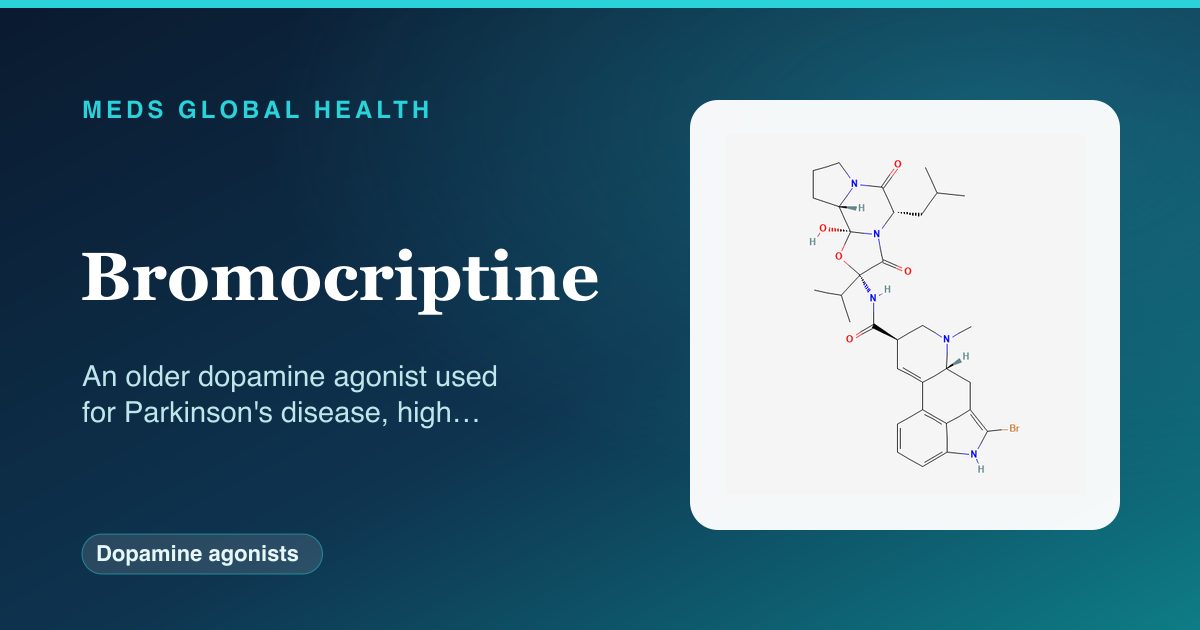
What it is
Bromocriptine is one of the older dopamine agonists. It is used in Parkinson's disease, but also has hormonal uses: it lowers high levels of the hormone prolactin (for example in a prolactin-producing pituitary tumour) and can be used to stop unwanted breast milk production. It is taken by mouth, and because it is an ergot-derived medicine it needs some extra long-term monitoring compared with newer dopamine agonists.
How it works
Bromocriptine acts directly on dopamine receptors in the brain and body, mimicking the effect of dopamine. In Parkinson's disease this helps make up for the lack of dopamine and supports movement. Dopamine also naturally suppresses the hormone prolactin, so by acting on the same receptors bromocriptine lowers prolactin levels and reduces or stops breast milk production.
Company & origin
Originated / developed by: Developed by Sandoz (now part of Novartis)..
Derived from ergot and developed by Sandoz in Switzerland; in clinical use since the 1970s for conditions linked to dopamine and the hormone prolactin.
What it treats
Conditions Bromocriptine is used for
Practical use
How to take Bromocriptine
General, dose-free guidance — always follow your prescriber's and the leaflet's specific instructions.
- It is usually started low and increased gradually to reduce nausea and dizziness.
- Taking it with food can help reduce nausea.
- Stand up slowly at first, as it can lower blood pressure and cause light-headedness.
- When used for Parkinson's, do not stop it suddenly without specialist advice.
- Report any new urges around gambling, shopping, eating or sex, or any breathlessness or chest symptoms.
Weighing it up
Advantages & disadvantages of Bromocriptine
Advantages
- Has both Parkinson's and hormonal uses, including lowering high prolactin.
- Effective at stopping unwanted breast milk production.
- Long-established medicine with well-understood effects.
Disadvantages
- Commonly causes nausea and a drop in blood pressure, so needs gradual introduction.
- Can cause impulse-control disorders such as compulsive gambling or shopping.
- As an ergot-derived medicine, carries a rare long-term risk of lung, heart-valve or abdominal fibrosis, needing monitoring.
Practical use
Good to know
Bromocriptine commonly causes nausea and can lower blood pressure, especially on standing, so it is usually started at a low level and built up gradually, often taken with food. Like other dopamine agonists it can trigger impulse-control disorders, such as gambling or compulsive shopping, which should be watched for. As an ergot-derived medicine it carries a small long-term risk of fibrosis affecting the lungs, heart valves or the space behind the abdomen, so monitoring is advised. It should not be stopped abruptly when used for Parkinson's.
Who should not take it / use with caution
- People with uncontrolled high blood pressure, certain serious heart-valve disease, or a history of fibrotic reactions.
- People with certain pregnancy-related blood pressure problems, or severe mental health conditions, need careful specialist assessment.
- Anyone whose doctor advises against it after reviewing their heart, lung and mental health history.
Monitoring
- Blood pressure, including checks for dizziness on standing.
- Prolactin levels and pituitary review when used for high prolactin.
- Periodic checks for fibrosis (such as heart, lung and kidney function) with long-term use, plus watching for impulse-control problems.
Side effects
- Nausea, especially early in treatment.
- Dizziness or light-headedness on standing (low blood pressure).
- Impulse-control problems, such as compulsive gambling, shopping, eating or sexual urges.
- Rarely, fibrosis affecting the lungs, heart valves or the space behind the abdomen with long-term use.
Key interactions
- Other medicines that lower blood pressure — combined effect can cause dizziness or faints.
- Dopamine-blocking medicines (such as some antipsychotics and anti-sickness drugs) — can oppose its effect.
- Certain antibiotics and other strong enzyme-affecting medicines — can change its levels.
- Alcohol — may worsen side effects in some people.
Available as: Tablets and capsules.
Answers
Bromocriptine: frequently asked questions
Why is bromocriptine used for both Parkinson's and high prolactin?
It acts on dopamine receptors. In Parkinson's this supports movement, while in the pituitary gland dopamine naturally lowers prolactin, so the same medicine reduces high prolactin levels.
Can bromocriptine stop breast milk?
Yes. By lowering prolactin it can stop unwanted breast milk production, although it is used selectively and other approaches are often preferred.
Why might I feel sick or dizzy when I start it?
Nausea and a drop in blood pressure are common early on. Starting at a low level, building up slowly and taking it with food all help to reduce these effects.
What are impulse-control disorders?
Dopamine agonists can occasionally trigger urges such as compulsive gambling, shopping, eating or increased sexual behaviour. These should be reported, as they usually settle when treatment is reviewed.
Why does bromocriptine need extra monitoring?
It is an ergot-derived medicine, which carries a rare long-term risk of fibrosis affecting the lungs, heart valves or abdomen. Regular checks help pick this up early.
The wider class
About Dopamine agonists
Bromocriptine belongs to the dopamine agonists class. For how the class as a whole works, its shared safety principles and monitoring, see the full guide.
Browse by body system
Authoritative sources
- BNF
- NICE CKS
Building a medicines information resource?
We create evidence-led, dose-free drug and formulary references for teams.