A dopamine agonist (for high prolactin)
Cabergoline
A long-acting dopamine-agonist tablet that lowers the hormone prolactin.
What is Cabergoline?
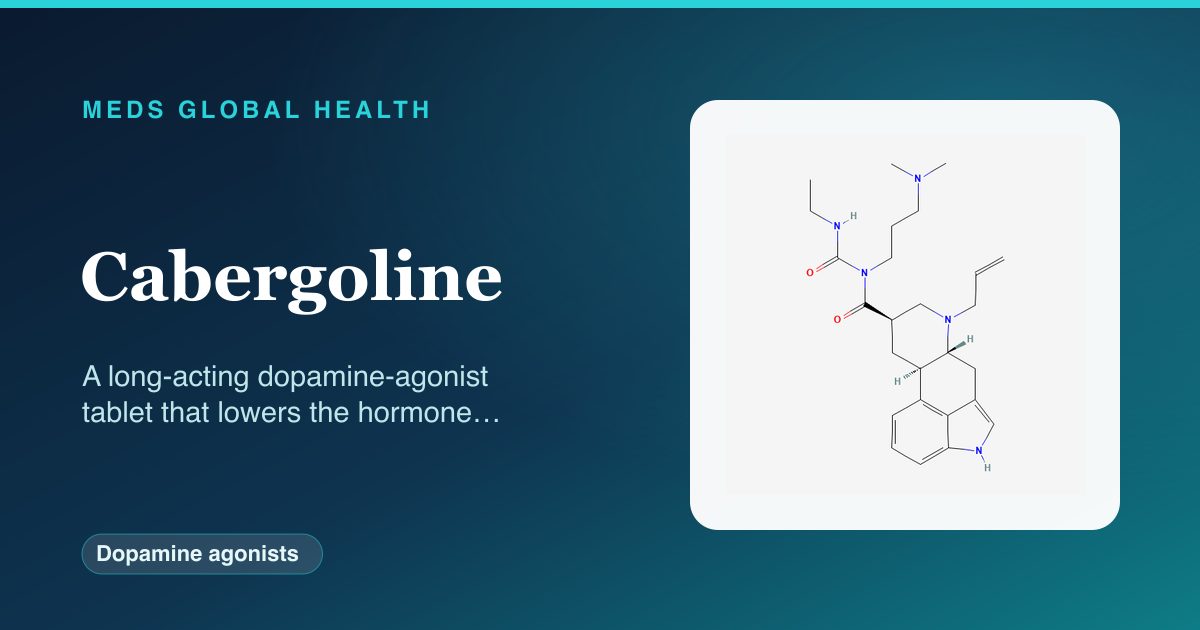
Cabergoline is a dopamine agonist taken as a tablet, most often to lower a high level of the hormone prolactin (for example from a small pituitary gland tumour called a prolactinoma). It can also be used in Parkinson's disease. It works by mimicking dopamine in the brain.
Education and reference only. This is a plain-language guide to Cabergoline — it deliberately contains no doses. Doses depend on the person, the brand and the reason for treatment, and belong with your prescriber. Always check the BNF, the product labelling (SmPC) and follow medical advice.
What it is
Cabergoline is a dopamine agonist, a tablet that acts like the brain chemical dopamine. Its main use is to reduce raised prolactin levels, and it is also used in some people with Parkinson's disease.
How it works
Cabergoline stimulates dopamine receptors. In the pituitary gland this signals it to release less prolactin, shrinking prolactin-producing tumours and lowering prolactin levels. In Parkinson's disease, it boosts dopamine signalling to ease movement symptoms.
Company & origin
Originated / developed by: Originally developed by Pharmacia (now part of Pfizer)..
Introduced in the 1990s as a long-acting dopamine agonist.
Practical use
How to take Cabergoline
General, dose-free guidance — always follow your prescriber's and the leaflet's specific instructions.
- Usually taken once or a couple of times a week, often with food to reduce nausea.
- Take it at around the same time on your scheduled days.
- Stand up slowly at first, as it can cause dizziness or a drop in blood pressure.
- Do not stop suddenly without advice from your specialist.
- Tell your doctor about any new urges to gamble, shop, or other impulsive behaviour.
- Attend any heart and prolactin checks your team arranges.
Weighing it up
Advantages & disadvantages of Cabergoline
Advantages
- Effective at lowering prolactin and shrinking prolactinomas.
- Long-acting, so dosing can be just once or twice a week.
- Can restore fertility and periods when high prolactin is the cause.
- Usually well tolerated at the lower doses used for high prolactin.
Disadvantages
- Can cause nausea, dizziness, and a drop in blood pressure on standing.
- May trigger impulse-control disorders such as compulsive gambling or shopping.
- Long-term higher doses carry a risk of heart-valve scarring, needing monitoring.
- Should not be stopped abruptly, especially in Parkinson's disease.
Practical use
Good to know
It is long-acting, so it is often taken only once or twice a week rather than every day. It can be associated with impulse-control problems and, with long-term higher doses, with effects on the heart valves, so monitoring is important. Because it can restore fertility quickly, discuss contraception and pregnancy plans with your team — advice on continuing or stopping it changes if you become pregnant.
Who should not take it / use with caution
- People with existing heart-valve disease or scarring of the lungs or abdomen (fibrosis).
- Those with poorly controlled high blood pressure.
- Anyone with a history of certain serious mental health reactions to dopamine agonists.
- Anyone allergic to cabergoline or other ergot-derived medicines.
Monitoring
- Prolactin levels are checked to guide treatment.
- Heart-valve monitoring (such as an echocardiogram) for long-term, higher-dose use.
- Regular review for mood changes and impulse-control behaviours.
Side effects
- Nausea, dizziness, or headache.
- A drop in blood pressure on standing, causing light-headedness.
- Impulse-control problems such as compulsive gambling, shopping, or eating.
- Rarely, heart-valve scarring with long-term higher doses.
Key interactions
- Medicines that block dopamine (some antipsychotics and anti-sickness drugs) can reduce its effect.
- Blood-pressure-lowering medicines may add to dizziness.
- Tell your doctor about all your medicines before starting.
Available as: Tablets.
Answers
Cabergoline: frequently asked questions
Why is cabergoline taken only a couple of times a week?
It is very long-acting, so its effect lasts for days. This means infrequent dosing is usually enough to keep prolactin under control.
Can cabergoline affect my behaviour?
Dopamine agonists can sometimes cause impulse-control problems such as compulsive gambling, shopping, or eating. Tell your doctor if you notice new urges.
Why might I need heart scans?
Long-term higher doses can rarely cause scarring of the heart valves, so your team may arrange echocardiograms to monitor this.
Can I stop cabergoline suddenly?
No. Stopping abruptly, especially in Parkinson's disease, can cause problems. Always reduce or stop under your specialist's guidance.
Can it help with fertility?
If high prolactin is preventing ovulation or periods, lowering it with cabergoline can restore fertility. Discuss family planning with your team.
The wider class
About Dopamine agonists
Cabergoline belongs to the dopamine agonists class. For how the class as a whole works, its shared safety principles and monitoring, see the full guide.
Browse by body system
Authoritative sources
- BNF
- NICE CKS
Building a medicines information resource?
We create evidence-led, dose-free drug and formulary references for teams.