A dopamine agonist
Ropinirole
A dopamine agonist for Parkinson’s disease and restless legs syndrome, available as tablets and a once-daily prolonged-release form.
What is Ropinirole?
Ropinirole is a dopamine agonist that mimics the brain chemical dopamine, which is lacking in Parkinson's disease. It is used to ease the stiffness, slowness and tremor of Parkinson's, and also to treat restless legs syndrome. Important things to know are that it can cause sudden sleepiness and impulse-control problems such as gambling, and it must not be stopped suddenly.
Education and reference only. This is a plain-language guide to Ropinirole — it deliberately contains no doses. Doses depend on the person, the brand and the reason for treatment, and belong with your prescriber. Always check the BNF, the product labelling (SmPC) and follow medical advice.
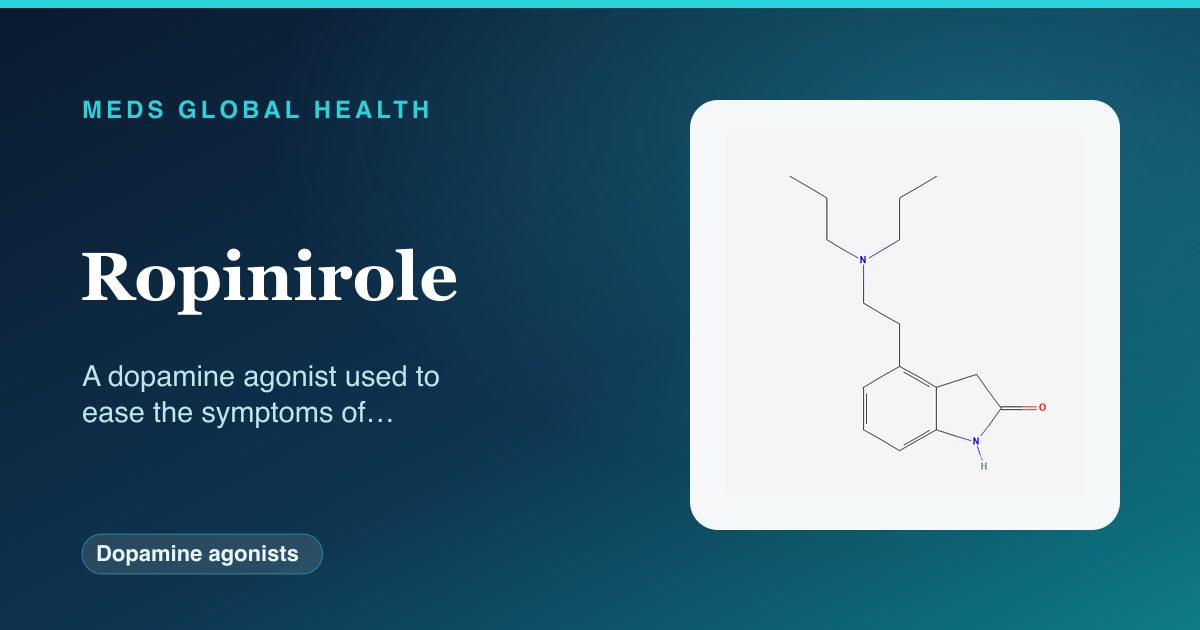
What it is
Ropinirole is a dopamine agonist, a medicine that acts in place of dopamine — the brain chemical that runs low in Parkinson's disease. It is used to improve the movement symptoms of Parkinson's, either alone in earlier disease or together with levodopa later on, and it is also used to treat restless legs syndrome. It comes as standard and as once-a-day modified-release tablets. The aim is to smooth out symptoms while keeping side effects manageable.
How it works
In Parkinson's disease the brain cells that make dopamine are gradually lost, which causes slowness, stiffness and tremor. Ropinirole works by directly stimulating dopamine receptors in the brain, mimicking the missing dopamine and helping movement become smoother. Because it stimulates these receptors directly, it does not rely on the brain converting it the way levodopa does, but the same dopamine action also explains side effects such as sudden sleepiness and impulsive behaviour.
Company & origin
Originated / developed by: Originally developed by GlaxoSmithKline..
Introduced in the late 1990s, ropinirole has been used in the UK for Parkinson's disease and restless legs.
What it treats
Conditions Ropinirole is used for
Practical use
How to take Ropinirole
General, dose-free guidance — always follow your prescriber's and the leaflet's specific instructions.
- Take it as prescribed; doses are increased slowly when you first start to reduce side effects.
- Swallow modified-release tablets whole and do not chew or crush them.
- Do not stop it suddenly — it must be reduced gradually under medical guidance.
- Take care with driving or machinery until you know whether it makes you drowsy.
- If a dose is missed, follow your team's advice rather than doubling up.
Weighing it up
Advantages & disadvantages of Ropinirole
Advantages
- Eases the slowness, stiffness and tremor of Parkinson's disease.
- Can be used early on to delay or reduce the need for levodopa.
- Available as a once-daily modified-release tablet and also helps restless legs syndrome.
Disadvantages
- Can cause sudden sleep attacks that affect driving and daily activities.
- May trigger impulse-control problems such as gambling, shopping or hypersexuality.
- Nausea and dizziness on standing are common, and it must be tapered rather than stopped abruptly.
Practical use
Good to know
Two safety points stand out. First, ropinirole can cause sudden, irresistible sleep attacks, sometimes without warning — be cautious about driving or operating machinery until you know how it affects you. Second, it can trigger impulse-control disorders such as gambling, compulsive shopping, binge eating or increased sexual urges; these can be out of character and easy to hide, so tell your family and your Parkinson's team to watch for them. It is built up slowly when starting and must never be stopped suddenly, as this can cause a serious withdrawal reaction.
Who should not take it / use with caution
- People who have had a severe reaction to ropinirole in the past.
- Used with great caution in people with serious heart disease, a history of impulse-control problems, or major psychiatric illness.
- Care is needed in older people and those prone to dizziness, hallucinations or low blood pressure on standing.
Monitoring
- Asking about daytime sleepiness and sleep attacks
- Asking specifically about new gambling, shopping, eating or sexual urges
- Blood pressure, including on standing, and overall symptom control
Side effects
- Nausea, dizziness, drowsiness and feeling faint on standing, especially early on.
- Sudden episodes of sleep, sometimes without warning.
- Impulse-control disorders such as gambling, compulsive shopping, binge eating or increased sexual urges; sometimes hallucinations or confusion.
Key interactions
- Other sedating medicines and alcohol add to drowsiness.
- Some medicines, including certain antibiotics and oestrogens, can change ropinirole levels.
- Medicines that block dopamine, such as some anti-sickness drugs and antipsychotics, can work against it.
Available as: Tablets and modified-release tablets.
Answers
Ropinirole: frequently asked questions
Can ropinirole make me fall asleep suddenly?
Yes. It can cause sudden, sometimes unwarned sleep attacks, even during activities such as driving. Until you know how it affects you, be careful with driving and machinery, and tell your prescriber if you feel very drowsy during the day.
I have started gambling or shopping much more — could it be the medicine?
It could. Dopamine agonists like ropinirole can cause impulse-control disorders, including gambling, compulsive shopping, binge eating and increased sexual urges, which can feel out of character. Tell your Parkinson's team straight away — it often improves when the medicine is adjusted.
Can I stop ropinirole if I don't like it?
Not suddenly. Stopping abruptly can cause a serious withdrawal reaction. Your team will reduce it gradually if it needs to be stopped, so always discuss it with them first.
What is the difference between ropinirole and Requip?
They are the same medicine. Ropinirole is the generic name and Requip is a brand name; both contain the same active ingredient.
Is ropinirole only for Parkinson's disease?
No. As well as Parkinson's, it is used to treat restless legs syndrome, a condition causing an uncomfortable urge to move the legs, usually at night.
The wider class
About Dopamine agonists
Ropinirole belongs to the dopamine agonists class. For how the class as a whole works, its shared safety principles and monitoring, see the full guide.
Browse by body system
Authoritative sources
- BNF: Ropinirole.
- NICE CKS: Parkinson's disease.
Building a medicines information resource?
We create evidence-led, dose-free drug and formulary references for teams.