An anti-sickness medicine for chemotherapy
Aprepitant
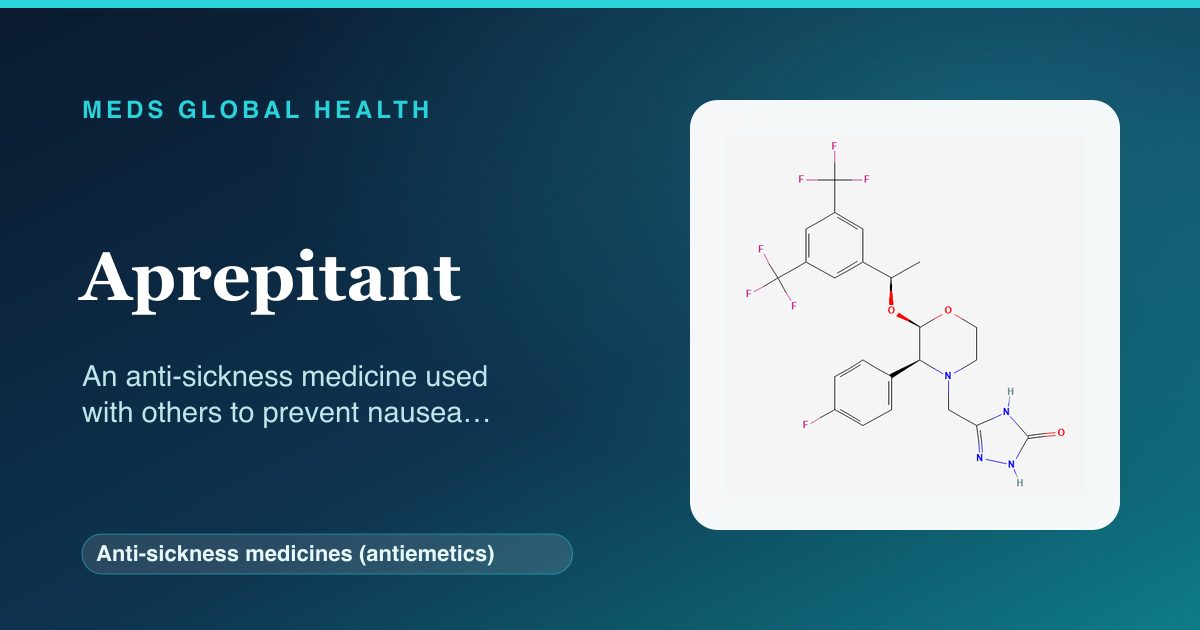
An anti-sickness medicine used with others to prevent nausea and vomiting from chemotherapy.
What is Aprepitant?
Aprepitant is an anti-sickness (antiemetic) medicine used to help prevent the nausea and vomiting that some chemotherapy treatments cause. It is given together with other anti-sickness medicines rather than on its own, and it is especially good at preventing sickness in the days after chemotherapy. It blocks a chemical signal in the brain involved in vomiting. It interacts with many other medicines and can make hormonal contraception less reliable, so extra precautions are needed.
Education and reference only. This is a plain-language guide to Aprepitant — it deliberately contains no doses. Doses depend on the person, the brand and the reason for treatment, and belong with your prescriber. Always check the BNF, the product labelling (SmPC) and follow medical advice.
What it is
Aprepitant is an antiemetic used to prevent nausea and vomiting caused by chemotherapy, particularly the more strongly sickness-inducing treatments. It is used as part of a combination of anti-sickness medicines rather than alone, and is taken around the time of chemotherapy. It is taken by mouth, usually starting on the day of treatment and continuing for a couple of days afterwards.
How it works
Aprepitant blocks a receptor in the brain (the NK1 receptor) that responds to a signal called substance P, which is involved in triggering vomiting. By blocking this pathway it helps prevent both the early and the delayed sickness that chemotherapy can cause. Working alongside other anti-sickness medicines that act in different ways gives more complete protection.
Company & origin
Originated / developed by: Merck (originator).
An antiemetic used in the UK to prevent nausea and vomiting caused by chemotherapy.
Practical use
How to take Aprepitant
General, dose-free guidance — always follow your prescriber's and the leaflet's specific instructions.
- Take it on the schedule your team gives you around chemotherapy, usually starting on the treatment day and continuing for a couple of days after.
- Keep taking it as planned even if you do not feel sick, as it is mainly there to prevent nausea rather than treat it once started.
- Use it together with the other anti-sickness medicines your team prescribes, not instead of them.
- If you use hormonal contraception, use additional non-hormonal precautions during treatment and for a while afterwards, as advised.
- If you miss a dose, contact your team for advice rather than guessing, as timing around chemotherapy matters.
Weighing it up
Advantages & disadvantages of Aprepitant
Advantages
- Adds extra protection against chemotherapy nausea when used with other anti-sickness medicines.
- Particularly good at preventing delayed sickness in the days after treatment.
- Taken as a short oral course, which is convenient around chemotherapy.
Disadvantages
- Interacts with many other medicines because of how it affects drug processing.
- Can make hormonal contraception less reliable, needing extra precautions.
- Used only alongside other anti-sickness medicines, not as a standalone treatment.
Practical use
Good to know
Aprepitant is given with other anti-sickness medicines, such as a 5HT3 blocker and a steroid, because the combination works better than any one alone for chemotherapy sickness. It is particularly valued for preventing delayed nausea in the days after treatment, so it is usually taken on a set schedule around chemotherapy even if you do not yet feel sick. Importantly, it interacts with many medicines because it affects how the body processes them, and it can make hormonal contraception (such as the pill, patch or implant) less reliable — so additional non-hormonal precautions are advised during and for a while after treatment. Always give your team a full list of your medicines, including anything bought over the counter.
Who should not take it / use with caution
- Anyone who has had an allergic reaction to aprepitant should avoid it.
- It is used with caution in significant liver disease and should be reviewed there.
- People taking certain medicines that strongly interact with it may need alternatives.
Monitoring
- Your team checks how well nausea and vomiting are controlled across the chemotherapy cycle.
- Medicines are reviewed for interactions before and during treatment.
- Contraception advice is given because effectiveness can be reduced.
Side effects
- Tiredness, hiccups, headache and constipation or diarrhoea can occur.
- Loss of appetite and indigestion are sometimes reported.
- Less commonly, dizziness or, rarely, an allergic reaction — report severe or unusual symptoms.
Key interactions
- It affects the CYP3A4 enzyme system, so it interacts with many medicines — give your team a full list.
- It can reduce the effectiveness of hormonal contraception, so use extra non-hormonal precautions.
- Doses of some medicines, such as certain steroids and blood thinners, may need adjusting.
Available as: Capsules taken by mouth (a related injectable form is also available).
Answers
Aprepitant: frequently asked questions
Is aprepitant used on its own?
No, it is used together with other anti-sickness medicines, because the combination prevents chemotherapy nausea better than any single medicine.
Why take it before I feel sick?
It mainly prevents nausea rather than treating it once it starts, so it is taken on a set schedule around chemotherapy, including the days afterwards.
Does it affect my contraception?
It can make hormonal contraception less reliable, so additional non-hormonal precautions are advised during and for a while after treatment.
Why does my team need my full medicine list?
Aprepitant interacts with many medicines through the body's drug-processing system, so doses may need adjusting and some combinations avoided.
What is it especially good at?
It is particularly effective at preventing delayed nausea and vomiting in the days following chemotherapy.
The wider class
About Anti-sickness medicines (antiemetics)
Aprepitant belongs to the anti-sickness medicines (antiemetics) class. For how the class as a whole works, its shared safety principles and monitoring, see the full guide.
Browse by body system
Authoritative sources
- BNF
- NICE CKS
Building a medicines information resource?
We create evidence-led, dose-free drug and formulary references for teams.