A long-acting anti-sickness tablet for chemotherapy
Rolapitant
A long-acting tablet taken with chemotherapy to help prevent delayed nausea and vomiting.
What is Rolapitant?
Rolapitant is an anti-sickness tablet used with chemotherapy to help prevent nausea and vomiting, especially the delayed kind that comes a day or more after treatment. It is an NK1 receptor blocker that is long-acting, so a single dose works over several days. It is taken together with other anti-sickness medicines, such as a steroid and a 5HT3 blocker, for the best effect. As with similar medicines, your team will check what else you take, as it can interact with some other drugs.
Education and reference only. This is a plain-language guide to Rolapitant — it deliberately contains no doses. Doses depend on the person, the brand and the reason for treatment, and belong with your prescriber. Always check the BNF, the product labelling (SmPC) and follow medical advice.
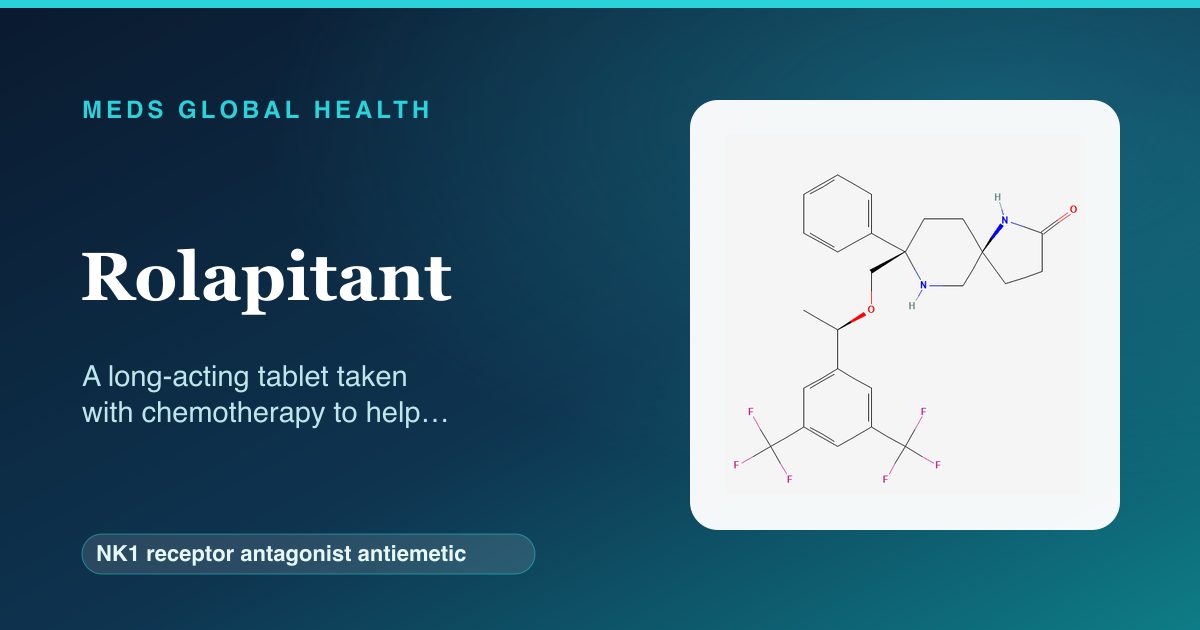
What it is
Rolapitant is an anti-sickness (antiemetic) medicine of the NK1 receptor antagonist group, taken as a tablet by mouth. It is used together with other anti-sickness medicines to help prevent the nausea and vomiting caused by chemotherapy, with a particular focus on delayed sickness over the days after treatment. A useful feature is that it is long-acting, so a single dose around the time of chemotherapy keeps working for several days. It is used as part of a combination rather than on its own.
How it works
Chemotherapy can trigger sickness partly through a brain chemical called substance P acting on NK1 receptors. Rolapitant blocks these NK1 receptors and stays in the body for a long time, so a single dose helps dampen this trigger over several days, which is why it is good at preventing delayed nausea and vomiting. Because chemotherapy causes sickness through more than one pathway, it is given with a steroid and a 5HT3 blocker, which act differently, for fuller protection. Being a tablet, it offers an oral option for this kind of prevention.
Company & origin
Originated / developed by: Generic (originator Tesaro).
A long-acting oral NK1 receptor blocker used with chemotherapy to help prevent delayed nausea and vomiting.
Practical use
How to take Rolapitant
General, dose-free guidance — always follow your prescriber's and the leaflet's specific instructions.
- Take it as a tablet around the time of chemotherapy, exactly as prescribed; a single dose lasts several days.
- Take it together with your other anti-sickness medicines, such as a steroid and a 5HT3 blocker.
- You do not need to take it every day, because it is long-acting — follow the schedule you are given.
- Tell your team about all your medicines, as it can interact with some other drugs.
- Report any signs of an allergic reaction, such as rash, swelling or breathing problems.
Weighing it up
Advantages & disadvantages of Rolapitant
Advantages
- Long-acting, so a single dose helps prevent sickness over several days, including the delayed kind.
- Taken as a tablet, offering a convenient oral option.
- Works through a different pathway from steroids and 5HT3 blockers, adding to their effect.
Disadvantages
- Works as part of a combination rather than on its own.
- Can interact with some other medicines, so the full list must be checked.
- Mainly prevents sickness rather than treating it once it has started.
Practical use
Good to know
Rolapitant is used as part of a combination — typically with a steroid (such as dexamethasone) and a 5HT3 blocker (such as ondansetron) — because together they cover the different ways chemotherapy causes sickness. Its main advantage is being long-acting: a single oral dose around the time of chemotherapy keeps protecting against delayed sickness for several days, so it does not need to be taken every day. As an NK1 blocker it can interact with some other medicines, so tell your team everything you take. It is generally well tolerated, with effects such as tiredness, hiccups, constipation and reduced appetite. As with all these medicines, report any signs of an allergic reaction.
Who should not take it / use with caution
- People who have had a serious allergic reaction to rolapitant should not take it.
- Used with caution where it interacts with other essential medicines.
- Care is needed in significant liver problems, where specialist advice is required.
Monitoring
- Checking how well the combination controls nausea and vomiting after chemotherapy.
- Watching for side effects such as constipation, hiccups and tiredness.
- Reviewing interacting medicines around the time of treatment.
Side effects
- Tiredness, hiccups, constipation and a reduced appetite are among the more common effects.
- Headache or dizziness in some people.
- Rarely, an allergic reaction with rash, swelling or breathing problems.
Key interactions
- It can affect how the body handles some other medicines, so these may need checking or adjusting.
- Tell your team about all your medicines, including any bought without a prescription.
- It is given with a steroid and a 5HT3 blocker, which are part of the planned combination, not a clash.
Available as: Tablets taken by mouth.
Answers
Rolapitant: frequently asked questions
Why don't I take rolapitant every day?
It is long-acting, so a single dose around the time of chemotherapy keeps working for several days; follow the exact schedule you are given.
What is it especially used for?
It is used to help prevent delayed nausea and vomiting, the sickness that can come a day or more after chemotherapy.
Why is it given with other anti-sickness medicines?
Chemotherapy causes sickness in more than one way, so it is combined with a steroid and a 5HT3 blocker to cover the different pathways for better protection.
Does it interact with my other medicines?
It can affect how the body handles some other medicines, so tell your team everything you take, including anything bought without a prescription.
Is it a tablet or an injection?
Rolapitant is taken as a tablet by mouth, which offers a convenient oral option for preventing delayed chemotherapy sickness.
The wider class
About NK1 receptor antagonist antiemetic
Rolapitant belongs to the nk1 receptor antagonist antiemetic class. For how the class as a whole works, its shared safety principles and monitoring, see the full guide.
Browse by body system
Authoritative sources
- BNF
- NICE CKS
Building a medicines information resource?
We create evidence-led, dose-free drug and formulary references for teams.