A treatment for vertigo and balance problems
Betahistine
A histamine-like medicine used to reduce the dizziness, vertigo, ringing in the ears and hearing problems of Meniere's disease.
What is Betahistine?
Betahistine is a medicine used for vertigo and balance problems, particularly Meniere's disease, where it can reduce attacks of dizziness, ringing in the ears (tinnitus) and hearing loss. It is thought to work by improving blood flow in the inner ear. Because it is similar to histamine, it is used with care in people with asthma or a peptic ulcer.
Education and reference only. This is a plain-language guide to Betahistine — it deliberately contains no doses. Doses depend on the person, the brand and the reason for treatment, and belong with your prescriber. Always check the BNF, the product labelling (SmPC) and follow medical advice.
What it is
Betahistine is a medicine used to treat the symptoms of Meniere's disease, a condition of the inner ear that causes attacks of vertigo (a spinning sensation), ringing in the ears (tinnitus) and hearing loss. It is taken regularly to reduce how often and how severe these attacks are. It is the main medicine used for Meniere's disease in the UK.
How it works
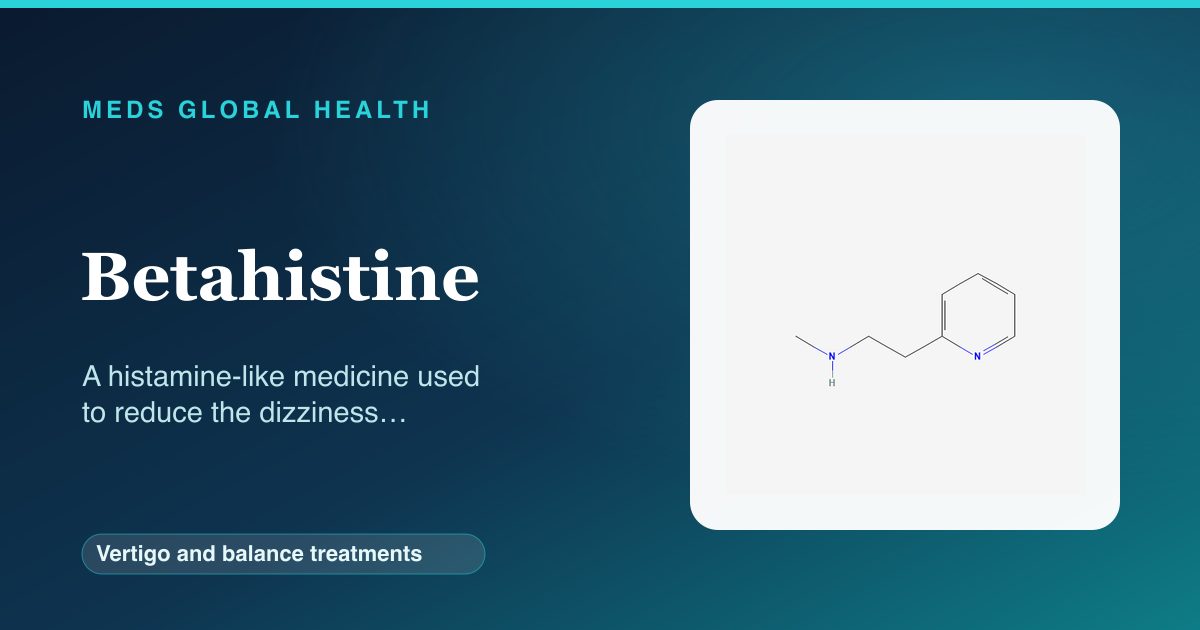
Betahistine is similar in structure to histamine, a natural body chemical. It is thought to work mainly by improving blood flow in the balance organ of the inner ear and by reducing pressure from the fluid there. By doing so, it helps to lessen the dizziness, vertigo and other symptoms that come from the inner ear in Meniere's disease.
Company & origin
Originated / developed by: A long-established vertigo treatment.
A histamine-like medicine used in the UK to reduce the attacks of vertigo, ringing and hearing loss seen in Meniere's disease.
Practical use
How to take Betahistine
General, dose-free guidance — always follow your prescriber's and the leaflet's specific instructions.
- It is usually taken with or after food to reduce the chance of an upset stomach.
- Take it regularly every day to help prevent attacks, not just when you feel dizzy.
- Give it time, as it can take some weeks before the benefit is clear.
- Tell your doctor if you have asthma or a history of stomach ulcers before starting.
- If you miss a dose, take it when you remember unless it is nearly time for the next one, then skip it and do not double up.
Weighing it up
Advantages & disadvantages of Betahistine
Advantages
- The main medicine used to reduce the frequency and severity of Meniere's attacks.
- Taken as a tablet and generally well tolerated.
- Can help several symptoms at once, including vertigo and ringing in the ears.
Disadvantages
- Needs to be taken regularly and can take weeks to show benefit.
- Used with caution in people with asthma or a peptic ulcer.
- Helps control symptoms but does not cure Meniere's disease.
Practical use
Good to know
Betahistine is taken regularly, usually with or after food, to help prevent attacks rather than to stop a single episode quickly. Because it is related to histamine, it can occasionally trigger wheeze in people with asthma and may aggravate a peptic ulcer, so it is used with care in these conditions. It can take some weeks of regular use before the benefit is clear. It is not a cure for Meniere's disease, and works best alongside other measures your specialist may suggest, such as reducing salt.
Who should not take it / use with caution
- People with a phaeochromocytoma (a rare adrenal gland tumour) should not take it.
- Used with caution in people with asthma, as it may trigger wheeze, and in those with a current or past peptic ulcer.
- Used with caution in pregnancy and breastfeeding; discuss with your prescriber.
Monitoring
- Whether the frequency and severity of vertigo attacks improve over a few weeks.
- Any breathing symptoms in people with asthma.
- Any stomach symptoms in people with a history of peptic ulcer.
Side effects
- Indigestion, nausea or a mild upset tummy, which is helped by taking it with food.
- Headache is fairly common.
- Rarely, wheeze in people with asthma, or an allergic reaction such as a rash or itching.
Key interactions
- Antihistamines may, in theory, reduce its effect, as betahistine acts on histamine pathways.
- Care is needed alongside medicines that can irritate the stomach if you have a history of ulcers.
- Tell your pharmacist about everything you take, including over-the-counter and herbal products.
Available as: Tablets.
Answers
Betahistine: frequently asked questions
What is betahistine used for?
It is used for Meniere's disease, an inner-ear condition causing attacks of vertigo, ringing in the ears and hearing loss. It is taken regularly to reduce these attacks.
Will it stop a dizzy attack straight away?
No. It is taken regularly to help prevent attacks over time rather than to stop a single attack quickly. It can take some weeks to show benefit.
Can I take it if I have asthma?
It is used with caution in asthma because, being similar to histamine, it can occasionally trigger wheeze. Tell your doctor if you have asthma.
Why take it with food?
Taking it with or after food reduces the chance of indigestion or an upset stomach, which are among its more common effects.
Does it cure Meniere's disease?
No. It helps control the symptoms but does not cure the condition, and works best alongside other measures your specialist suggests.
The wider class
About Vertigo and balance treatments
Betahistine belongs to the vertigo and balance treatments class. For how the class as a whole works, its shared safety principles and monitoring, see the full guide.
Browse by body system
Authoritative sources
- BNF
- NICE CKS
Building a medicines information resource?
We create evidence-led, dose-free drug and formulary references for teams.