A long-acting anti-sickness medicine for chemotherapy
Palonosetron
A long-acting anti-sickness medicine that helps prevent nausea and vomiting from chemotherapy.
What is Palonosetron?
Palonosetron is an anti-sickness medicine used to help prevent the nausea and vomiting caused by chemotherapy. It belongs to a group called 5HT3-receptor antagonists, which block a key sickness signal, and it is notable for being long-acting, so a single dose covers a long stretch of time. Common side effects are constipation and headache. Like others in its group it can affect the heart's electrical rhythm (the QT interval), though generally less than older medicines of this type. It is often combined with netupitant as the brand Akynzeo.
Education and reference only. This is a plain-language guide to Palonosetron — it deliberately contains no doses. Doses depend on the person, the brand and the reason for treatment, and belong with your prescriber. Always check the BNF, the product labelling (SmPC) and follow medical advice.
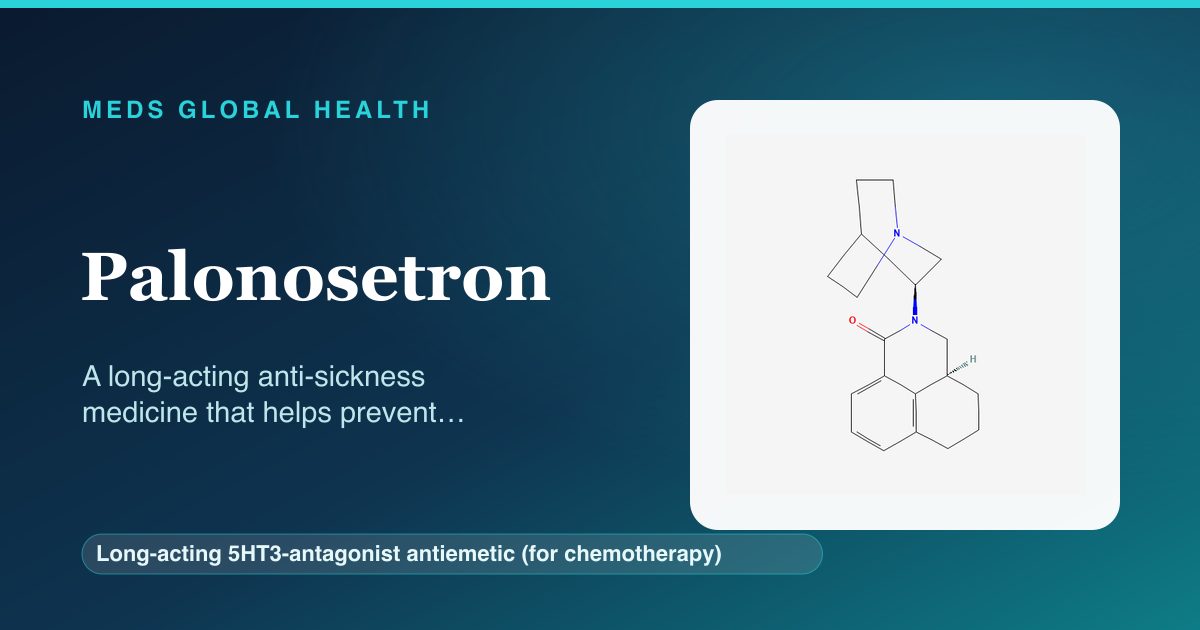
What it is
Palonosetron is a medicine used to help prevent the nausea and vomiting that chemotherapy can cause. It belongs to a well-established group of anti-sickness medicines called 5HT3-receptor antagonists. Its main feature is that it is long-acting, meaning a single dose keeps working for a long time, which makes it useful for both the early and the delayed sickness that chemotherapy can bring. It may be given on its own or as a fixed combination with netupitant, often as the brand Akynzeo, and is used as part of a planned anti-sickness regimen by the cancer team.
How it works
Chemotherapy can release a chemical called serotonin in the gut, which triggers nausea and vomiting by acting on 5HT3 receptors. Palonosetron blocks these receptors, so this sickness signal is interrupted. What sets it apart from older medicines in the same group is that it stays active much longer, so one dose gives prolonged protection. It is given before or around chemotherapy so it is already working when sickness would otherwise begin, and it is often paired with another medicine that blocks a different sickness pathway for fuller cover.
Company & origin
A medicine used in the UK to help prevent nausea and vomiting caused by chemotherapy, known for its long-lasting effect.
Practical use
How to take Palonosetron
General, dose-free guidance — always follow your prescriber's and the leaflet's specific instructions.
- Have it as part of your anti-sickness plan around chemotherapy, on the schedule your cancer team arranges.
- It is used as a preventer before chemotherapy rather than once you already feel sick.
- If it is the combined product with netupitant, take it as a single dose as directed.
- Tell your team about any heart-rhythm problems or medicines that affect the heart rhythm.
- Let your team know if sickness still breaks through, as extra anti-sickness medicine may be needed.
Weighing it up
Advantages & disadvantages of Palonosetron
Advantages
- Long-acting, so a single dose protects against sickness for an extended period.
- Helps prevent both early and delayed chemotherapy nausea and vomiting.
- Often combined with netupitant to cover two different sickness pathways at once.
Disadvantages
- Works as a preventer, so it is less useful once sickness has already started.
- Commonly causes constipation and headache.
- Can affect the heart's rhythm (the QT interval), though generally less than older medicines of its type.
Practical use
Good to know
The standout feature of palonosetron is how long it lasts: a single dose protects against sickness for an extended period, which helps with the delayed nausea and vomiting that can follow chemotherapy. It works best as a preventer, given before chemotherapy rather than once you already feel sick. The most common side effects are constipation and headache. Like all medicines in its group, it can affect the heart's electrical rhythm (the QT interval), though it generally does so less than some older 5HT3 medicines; even so, your team may take extra care if you have heart-rhythm problems or take other medicines that affect the QT interval. It is frequently combined with netupitant as Akynzeo to cover two sickness pathways, and it is used as part of a planned anti-sickness regimen.
Who should not take it / use with caution
- People who have had a serious allergic reaction to palonosetron should not have it.
- It is used with caution in people with certain heart-rhythm problems or on medicines that affect the QT interval.
- It is used with care in pregnancy and breastfeeding, guided by the cancer team.
Monitoring
- Reviewing how well it controls nausea and vomiting through the chemotherapy cycle.
- Checking the heart's rhythm where appropriate, especially with other QT-affecting medicines.
- Watching for side effects such as constipation and headache.
Side effects
- Constipation, which is a common effect.
- Headache and, in some people, dizziness or tiredness.
- Less commonly, changes in the heart's rhythm (the QT interval).
Key interactions
- Medicines that affect the heart's QT interval should be reviewed when using palonosetron.
- Combining it with other serotonin-acting medicines may, rarely, raise the risk of serotonin-related effects.
- Tell your team about all your medicines so interactions can be checked before each cycle.
Available as: A solution for injection into a vein, and capsules by mouth as a combination with netupitant.
Answers
Palonosetron: frequently asked questions
What is palonosetron used for?
It is used to help prevent the nausea and vomiting caused by chemotherapy, by blocking a key chemical signal that triggers sickness.
What makes it different from other anti-sickness medicines?
It is long-acting, so a single dose keeps working for a long time, which helps with the delayed sickness that can follow chemotherapy.
Should I wait until I feel sick to have it?
No. It works best as a preventer, given before chemotherapy to stop sickness starting, rather than once you already feel unwell.
Does it affect the heart?
Like others in its group, it can affect the heart's electrical rhythm (the QT interval), though generally less than some older medicines; your team takes care if you have heart-rhythm concerns.
Why is it sometimes combined with netupitant?
Palonosetron and netupitant block different sickness pathways, so combining them, often as Akynzeo, gives fuller protection against chemotherapy sickness.
The wider class
About Long-acting 5HT3-antagonist antiemetic (for chemotherapy)
Palonosetron belongs to the long-acting 5ht3-antagonist antiemetic (for chemotherapy) class. For how the class as a whole works, its shared safety principles and monitoring, see the full guide.
Browse by body system
Authoritative sources
- BNF
- NICE CKS
Building a medicines information resource?
We create evidence-led, dose-free drug and formulary references for teams.