A topical antifungal (Canesten in the UK, Lotrimin in the US)
Clotrimazole
A widely available antifungal cream and pessary for thrush, athlete's foot and ringworm — sold as Canesten in the UK and Lotrimin in the US, and able to weaken latex condoms.
What is Clotrimazole?
Clotrimazole is a topical antifungal used as a cream, pessary or spray rather than swallowed. It treats common fungal infections such as vaginal thrush, athlete's foot, ringworm and fungal skin rashes.
Education and reference only. This is a plain-language guide to Clotrimazole — it deliberately contains no doses. Doses depend on the person, the brand and the reason for treatment, and belong with your prescriber. Always check the BNF, the product labelling (SmPC) and follow medical advice.
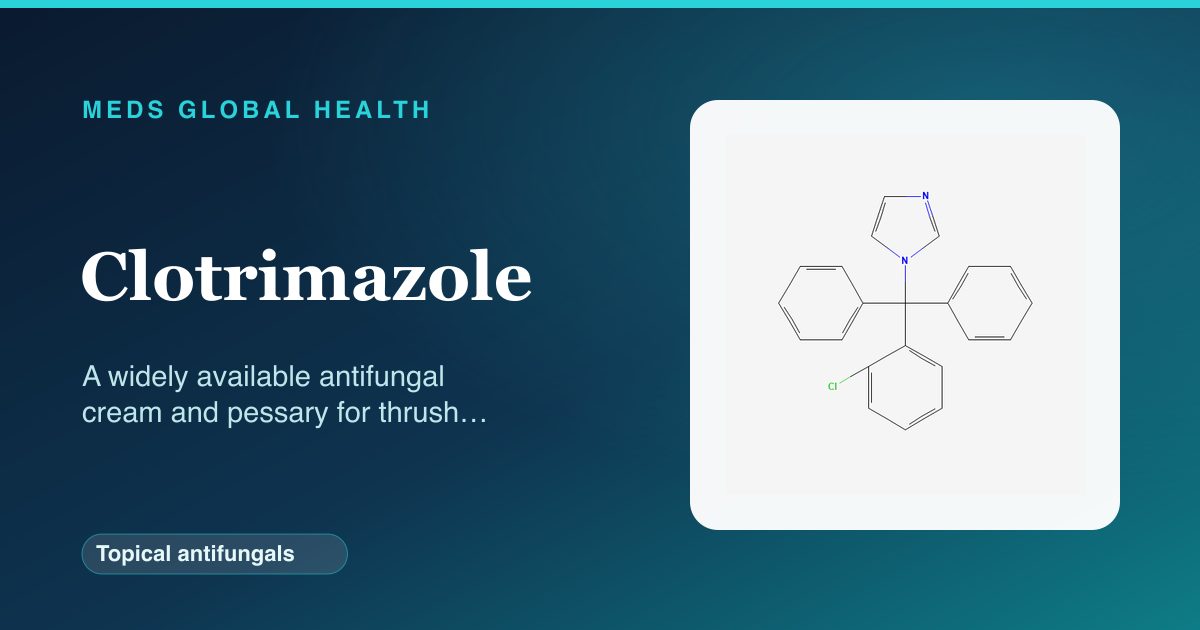
What it is
Clotrimazole is a topical antifungal — a cream, pessary or spray applied to the skin or inside the vagina rather than swallowed — used to clear common fungal infections. These include vaginal thrush (and the related itch in a partner), athlete's foot, ringworm, fungal nappy and skin-fold rashes, and other yeast and fungal skin infections. It is a useful example of brand names differing across countries: in the UK it is best known as Canesten, while in the US the same ingredient is sold as Lotrimin. It is widely available over the counter.
How it works
Fungi and yeasts depend on a substance called ergosterol to build a healthy outer cell membrane. Clotrimazole interferes with the production of ergosterol, so the fungal cell membrane becomes leaky and the fungus cannot grow or survive. Because it is applied directly to the affected skin or area, it acts where it is needed with very little absorbed into the rest of the body, which is why it is generally so well tolerated.
Company & origin
Originated / developed by: Bayer.
Clotrimazole was discovered in the late 1960s by chemists at Bayer AG in Germany (work associated with mycologist Karl Heinz Plempel) and introduced as one of the first imidazole antifungals around 1969.
Practical use
How to take Clotrimazole
General, dose-free guidance — always follow your prescriber's and the leaflet's specific instructions.
- Apply the cream thinly to clean, dry skin and a little way beyond the affected area, usually morning and night.
- For vaginal thrush, insert the pessary or internal cream high into the vagina, ideally at bedtime.
- Wash and dry your hands before and after applying it.
- Keep using it for the full recommended period, even once the rash or itching settles, to stop the infection returning.
- Be aware the cream and pessary can weaken latex condoms and diaphragms around the time of use.
- See a pharmacist or doctor if symptoms do not improve or keep coming back.
Weighing it up
Advantages & disadvantages of Clotrimazole
Advantages
- Acts directly at the site of infection with little absorbed into the body.
- Available without prescription for common infections.
- Comes in several forms to suit skin, vaginal and other sites.
- Generally well tolerated and suitable in pregnancy for thrush on medical advice.
Disadvantages
- Can cause local irritation, burning, stinging or redness when applied.
- Needs consistent, repeated application to work.
- Can damage latex condoms and diaphragms.
- Not suitable for fungal infections that are widespread or deep, which need oral treatment.
Practical use
Good to know
It is applied to the affected area, and it is worth continuing for a short while after the rash looks better to stop the infection coming straight back. One practical caution matters a lot: clotrimazole creams and pessaries can weaken latex condoms and diaphragms, making them less reliable, so other contraception or protection should be used around treatment. Thrush that keeps coming back, occurs with fever or pain, or appears for the first time during pregnancy is worth getting checked rather than just self-treating, and athlete's foot or ringworm that does not clear should be reviewed.
Who should not take it / use with caution
- Anyone who has had an allergic reaction to clotrimazole or a similar "azole" antifungal.
- For vaginal use, a first-ever episode, symptoms in someone under or over the usual age range, recurrent thrush, pregnancy, or any unusual discharge, bleeding, pain or fever should be assessed rather than self-treated.
- Not for use in the eyes; broken or extensively damaged skin, or infections that are spreading or not improving, need professional advice.
Monitoring
- Whether the infection clears within the expected time
- For recurrent or non-improving infection that needs review
- No blood tests needed for normal topical use
Side effects
- Mild local irritation — a brief burning, stinging, itching or redness where it is applied.
- Occasionally, peeling or a rash at the site.
- Rarely, a genuine allergic reaction with marked swelling, blistering or a spreading rash — stop and seek advice if this happens.
Key interactions
- Very few, because so little is absorbed; the most important practical point is that it can damage latex condoms and diaphragms, reducing their reliability.
- Avoid using it at the same site as other creams unless advised, as this can dilute or interfere with it.
- If athlete's foot or another infection is being treated with a separate oral antifungal, combining treatments should be guided by a professional.
Available as: Cream, vaginal pessaries and internal cream, a spray and a solution; often combined in packs with other ingredients (for example with hydrocortisone for inflamed skin).
Answers
Clotrimazole: frequently asked questions
Is Canesten the same as Lotrimin?
Yes — both contain clotrimazole as the active ingredient and work the same way. Canesten is the familiar brand in the UK, while Lotrimin is the equivalent in the US. So if a US product or website mentions Lotrimin, the UK equivalent on the shelf is usually Canesten clotrimazole.
Can I use it with condoms?
Take care: clotrimazole creams and pessaries can weaken latex condoms and diaphragms, making them more likely to fail, and this effect can last a short while after use. Use an additional or alternative form of protection or contraception around the time of treatment, and ask your pharmacist if you are unsure.
How long should I keep using it?
Follow the directions for the specific product, and as a general rule keep applying it for a little while after the skin looks clear, because the fungus can linger even when symptoms have faded. Stopping too soon is a common reason for the infection bouncing back. If it has not improved in the expected time, get it checked.
Should I see someone instead of self-treating my thrush?
Self-treatment is reasonable for a straightforward, recognised repeat of thrush. But get assessed if it is your first ever episode, if it keeps coming back, if you are pregnant, or if there is unusual discharge, bleeding, pain, fever, or no improvement — these may need a different diagnosis or treatment.
What is the difference between clotrimazole and the brands?
They are the same medicine — clotrimazole is the generic (active-ingredient) name, and Canesten (UK) and Lotrimin (US) are brands. Generic clotrimazole contains the identical active ingredient and works the same way; it is usually cheaper than the branded versions.
The wider class
About Topical antifungals
Clotrimazole belongs to the topical antifungals class. For how the class as a whole works, its shared safety principles and monitoring, see the full guide.
Browse by body system
Authoritative sources
- BNF: Clotrimazole.
- electronic Medicines Compendium (SmPC): Clotrimazole (Canesten).
- NICE CKS: Thrush in men and women.
Building a medicines information resource?
We create evidence-led, dose-free drug and formulary references for teams.