A topical and oral-gel antifungal
Miconazole
An antifungal applied to the skin, used in the mouth as a gel, or used vaginally to treat thrush and fungal skin infections.
What is Miconazole?
Miconazole is an antifungal that comes in several forms for different sites: a cream or powder for fungal skin infections, a gel for oral thrush, and vaginal preparations for thrush. It works against yeasts and other fungi while being applied directly where it is needed.
Education and reference only. This is a plain-language guide to Miconazole — it deliberately contains no doses. Doses depend on the person, the brand and the reason for treatment, and belong with your prescriber. Always check the BNF, the product labelling (SmPC) and follow medical advice.
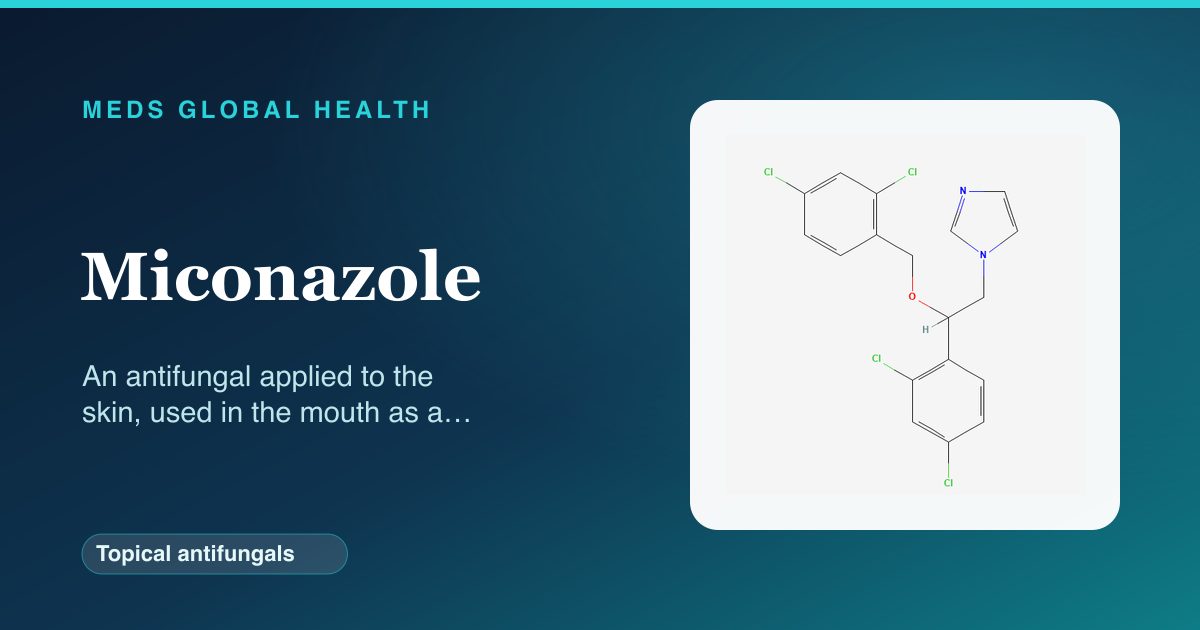
What it is
Miconazole is a widely used antifungal that comes in several forms for different sites: a cream or powder for fungal skin infections such as athlete's foot, ringworm and skin-fold thrush; an oral gel held in the mouth for oral thrush; and pessaries or vaginal cream for vaginal thrush. In the UK the familiar brand is Daktarin (with Daktarin Oral Gel for the mouth); in the US the vaginal-thrush products are often sold as Monistat, while skin products carry various names. Many forms are available from a pharmacy without a prescription. Although it is mostly used on the surface, the oral gel is partly absorbed, which is why it can interact with some medicines.
How it works
Miconazole belongs to the "azole" family of antifungals. It damages the fungal cell membrane by blocking the fungus's ability to make ergosterol, a fatty substance the membrane needs to stay intact. Without it the membrane becomes leaky and the fungal cell cannot survive, which clears the infection. It also has some action against certain bacteria that can complicate skin-fold rashes.
Company & origin
Originated / developed by: Janssen Pharmaceutica (now part of Johnson & Johnson).
Miconazole was developed in the late 1960s by Janssen Pharmaceutica in Belgium and introduced around 1969 as an imidazole antifungal, later widely sold as Daktarin and Monistat.
Practical use
How to take Miconazole
General, dose-free guidance — always follow your prescriber's and the leaflet's specific instructions.
- For skin infections, apply the cream or powder to clean, dry skin and a little beyond the affected edge.
- For oral thrush, hold the gel in the mouth, in contact with the affected areas, for as long as possible before swallowing.
- Continue treatment for the full recommended period, and usually for a short time after symptoms clear, to prevent relapse.
- Vaginal preparations can weaken latex condoms and diaphragms around the time of use.
- Tell your pharmacist or doctor about other medicines, as the oral gel can interact with some, including warfarin.
- Seek advice if the infection does not settle or keeps returning.
Weighing it up
Advantages & disadvantages of Miconazole
Advantages
- Available in skin, oral and vaginal forms for different infections.
- Acts locally with limited absorption from skin preparations.
- Many forms can be bought without prescription.
- Effective against common yeast and fungal infections.
Disadvantages
- Can cause local irritation, burning or an unpleasant taste with the oral gel.
- The oral gel can interact with several medicines, including blood thinners.
- Vaginal forms can damage latex contraceptives.
- Requires repeated, consistent application to clear the infection.
Practical use
Good to know
For skin infections it is usually rubbed in and continued for a while after the rash looks better, because stopping too soon lets the infection return. The oral gel is held in the mouth, in contact with the affected areas, rather than swallowed straight away, and is kept away from the back of the throat in babies to avoid choking. Even though it is used in the mouth, enough is absorbed to matter for people taking warfarin or certain other medicines (see interactions). Vaginal products can weaken latex condoms and diaphragms.
Who should not take it / use with caution
- People who have had an allergic reaction to miconazole or other azole antifungals.
- The oral gel is not suitable for very young babies and is used with care in others because of a choking risk and because it interacts with warfarin and some other medicines.
- People taking warfarin or certain statins should check before using the oral gel, as levels of those medicines can rise.
Monitoring
- No routine blood tests for skin use
- Clotting (INR) is watched more closely if the oral gel is used with warfarin
- Response of the infection and the skin or mouth
Side effects
- Mild burning, stinging, itching or redness where it is applied.
- With the oral gel, an altered taste, a dry or sore mouth, or mild nausea.
- Rarely, an allergic skin reaction; very rarely a more serious allergic reaction needing urgent care.
Key interactions
- The oral gel can raise the effect of warfarin and increase bleeding risk — this combination needs caution and closer monitoring of clotting.
- It can raise levels of some statins (such as simvastatin and atorvastatin), increasing the risk of muscle side effects.
- It can affect certain other medicines handled by the same liver pathways, including some diabetes tablets — the more is absorbed, the more this matters, so the oral gel is the form most likely to interact.
Available as: Cream, powder and spray for the skin; an oral gel for the mouth; pessaries and vaginal cream for vaginal thrush. Many forms are available without a prescription.
Answers
Miconazole: frequently asked questions
How long should I keep using miconazole cream?
For skin infections, keep applying it for as long as advised — usually for a period after the rash has cleared — so the fungus is fully treated and does not come straight back. If a skin infection has not improved after the recommended course, have it reviewed rather than continuing indefinitely.
I take warfarin — is the oral gel safe for me?
Check with your pharmacist or GP first. Miconazole oral gel is partly absorbed and can raise warfarin's effect, increasing the risk of bleeding, so it may need to be avoided or your clotting (INR) watched more closely. A different thrush treatment may be suggested.
Can I use the oral gel for my baby's thrush?
It is used in babies only under guidance and with care, because applying gel near the back of a small mouth can cause choking and it is not suitable for very young infants. Always follow the age advice on the product and your health visitor's or pharmacist's instructions.
Does miconazole affect condoms?
Vaginal miconazole cream and pessaries can weaken latex condoms and diaphragms, making them less reliable, and this effect can last for a short while after treatment. Use an additional or non-latex method if you need contraception or protection during and just after treatment.
What is the difference between miconazole, Daktarin and Monistat?
They are the same active ingredient — miconazole is the generic name, Daktarin is a common UK brand (including Daktarin Oral Gel), and Monistat is a US brand often used for vaginal thrush. The form matters more than the brand: skin, mouth and vaginal products are designed for those specific sites.
The wider class
About Topical antifungals
Miconazole belongs to the topical antifungals class. For how the class as a whole works, its shared safety principles and monitoring, see the full guide.
Browse by body system
Authoritative sources
- BNF: Miconazole.
- electronic Medicines Compendium (SmPC): Daktarin Oral Gel.
- NICE CKS: Thrush in men and women; Antifungal medicines.
Building a medicines information resource?
We create evidence-led, dose-free drug and formulary references for teams.