An antifungal cream for athlete's foot and ringworm
Luliconazole
An antifungal cream applied to the skin to treat fungal infections such as athlete's foot and ringworm.
What is Luliconazole?
Luliconazole is an antifungal cream applied directly to the skin to treat common fungal infections such as athlete's foot, ringworm and jock itch. It works by stopping the fungus from growing, which clears the infection and eases the itching, redness and scaling. It is generally very well tolerated, with the main side effect being mild irritation, redness or itching where it is applied. It is used for a short course and only on the skin, not swallowed.
Education and reference only. This is a plain-language guide to Luliconazole — it deliberately contains no doses. Doses depend on the person, the brand and the reason for treatment, and belong with your prescriber. Always check the BNF, the product labelling (SmPC) and follow medical advice.
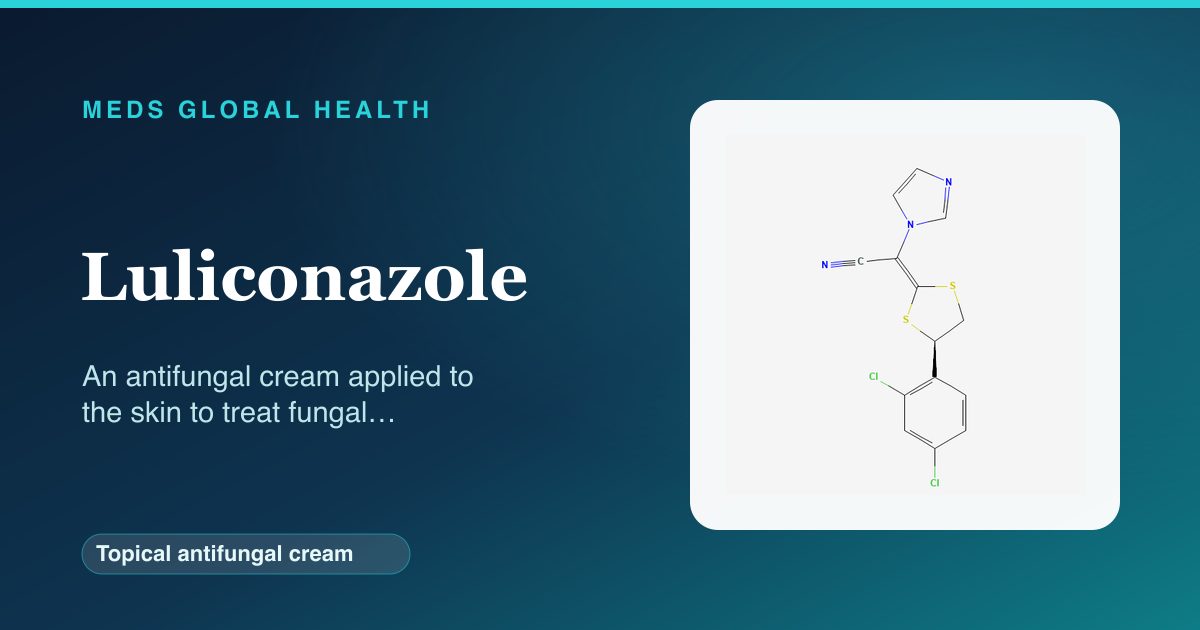
What it is
Luliconazole is a medicine that comes as a cream applied to the skin to treat fungal infections. It is used for conditions such as athlete's foot (between the toes), ringworm (a ring-shaped rash) and jock itch (in the groin), which are all caused by the same family of skin fungi. It belongs to the azole group of antifungals and is for external use only, applied as a thin layer to the affected area for a short course. It tends to be very well tolerated, with problems mostly limited to the skin where it is put on.
How it works
Luliconazole works against the fungi that cause skin infections by damaging their cell walls, so the fungus can no longer grow and spread. As the fungus is cleared, the symptoms it causes — itching, redness, scaling and a spreading rash — settle and the skin recovers. Because it is applied directly to the affected area, it acts mainly where it is needed and very little is absorbed into the rest of the body, which is part of why it is so well tolerated.
Company & origin
An antifungal cream used in the UK and elsewhere to treat fungal skin infections such as athlete's foot and ringworm.
Practical use
How to take Luliconazole
General, dose-free guidance — always follow your prescriber's and the leaflet's specific instructions.
- Apply a thin layer to the affected skin and a little of the surrounding area, on clean, dry skin.
- Use it for the full course you are given, even if the rash looks better, to stop the infection coming back.
- Wash and dry your hands after applying it, unless you are treating your hands, to avoid spreading the infection.
- Keep it away from your eyes, mouth and the inside of your nose, as it is for use on the skin only.
- If the rash does not improve, gets worse or starts to weep, get it checked rather than continuing on your own.
Weighing it up
Advantages & disadvantages of Luliconazole
Advantages
- An effective treatment for common fungal skin infections such as athlete's foot and ringworm.
- Generally very well tolerated, with side effects usually limited to mild skin irritation.
- Applied directly to the skin, so very little is absorbed into the rest of the body.
Disadvantages
- Can cause mild irritation, redness, dryness or itching where it is applied.
- Needs to be used for the full course, as stopping early can let the infection return.
- Only treats fungal infections, so it will not help a rash that is not fungal.
Practical use
Good to know
The most useful thing to know is that luliconazole is generally very well tolerated, with the only common problem being mild irritation, redness, dryness or itching where the cream is applied, which usually settles. For the treatment to work fully it helps to keep using it for the whole course you are given, even after the rash looks better, because stopping too soon can let the infection come back. Applying it to clean, dry skin and washing your hands afterwards helps it work and stops the infection spreading to other areas. It is for use on the skin only and should be kept away from the eyes, mouth and inside the nose. If the rash does not improve, gets worse, or weeps and looks infected, it is worth getting it checked, as not every rash is fungal.
Who should not take it / use with caution
- People who have had a serious allergic reaction to luliconazole or similar antifungal creams should not use it.
- It is used with care on broken or badly inflamed skin, and around the eyes, where it should be avoided.
- If you are pregnant or breastfeeding, check with a pharmacist or doctor before using it.
Monitoring
- Checking that the rash is improving over the course of treatment.
- Watching for any worsening, weeping or signs the rash may not be fungal.
- Looking out for skin irritation or an allergic reaction where the cream is applied.
Side effects
- Mild irritation, redness, dryness or itching where the cream is applied.
- Occasionally a burning or stinging feeling at the application site.
- Rarely, an allergic skin reaction, which means the cream should be stopped and advice sought.
Key interactions
- Because very little is absorbed, it has few well-established interactions with other medicines.
- Avoid using other creams on the same area at the same time unless advised, as they may interfere.
- Tell a pharmacist or doctor about other skin treatments you are using on the affected area.
Available as: A cream applied to the skin.
Answers
Luliconazole: frequently asked questions
What is luliconazole used for?
It is an antifungal cream used to treat common fungal skin infections such as athlete's foot, ringworm and jock itch by stopping the fungus from growing.
How long should I use it for?
Use it for the full course you are given, even after the rash looks better, because stopping too soon can let the infection come back.
Is it safe to use?
It is generally very well tolerated; the main side effect is mild irritation, redness or itching where it is applied, and very little is absorbed into the body.
Can I use it anywhere on my body?
It is for use on the skin only and should be kept away from your eyes, mouth and the inside of your nose; follow the advice for where to apply it.
What if the rash does not get better?
If the rash does not improve, gets worse or starts to weep, get it checked, as not every rash is fungal and it may need a different treatment.
The wider class
About Topical antifungal cream
Luliconazole belongs to the topical antifungal cream class. For how the class as a whole works, its shared safety principles and monitoring, see the full guide.
Browse by body system
Authoritative sources
- BNF
- NICE CKS
Building a medicines information resource?
We create evidence-led, dose-free drug and formulary references for teams.