A nail solution for fungal nail infection
Efinaconazole
An antifungal solution painted onto the nail to treat a fungal nail infection.
What is Efinaconazole?
Efinaconazole is an antifungal solution that is applied directly to a nail affected by a fungal infection. It is painted onto and around the nail, usually once a day, and works by killing the fungus growing in and under the nail. Because nails grow slowly, treatment has to continue for many months, and improvement is gradual as healthy new nail grows out. The most common side effects are reactions where it is applied, such as redness, irritation or ingrown nails. It is flammable, so it should be kept away from flames and heat while it is wet on the nail.
Education and reference only. This is a plain-language guide to Efinaconazole — it deliberately contains no doses. Doses depend on the person, the brand and the reason for treatment, and belong with your prescriber. Always check the BNF, the product labelling (SmPC) and follow medical advice.
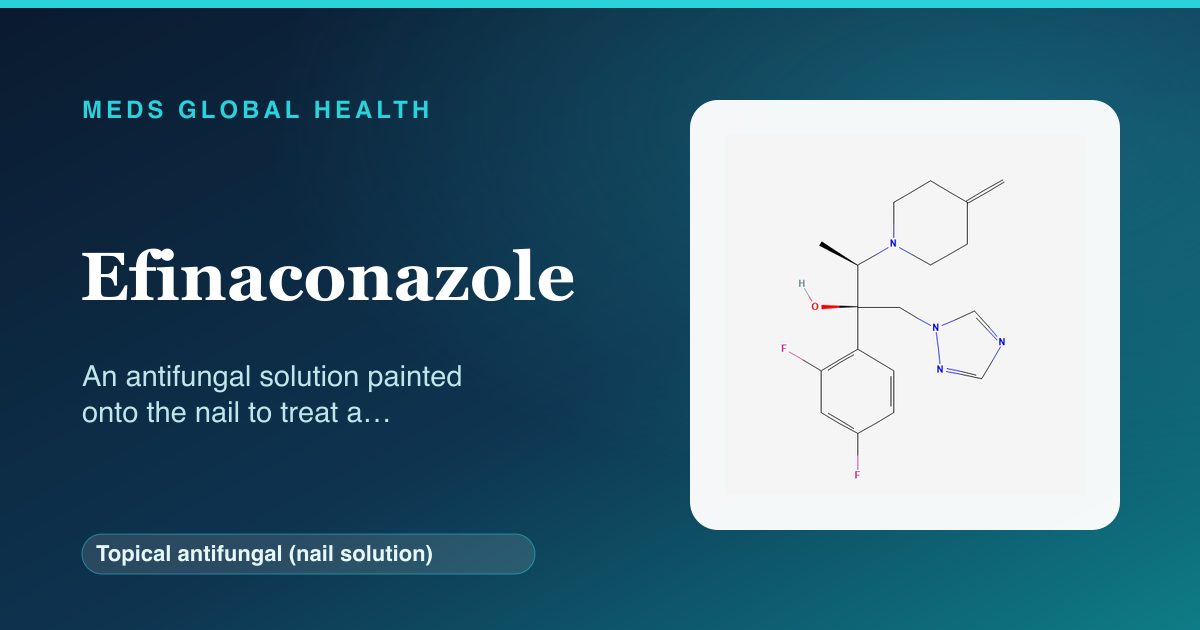
What it is
Efinaconazole is a topical antifungal medicine in the form of a solution that is applied to the nail. It is used to treat fungal nail infections, which make the nail thickened, discoloured and crumbly. Unlike antifungal tablets, which work from the inside, efinaconazole is painted directly onto the affected nail and the skin around it. It is a treatment that needs patience, because nails grow slowly and it can take many months of daily use before a clear, healthy nail grows through. It is prescribed for fungal infection of the toenails or fingernails.
How it works
Efinaconazole stops the fungus that is infecting the nail from making a substance it needs to build its cell walls, which kills the fungus and stops it spreading. Applied as a solution, it is designed to penetrate the nail to reach the infection underneath. Because the visible part of the nail does not heal itself, the improvement you see comes from healthy new nail growing out from the base to replace the infected part. As nails grow slowly, this is why treatment continues for many months and why progress is gradual rather than sudden.
Company & origin
An antifungal nail solution used in the UK to treat fungal infection of the toenails or fingernails, applied directly to the nail.
Practical use
How to take Efinaconazole
General, dose-free guidance — always follow your prescriber's and the leaflet's specific instructions.
- Apply it to the affected nail, the skin around it and under the tip of the nail, usually once a day as directed.
- Let it dry fully before covering the nail or putting on socks or footwear.
- Keep it away from naked flames, lit cigarettes and heat while it is wet, as it is flammable.
- Keep using it for the full course, which is many months, even though improvement is slow.
- Avoid nail polish or artificial nails during treatment unless your prescriber says otherwise.
Weighing it up
Advantages & disadvantages of Efinaconazole
Advantages
- Applied directly to the nail, avoiding the whole-body effects of antifungal tablets.
- A useful option for people who cannot take or prefer to avoid antifungal tablets.
- Targets the infection at the nail itself.
Disadvantages
- Needs daily use for many months, requiring patience and persistence.
- Can cause irritation, redness, blisters or ingrown nails where it is applied.
- The solution is flammable while wet, so heat and flames must be avoided.
Practical use
Good to know
The most important thing to understand about efinaconazole is that it works slowly: nails take a long time to grow, so it usually needs to be applied every day for many months, and you only see a clearly healthy nail once enough new nail has grown out. Stopping too soon often lets the infection return. It is applied to the whole nail, the surrounding skin and under the tip, and you should let it dry before covering the nail. A practical safety point is that the solution is flammable while wet, so keep it away from naked flames, lit cigarettes and heat until it has dried. The most common side effects are reactions where it is applied, such as redness, irritation, blisters or ingrown nails. It is best to avoid nail polish or artificial nails during treatment unless advised otherwise.
Who should not take it / use with caution
- People who have had a reaction to efinaconazole or any of the solution's ingredients should not use it.
- It is used with care on broken or inflamed skin around the nail; ask your prescriber for advice.
- Discuss use in pregnancy or breastfeeding with your prescriber before starting.
Monitoring
- Reviewing the nail over time to see whether healthy new nail is growing out.
- Watching for irritation or other reactions where it is applied.
- Deciding whether to continue, change or stop treatment based on progress.
Side effects
- Redness, irritation, itching or dryness where it is applied.
- Blisters, pain or an ingrown nail in some people.
- Rarely, a more troublesome skin reaction, which should be reported.
Key interactions
- Because it is applied only to the nail and absorbed very little, it has no well-established interactions with medicines taken by mouth.
- Avoid applying other nail products at the same time unless advised, as they may affect how it works.
- Its main practical hazard is flammability while wet, not a drug interaction.
Available as: A solution applied to the nail, usually with a brush applicator.
Answers
Efinaconazole: frequently asked questions
What is efinaconazole used for?
It is used to treat fungal nail infections of the toenails or fingernails, applied as a solution directly to the affected nail.
Why does treatment take so long?
Nails grow slowly, so you only see a clearly healthy nail once enough new nail has grown out to replace the infected part, which can take many months of daily use.
Is it flammable?
Yes, the solution is flammable while it is wet, so keep it away from naked flames, lit cigarettes and heat until it has dried on the nail.
Can I wear nail polish while using it?
It is usually best to avoid nail polish or artificial nails during treatment unless your prescriber advises otherwise, as they can interfere with treatment.
What if I stop early?
Stopping before the full course is finished often lets the infection return, so it is important to keep applying it for as long as directed.
The wider class
About Topical antifungal (nail solution)
Efinaconazole belongs to the topical antifungal (nail solution) class. For how the class as a whole works, its shared safety principles and monitoring, see the full guide.
Browse by body system
Authoritative sources
- BNF
- NICE CKS
Building a medicines information resource?
We create evidence-led, dose-free drug and formulary references for teams.