Also called ACTH, a hormone that drives the body's own steroids
Corticotropin
A hormone (ACTH) used in a few specific conditions and as a test, which works by switching on the body's own steroids.
What is Corticotropin?
Corticotropin, also called ACTH, is a hormone that tells the adrenal glands to make the body's own steroid hormones. As a medicine it is used in a small number of specific situations, such as infantile spasms in babies, and as a test to check how well the adrenal glands work. Because it switches on the body's natural steroids, it can cause the same effects as taking a steroid: raised blood sugar, a higher risk of infection, and changes in mood and fluid balance. Serious allergic reactions can also occur, so it is used under specialist supervision.
Education and reference only. This is a plain-language guide to Corticotropin — it deliberately contains no doses. Doses depend on the person, the brand and the reason for treatment, and belong with your prescriber. Always check the BNF, the product labelling (SmPC) and follow medical advice.
What it is
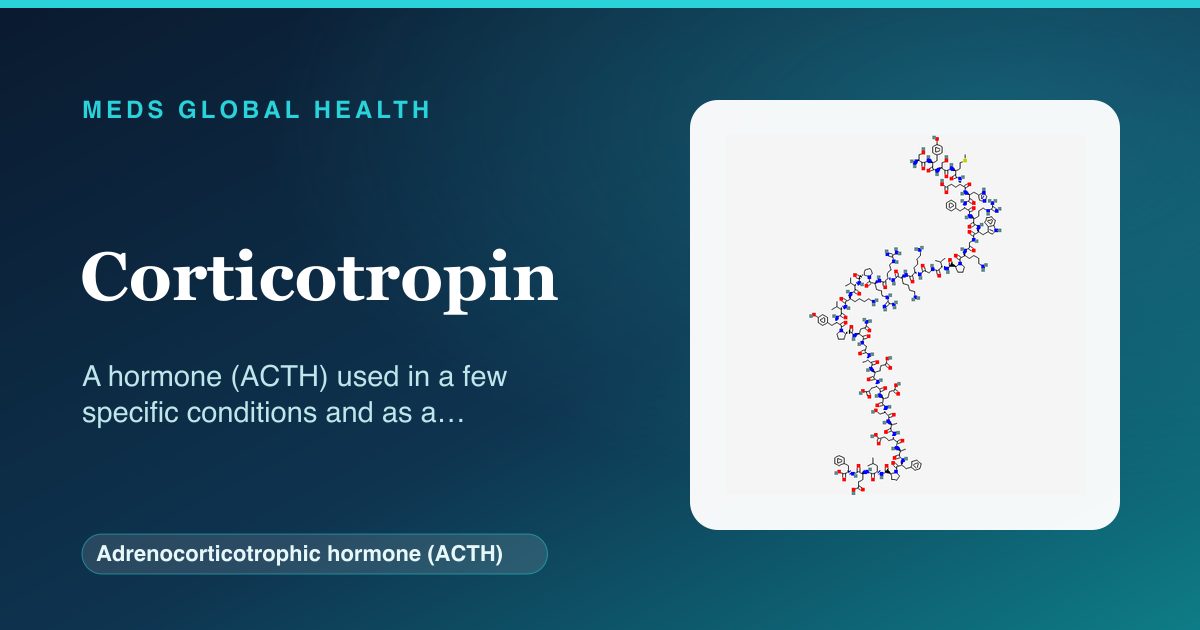
Corticotropin, usually known by its short name ACTH (adrenocorticotrophic hormone), is a hormone that the body normally makes in the brain's pituitary gland. Its job is to signal the adrenal glands to produce the body's own steroid hormones. As a medicine it is a specialist treatment used only in a few specific conditions, such as a type of seizure in babies called infantile spasms, and it is also used as a diagnostic agent to test how well the adrenal glands respond. It is given by injection under the care of a specialist team.
How it works
Corticotropin works by acting on the adrenal glands and prompting them to release the body's own natural steroid hormones, chiefly cortisol. So rather than supplying a steroid directly, it turns up the body's internal steroid production. This is why its medical effects, and its side effects, are very like those of taking a steroid medicine. When used as a test, the way the adrenal glands respond to a dose shows whether those glands are working properly, which helps doctors diagnose certain hormone problems.
Company & origin
A specialist hormone medicine used in the UK for a few specific conditions, such as infantile spasms, and as a diagnostic test of the adrenal glands.
Practical use
How to take Corticotropin
General, dose-free guidance — always follow your prescriber's and the leaflet's specific instructions.
- Use it only under specialist supervision, as it is given by injection by or arranged through a specialist team.
- Expect the team to watch for steroid-type effects such as raised blood sugar and signs of infection.
- Report any signs of infection promptly, as the medicine can lower your defences.
- Tell the team straight away about any signs of an allergic reaction, such as rash, swelling or difficulty breathing.
- Do not stop or change treatment on your own; follow the specialist plan exactly.
Weighing it up
Advantages & disadvantages of Corticotropin
Advantages
- A useful treatment in a few specific conditions, such as infantile spasms in babies.
- Also valuable as a test of how well the adrenal glands are working.
- Works by switching on the body's own steroid production rather than supplying a steroid directly.
Disadvantages
- Causes steroid-type effects such as raised blood sugar, infection risk and mood or fluid changes.
- Can cause serious allergic reactions.
- A specialist medicine given by injection, used only in particular situations.
Practical use
Good to know
The key idea is that corticotropin causes 'steroid effects' indirectly, by driving the body's own adrenal glands, so anyone using it should expect the kinds of effects seen with steroids: raised blood sugar, a greater chance of picking up infections, changes in mood or sleep, fluid retention and, with longer use, effects on bones. A serious safety point is that it can cause serious allergic reactions, which is one reason it is given under close supervision. It is a specialist medicine used for particular reasons rather than an everyday treatment, and it is given by injection. The specialist team will weigh up the benefits against these risks, watch closely for infection and other effects, and tailor how it is used.
Who should not take it / use with caution
- People who have had a serious allergic reaction to corticotropin should not use it.
- It is used with great care, or avoided, in people with active infections or certain other conditions, under specialist judgement.
- It should only be used under specialist supervision, with close monitoring.
Monitoring
- Watching for signs of infection, as the medicine lowers the body's defences.
- Checking blood sugar, blood pressure and fluid balance.
- Reviewing mood, behaviour and, in children, growth over time.
Side effects
- Raised blood sugar and a higher chance of picking up infections.
- Changes in mood, sleep or behaviour, and fluid retention with swelling.
- Raised blood pressure and, with longer use, effects on bones and growth in children.
- Serious allergic reactions, which need urgent medical attention.
Key interactions
- It can add to the effects of other steroid medicines, increasing steroid-type side effects.
- It may affect blood sugar, so diabetes treatment may need adjusting.
- Tell the specialist team about all medicines and vaccines, as some live vaccines may need to be avoided.
Available as: A medicine given by injection, under specialist care.
Answers
Corticotropin: frequently asked questions
What is corticotropin used for?
It is a hormone (ACTH) used in a few specific conditions, such as infantile spasms in babies, and as a test of how well the adrenal glands work.
How is it different from a steroid?
Rather than supplying a steroid directly, it tells the adrenal glands to make the body's own steroids, so its effects are very like those of a steroid medicine.
What side effects should I expect?
Steroid-type effects such as raised blood sugar, a higher infection risk, and changes in mood and fluid balance, plus a risk of serious allergic reactions.
Why is it given under specialist care?
It is used in particular conditions, is given by injection, and can cause significant effects, so a specialist team supervises and monitors treatment closely.
Is ACTH the same thing?
Yes. ACTH (adrenocorticotrophic hormone) is the common short name for corticotropin; they are the same hormone.
The wider class
About Adrenocorticotrophic hormone (ACTH)
Corticotropin belongs to the adrenocorticotrophic hormone (acth) class. For how the class as a whole works, its shared safety principles and monitoring, see the full guide.
Browse by body system
Authoritative sources
- BNF
- NICE CKS
Building a medicines information resource?
We create evidence-led, dose-free drug and formulary references for teams.