An oral corticosteroid (mainly US; UK uses prednisolone)
Prednisone
An oral steroid that damps down inflammation and the immune system — used mainly in the US, where the UK almost always uses prednisolone; never stopped abruptly after long-term use.
What is Prednisone?
Prednisone is an oral corticosteroid, or 'steroid', that reduces inflammation and calms an overactive immune system. It is used for a wide range of inflammatory and immune conditions, such as severe asthma flares, arthritis and autoimmune diseases. In the UK, prednisolone is the corticosteroid usually prescribed.
Education and reference only. This is a plain-language guide to Prednisone — it deliberately contains no doses. Doses depend on the person, the brand and the reason for treatment, and belong with your prescriber. Always check the BNF, the product labelling (SmPC) and follow medical advice.
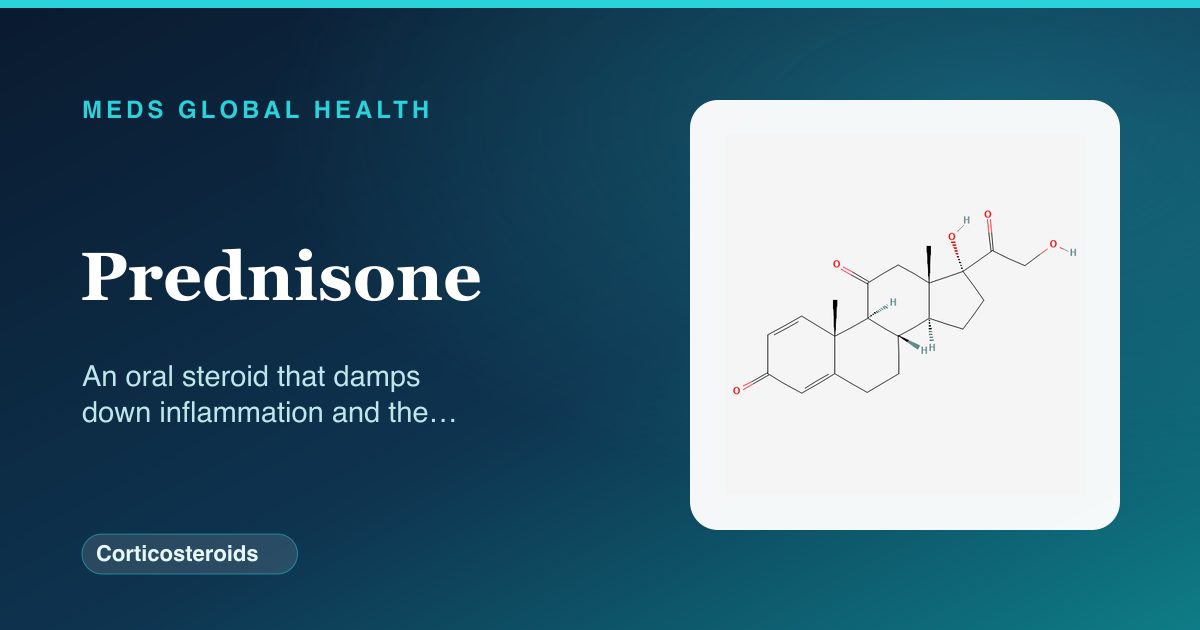
What it is
Prednisone is an oral corticosteroid ("steroid") that reduces inflammation and calms an overactive immune system. It is used for a wide range of inflammatory and immune conditions, including rheumatoid arthritis and flares of asthma or COPD. A key naming point for UK patients: prednisone is the form used mainly in the United States. In the UK and most of Europe the near-identical medicine prednisolone is used instead — the body actually converts prednisone into prednisolone (its active form) in the liver, so they are essentially equivalent, but UK prescriptions and packs will almost always say "prednisolone".
How it works
Corticosteroids mimic cortisol, a hormone the body makes naturally that controls inflammation and the immune response. Prednisone (once converted to prednisolone) switches off many of the genes and chemical messengers that drive inflammation, reducing swelling, redness, pain and the activity of immune cells. This makes it powerful for calming flares of inflammatory disease — but because it suppresses the immune system and influences many body systems, longer use brings a broad range of effects, and the body's own cortisol production winds down while taking it.
Company & origin
Originated / developed by: Schering Corporation (and Upjohn).
Prednisone, a synthetic corticosteroid, was developed in the mid-1950s; Schering Corporation and Upjohn introduced it around 1955 (brand names such as Meticorten/Deltasone) and it has long been generic.
What it treats
Conditions Prednisone is used for
Practical use
How to take Prednisone
General, dose-free guidance — always follow your prescriber's and the leaflet's specific instructions.
- Usually taken in the morning with food, which suits the body's natural rhythm and reduces stomach upset.
- Take it exactly as prescribed and follow any instructions for gradually reducing the dose.
- Never stop suddenly after taking it for more than a short course, as the body needs time to readjust.
- Carry a steroid card and tell any health professional you are taking steroids, especially if you become unwell.
- Be alert to signs of infection, mood changes and raised blood sugar, and report them.
- Avoid contact with chickenpox or measles if you have not had them, and seek advice if exposed.
Weighing it up
Advantages & disadvantages of Prednisone
Advantages
- Powerful and fast-acting at controlling inflammation and immune flare-ups.
- Treats many different conditions and can be life-saving in severe illness.
- Taken by mouth and inexpensive.
Disadvantages
- Long-term use can cause weight gain, raised blood sugar, thinning bones, high blood pressure and increased infection risk.
- Can affect mood and sleep.
- Must never be stopped abruptly after prolonged use because of the risk of a serious withdrawal reaction.
- Requires monitoring and a steroid card during longer courses.
Practical use
Good to know
Short courses are usually straightforward, but anyone on steroids for more than a few weeks must never stop them abruptly — the body's own cortisol production is suppressed, and a sudden stop can trigger a dangerous "adrenal crisis", so the dose is tapered down gradually. People on longer-term steroids are given a Steroid Emergency Card and taught "sick-day rules": if you become very unwell, develop an infection, or need surgery, you may need extra steroid to cope with the stress. It is usually taken in the morning to match the body's natural rhythm, and with food to protect the stomach.
Who should not take it / use with caution
- It is not so much "who must never take it" as "who needs extra care" — a serious untreated infection (especially viral infections such as chickenpox or shingles in someone non-immune) is a key caution.
- Used with particular care in people with diabetes (it raises blood sugar), high blood pressure, heart failure, stomach ulcers, osteoporosis, glaucoma, or certain mental-health conditions.
- Long-term use needs caution in children (growth), in older people, and the dose and duration are always kept as low and short as the condition allows; it is never stopped suddenly after prolonged use.
Monitoring
- Blood pressure, blood sugar and weight
- Bone health on longer-term use
- Signs of infection, mood changes, and a clear plan for tapering and for sick-day rules
Side effects
- Short term: increased appetite, weight gain, mood or sleep changes, raised blood sugar, indigestion, and a higher chance of infection.
- Longer term: thinning of the bones (osteoporosis), thinning skin that bruises easily, muscle weakness, cataracts or glaucoma, and a rounder face and changed body shape.
- Suppression of the body's own cortisol, so that stopping suddenly — or coping with serious illness or surgery — can cause a dangerous adrenal crisis; report severe illness, collapse, or being unable to keep medicine down.
Key interactions
- NSAID painkillers and aspirin add to the risk of stomach irritation and ulcers.
- It can raise blood sugar, so people with diabetes may need their treatment adjusted; it can also lower blood potassium, which matters alongside certain heart medicines.
- Some medicines change its levels (such as certain epilepsy medicines, rifampicin, and some antifungals), and live vaccines are generally avoided while the immune system is suppressed.
Available as: Tablets (in the US). In the UK the equivalent medicine, prednisolone, comes as ordinary tablets, soluble tablets, gastro-resistant tablets and a liquid.
Answers
Prednisone: frequently asked questions
Why does my UK prescription say prednisolone, not prednisone?
Because prednisolone is the form used routinely in the UK, while prednisone is used mainly in the US. They are almost the same medicine — the body converts prednisone into prednisolone (the active form) in the liver — so for practical purposes they are equivalent. If you have moved from a country that uses prednisone, your UK team will simply prescribe the matching prednisolone.
Can I just stop taking it when I feel better?
Not if you have taken it for more than a short course. Steroids suppress your body's own cortisol production, and stopping suddenly can cause a dangerous adrenal crisis. The dose must be tapered down gradually under guidance. Always follow the reduction plan and never stop long-term steroids on your own.
What is a Steroid Emergency Card and sick-day rules?
If you take steroids long term, you should carry a Steroid Emergency Card so that anyone treating you knows your body may not make enough cortisol in a crisis. "Sick-day rules" mean that if you become seriously ill, get an infection, or need surgery, you may need extra steroid to cope with the stress — your team will explain when and how.
What are the main risks of taking it for a long time?
Longer-term steroids can thin the bones (osteoporosis) and skin, raise blood sugar and blood pressure, increase infection risk, cause weight gain and mood changes, and bring on cataracts or glaucoma. This is why the lowest effective dose for the shortest time is used, with monitoring and sometimes bone-protecting treatment alongside.
Is generic prednisone or prednisolone as good as a brand?
Yes. Whether it is generic or branded, the active ingredient is the same and works in the same way. In the UK most steroid tablets are prescribed generically as prednisolone; in the US as prednisone. The important thing is taking the right form and following the dosing and tapering plan.
The wider class
About Corticosteroids
Prednisone belongs to the corticosteroids class. For how the class as a whole works, its shared safety principles and monitoring, see the full guide.
Browse by body system
Authoritative sources
- BNF: Prednisolone.
- electronic Medicines Compendium (SmPC): Prednisolone.
- NICE CKS: Steroid tablets (prednisolone).
Building a medicines information resource?
We create evidence-led, dose-free drug and formulary references for teams.