An oral corticosteroid (steroid) tablet
Deflazacort
An oral steroid used to calm inflammation and overactive immune responses in a range of conditions.
What is Deflazacort?
Deflazacort is an oral corticosteroid, a type of steroid that calms inflammation and dampens an overactive immune system. It is used for inflammatory and immune-related conditions and, in some countries, as a long-term treatment to help maintain muscle strength in Duchenne muscular dystrophy. Like all steroids it can raise blood sugar, increase the risk of infection, and affect bones, growth in children and the body's own steroid system. It should be taken as prescribed and must never be stopped suddenly after more than a short course, because the body needs time to start making its own steroids again.
Education and reference only. This is a plain-language guide to Deflazacort — it deliberately contains no doses. Doses depend on the person, the brand and the reason for treatment, and belong with your prescriber. Always check the BNF, the product labelling (SmPC) and follow medical advice.
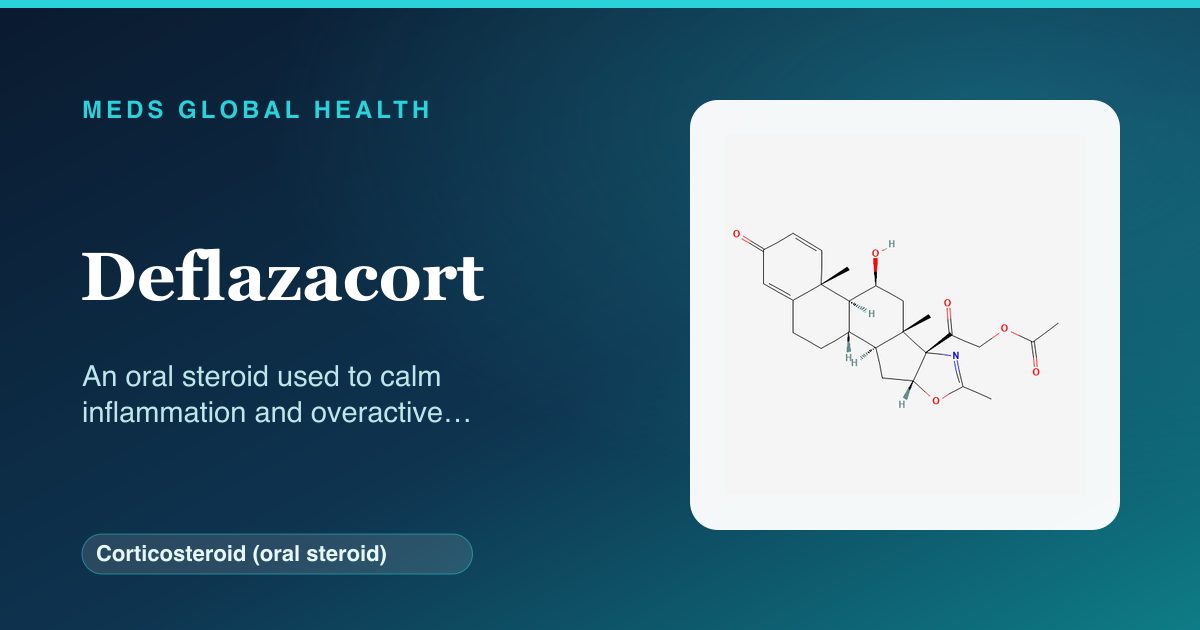
What it is
Deflazacort is a corticosteroid, a man-made version of a hormone the body makes naturally. Steroids like this are powerful at reducing inflammation and quietening an overactive immune system, so deflazacort is used for a variety of inflammatory and immune-related conditions. In some countries it is used as a regular, long-term treatment in Duchenne muscular dystrophy, an inherited condition that weakens the muscles, where steroids help slow the loss of muscle strength. It is taken by mouth as tablets, under the supervision of a doctor who decides the dose and how long it is needed.
How it works
Deflazacort works by switching down the body's inflammatory and immune responses. Inflammation is useful in short bursts but can cause harm when it is excessive or long-lasting, and an overactive immune system can attack the body's own tissues. By calming these processes, deflazacort eases swelling, pain and damage in inflammatory conditions and helps control immune-driven disease. In Duchenne muscular dystrophy, this anti-inflammatory action is thought to help preserve muscle function for longer. Because it acts like the body's own steroid hormone, taking it for more than a short time tells the body to make less of its own, which is why the dose is reduced gradually rather than stopped suddenly.
Company & origin
A corticosteroid used to dampen down inflammation and overactive immune responses, and used in some countries as a long-term treatment in Duchenne muscular dystrophy.
Practical use
How to take Deflazacort
General, dose-free guidance — always follow your prescriber's and the leaflet's specific instructions.
- Take it exactly as prescribed, usually by mouth in the morning, often with or after food to protect your stomach.
- Do not stop it suddenly after more than a short course; the dose must be reduced gradually under medical advice.
- Carry a steroid card or alert and show it to any doctor, nurse, dentist or pharmacist treating you.
- Tell your team promptly if you become unwell, have an infection, an injury or need surgery, as your dose may need adjusting.
- Avoid close contact with chickenpox, shingles or measles if you have not had them, and seek advice if you are exposed.
Weighing it up
Advantages & disadvantages of Deflazacort
Advantages
- A powerful and reliable way to reduce inflammation and calm an overactive immune system.
- Taken by mouth as tablets, making it convenient for many conditions.
- Can help maintain muscle strength over time when used in Duchenne muscular dystrophy.
Disadvantages
- Longer use can raise blood sugar and blood pressure, thin the bones and slow growth in children.
- Increases the risk of infections and can hide their early signs.
- Must never be stopped suddenly after more than a short course, as this can be dangerous.
Practical use
Good to know
The single most important thing to understand about deflazacort is that, after more than a short course, it must not be stopped suddenly. The body slows its own steroid production while you take it, and stopping abruptly can leave you dangerously short of steroid, so the dose is lowered step by step under medical advice. Carry a steroid card or alert, and tell any healthcare professional you are taking it, especially if you become unwell, have an injury, or need surgery, as you may need a higher dose at those times. Steroids can raise blood sugar, push up blood pressure, increase the risk and severity of infections (and can mask their signs), thin the bones over time, and in children can slow growth. They can also affect mood and sleep and increase appetite. Taking it in the morning, often with food, can help, and your team will monitor you during longer treatment.
Who should not take it / use with caution
- People who have had a serious allergic reaction to deflazacort should not take it.
- People with an untreated active infection generally should not start it until the infection is being treated, as it can make infections worse.
- It is used with caution in people with diabetes, high blood pressure, osteoporosis, stomach ulcers or mental-health problems, under medical guidance.
- Live vaccines are usually avoided while taking it, so check with your team before any vaccination.
Monitoring
- Checking blood pressure, blood sugar and weight during longer treatment.
- Monitoring growth in children and bone health with long-term use.
- Reviewing the dose regularly so the lowest effective amount is used, and planning a gradual reduction when stopping.
Side effects
- Raised blood sugar, increased appetite and weight gain, especially with longer use.
- A higher risk of infections, which may also be harder to spot.
- Mood or sleep changes, indigestion, and over time thinning of the bones and skin.
- In children, longer use can slow growth, so growth is monitored.
Key interactions
- Some medicines, including certain antifungals and antibiotics, can raise steroid levels and increase side effects.
- It can affect blood sugar control, so people with diabetes may need their treatment adjusted.
- Taking it with anti-inflammatory painkillers (NSAIDs) increases the risk of stomach irritation and bleeding.
Available as: Tablets taken by mouth.
Answers
Deflazacort: frequently asked questions
What is deflazacort used for?
It is an oral corticosteroid used to calm inflammation and overactive immune responses in a range of conditions, and in some countries as a long-term treatment in Duchenne muscular dystrophy.
Why can't I stop it suddenly?
After more than a short course your body makes less of its own steroid, so stopping abruptly can leave you dangerously short; the dose must be lowered gradually under medical advice.
Will it affect my blood sugar?
Steroids can raise blood sugar, so if you have diabetes your treatment may need adjusting, and your team may check your levels during longer use.
Does it make infections more likely?
Yes, it can increase the risk of infections and can mask their early signs, so tell your team promptly if you feel unwell or are exposed to chickenpox, shingles or measles.
Should I carry a steroid card?
Yes, carry a steroid card or alert and show it to any healthcare professional, as you may need a higher dose if you are unwell, injured or having surgery.
The wider class
About Corticosteroid (oral steroid)
Deflazacort belongs to the corticosteroid (oral steroid) class. For how the class as a whole works, its shared safety principles and monitoring, see the full guide.
Browse by body system
Authoritative sources
- BNF
- NICE CKS
Building a medicines information resource?
We create evidence-led, dose-free drug and formulary references for teams.