A 'Z-drug' sleeping tablet
Eszopiclone
A 'Z-drug' sleeping tablet used for short-term help with insomnia.
What is Eszopiclone?
Eszopiclone is a 'Z-drug', a type of sleeping tablet used to help with insomnia (difficulty sleeping). It works by calming the brain to help people fall asleep and stay asleep. It is meant for short-term use because, with longer use, the body can become used to it and dependence can develop. Common problems include next-day drowsiness, which can affect driving and concentration, and an unpleasant taste in the mouth. Less commonly, people may carry out complex activities such as walking, eating or even driving while not fully awake and with no memory of it.
Education and reference only. This is a plain-language guide to Eszopiclone — it deliberately contains no doses. Doses depend on the person, the brand and the reason for treatment, and belong with your prescriber. Always check the BNF, the product labelling (SmPC) and follow medical advice.
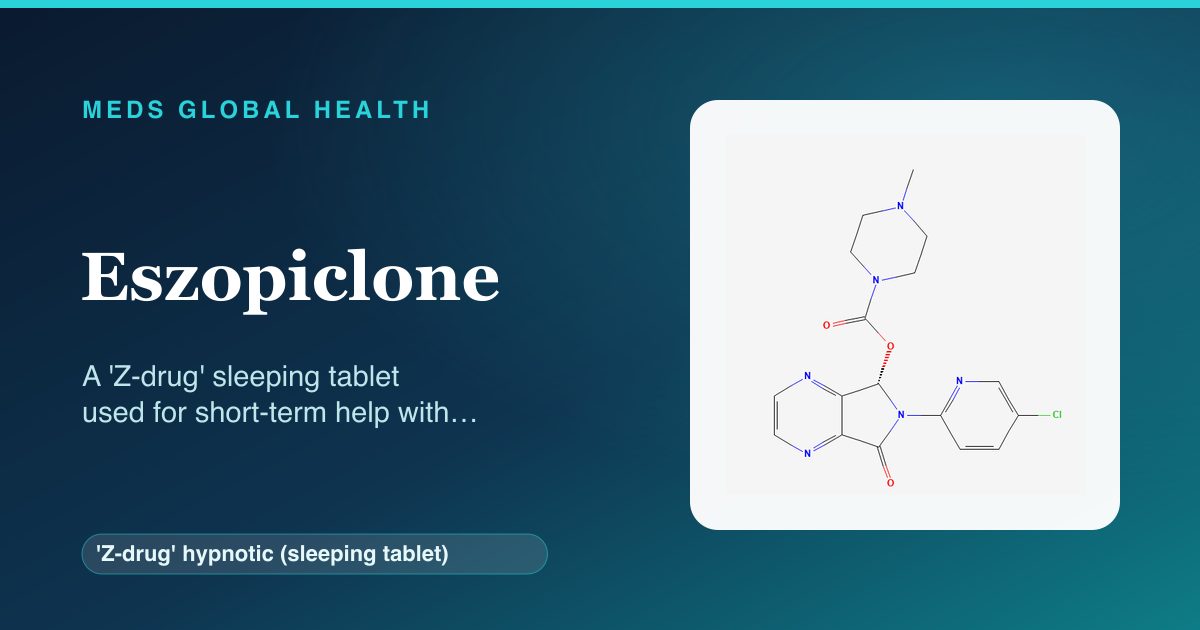
What it is
Eszopiclone is a sleeping tablet from the group known as 'Z-drugs', which work in a similar way to benzodiazepines but are a distinct group. It is used to help people with insomnia, meaning trouble falling asleep or staying asleep, usually for a short period and alongside good sleep habits rather than as a long-term solution. It is taken by mouth at bedtime. Because sleeping tablets can lead to dependence and to next-day effects, eszopiclone is intended for short courses, with the underlying causes of poor sleep also being addressed.
How it works
Eszopiclone increases the effect of a natural calming signal in the brain called GABA, which dampens down brain activity. This makes it easier to fall asleep and can help people stay asleep. Because it acts on the brain to promote sleep, its effects can sometimes linger into the next day, causing drowsiness, and they can also affect alertness and coordination. With repeated use, the brain can adjust to the medicine, which is why it can become less effective over time and why dependence can develop, making short-term use the safest approach.
Company & origin
A 'Z-drug' sleeping tablet related to other Z-drugs, used for short-term help with insomnia.
What it treats
Conditions Eszopiclone is used for
Practical use
How to take Eszopiclone
General, dose-free guidance — always follow your prescriber's and the leaflet's specific instructions.
- Take it at bedtime, only when you are able to get a full night's sleep, exactly as prescribed.
- Use it for as short a time as possible, as it is meant for short-term help with sleep.
- Be cautious about driving or operating machinery the next day, as drowsiness can linger.
- Avoid alcohol and other sedating medicines, which add to its effects.
- Tell your prescriber if you do anything while not fully awake, or before stopping after longer use, so it can be tapered.
Weighing it up
Advantages & disadvantages of Eszopiclone
Advantages
- Can help with short-term insomnia by making it easier to fall asleep and stay asleep.
- Taken as a simple tablet at bedtime.
- Intended for short courses while sleep problems are addressed.
Disadvantages
- Can cause next-day drowsiness that impairs driving and concentration.
- Can lead to dependence and become less effective with longer use.
- Can cause an unpleasant taste and, less commonly, complex sleep behaviours.
Practical use
Good to know
The main things to know about eszopiclone all point towards using it for as short a time as possible. Next-day drowsiness is common and can impair driving, operating machinery and concentration, so caution is needed the following day, especially when first starting. With longer use, the body can become used to it, the medicine can work less well, and dependence can develop, with difficulty sleeping when it is stopped, so it is best used for short courses and stopped carefully if it has been taken for a while. A distinctive side effect is an unpleasant, bitter or metallic taste in the mouth. A less common but important effect is carrying out complex activities, such as walking, eating, making calls or even driving, while not fully awake and with no memory afterwards; if this happens, the medicine should be stopped and the prescriber told. Alcohol and other sedating medicines add to its effects and should be avoided.
Who should not take it / use with caution
- People who have had a serious allergic reaction to it should not take it.
- It is used with caution, or avoided, in people with a history of dependence on alcohol or medicines.
- It is used with caution in people with breathing problems, severe liver problems or sleep apnoea.
- It is generally avoided in pregnancy and breastfeeding unless advised by a doctor.
Monitoring
- Reviewing whether it is still needed, to keep use as short as possible.
- Watching for next-day drowsiness and any signs of dependence.
- Checking for complex sleep behaviours and stopping the medicine if they occur.
Side effects
- Next-day drowsiness, which can affect driving and concentration.
- An unpleasant, bitter or metallic taste in the mouth.
- Dizziness, headache or a dry mouth.
- Less commonly, complex sleep behaviours such as walking, eating or driving while not fully awake.
Key interactions
- Alcohol adds to its sedating effect and should be avoided.
- Other sedating medicines, such as strong painkillers or some antihistamines, increase drowsiness.
- Some medicines can change its level in the body, so tell your prescriber everything you take.
Available as: Tablets taken by mouth at bedtime.
Answers
Eszopiclone: frequently asked questions
What is eszopiclone used for?
It is a 'Z-drug' sleeping tablet used for short-term help with insomnia, calming the brain to make it easier to fall asleep and stay asleep.
Why should I only use it short-term?
With longer use the body can become used to it, it can work less well, and dependence can develop, so short courses are the safest approach.
Can it affect my driving the next day?
Yes. Next-day drowsiness is common and can affect driving and concentration, so be cautious the following day, especially when first starting.
Why does it leave a strange taste?
An unpleasant, bitter or metallic taste in the mouth is a recognised side effect of eszopiclone and is usually harmless.
What are complex sleep behaviours?
Some people walk, eat, make calls or even drive while not fully awake and with no memory of it; if this happens, stop the medicine and tell your prescriber.
The wider class
About 'Z-drug' hypnotic (sleeping tablet)
Eszopiclone belongs to the 'z-drug' hypnotic (sleeping tablet) class. For how the class as a whole works, its shared safety principles and monitoring, see the full guide.
Browse by body system
Authoritative sources
- BNF
- NICE CKS
Building a medicines information resource?
We create evidence-led, dose-free drug and formulary references for teams.