An alpha-agonist glaucoma eye drop
Apraclonidine
An alpha-agonist eye drop used mainly short-term to control eye pressure, often around laser eye procedures.
What is Apraclonidine?
Apraclonidine is an alpha-agonist eye drop that lowers the pressure inside the eye. It is used mainly for short periods, particularly to control the rise in eye pressure that can follow laser eye procedures, rather than as a long-term glaucoma treatment. It can cause dry mouth, drowsiness and eye redness, and is not suitable for long-term use in young children.
Education and reference only. This is a plain-language guide to Apraclonidine — it deliberately contains no doses. Doses depend on the person, the brand and the reason for treatment, and belong with your prescriber. Always check the BNF, the product labelling (SmPC) and follow medical advice.
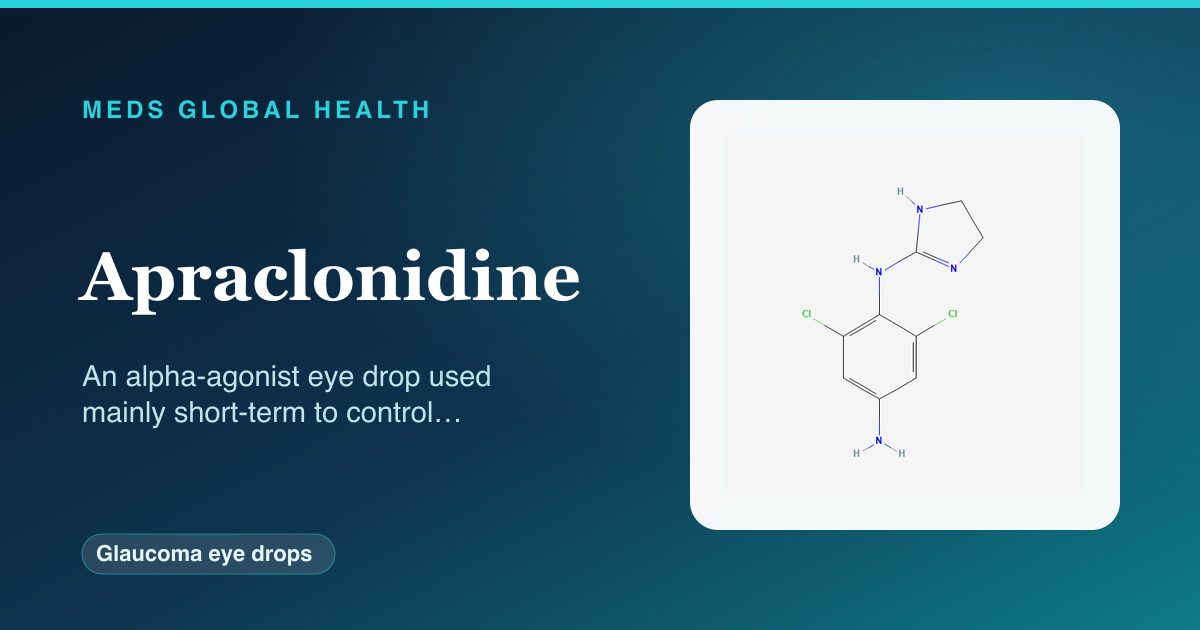
What it is
Apraclonidine is an eye drop from the alpha-agonist group used to lower the pressure inside the eye. It is most often used for short-term control — for example, to prevent or treat a rise in eye pressure around laser eye treatments — rather than as an everyday, long-term glaucoma medicine, partly because its effect can fade with continued use.
How it works
Apraclonidine stimulates alpha receptors in the eye, which reduces the amount of fluid (aqueous humour) the eye makes and helps it drain more easily. Both effects lower the pressure inside the eye, protecting the optic nerve from pressure-related damage.
What it treats
Conditions Apraclonidine is used for
Practical use
How to take Apraclonidine
General, dose-free guidance — always follow your prescriber's and the leaflet's specific instructions.
- Wash your hands, tilt your head back and apply the drop into the pocket of the lower lid without touching the eye with the dropper.
- Afterwards, gently press the inner corner of the eye and keep the eye closed for a short while to limit absorption into the body.
- Leave a short gap if you use more than one type of eye drop.
- It can cause drowsiness, so take care driving or using machinery until you know how it affects you.
- Remove soft contact lenses before the drop and wait a short while before replacing them.
- Use it only for as long as your eye specialist advises, as it is generally a short-term treatment.
Weighing it up
Advantages & disadvantages of Apraclonidine
Advantages
- Useful for controlling short-term rises in eye pressure, such as around laser eye procedures.
- Lowers eye pressure both by reducing fluid production and improving drainage.
- Acts mainly in the eye, with good technique limiting whole-body effects.
Disadvantages
- Its pressure-lowering effect tends to fade with prolonged use, so it is not ideal long-term.
- Can cause dry mouth, drowsiness and eye redness, and local allergic reactions are fairly common with longer use.
- Not suitable for long-term use in young children, who are more sensitive to its effects.
Practical use
Good to know
It is usually used for short periods, especially around laser procedures, because its pressure-lowering effect tends to lessen if used long-term. After putting in the drop, gently press the inner corner of the eye and keep it closed for a short while to reduce absorption into the body. It can cause a dry mouth, drowsiness and eye redness, and some people develop a local allergic reaction with longer use. It is not used long-term in young children, who are more sensitive to its effects.
Who should not take it / use with caution
- Not used long-term in young children, who are more sensitive to its drowsiness and other effects.
- Avoided in people allergic to it or to clonidine-type medicines, and used cautiously in severe heart or blood-vessel disease.
- Used with caution in significant heart, kidney or liver disease, and in pregnancy or breastfeeding only on advice.
- Not used by people taking monoamine-oxidase inhibitor (MAOI) antidepressants, or alongside tricyclic antidepressants.
Monitoring
- Eye pressure, particularly around the procedure it is being used for.
- Any local allergic reaction (redness, itching, swelling) with continued use.
- Drowsiness, dry mouth or heart-rate effects.
Side effects
- Eye redness, itching, discomfort or dryness; a local allergic reaction can develop with longer use.
- Dry mouth, an altered taste, and drowsiness or tiredness.
- Less commonly, headache, a slow heartbeat or a feeling of dizziness.
Key interactions
- Adds to drowsiness with alcohol and other sedating medicines.
- Must not be combined with MAOI antidepressants; also avoided with tricyclic antidepressants.
- Leave a short gap when using other eye drops so they are not washed out.
Available as: Eye drops.
Answers
Apraclonidine: frequently asked questions
Is apraclonidine a long-term glaucoma treatment?
Usually not — it is mainly used for short periods, especially to control eye pressure around laser procedures, because its pressure-lowering effect tends to fade with prolonged use.
Can it make me drowsy?
Yes, some people feel drowsy or tired because a little is absorbed into the body. Take care driving or using machinery until you know how it affects you, and avoid alcohol.
Why does my mouth feel dry with it?
Dry mouth is a recognised effect of this type of drop, because some of the medicine is absorbed into the body. It usually eases when the treatment is stopped.
Can children use it?
It is not used long-term in young children, who are more sensitive to its effects. Any use in children should be under close specialist supervision.
Why press on the corner of my eye after the drop?
Pressing gently on the inner corner and keeping the eye closed for a short while reduces how much of the medicine drains into the body, lessening side effects such as dry mouth and drowsiness.
The wider class
About Glaucoma eye drops
Apraclonidine belongs to the glaucoma eye drops class. For how the class as a whole works, its shared safety principles and monitoring, see the full guide.
Browse by body system
Authoritative sources
- BNF
- NICE CKS
Building a medicines information resource?
We create evidence-led, dose-free drug and formulary references for teams.