A glaucoma eye drop (prostaglandin analogue)
Tafluprost
A once-daily eye drop that lowers pressure inside the eye in glaucoma, available preservative-free.
What is Tafluprost?
Tafluprost is a prostaglandin-analogue eye drop used to lower raised pressure inside the eye in glaucoma and ocular hypertension, helping protect the optic nerve and your sight. It is usually used as one drop in the affected eye(s) once a day, in the evening. It can darken and lengthen the eyelashes, gradually darken the coloured part of the eye (iris), and cause eye redness. It is available preservative-free, which can suit sensitive eyes.
Education and reference only. This is a plain-language guide to Tafluprost — it deliberately contains no doses. Doses depend on the person, the brand and the reason for treatment, and belong with your prescriber. Always check the BNF, the product labelling (SmPC) and follow medical advice.
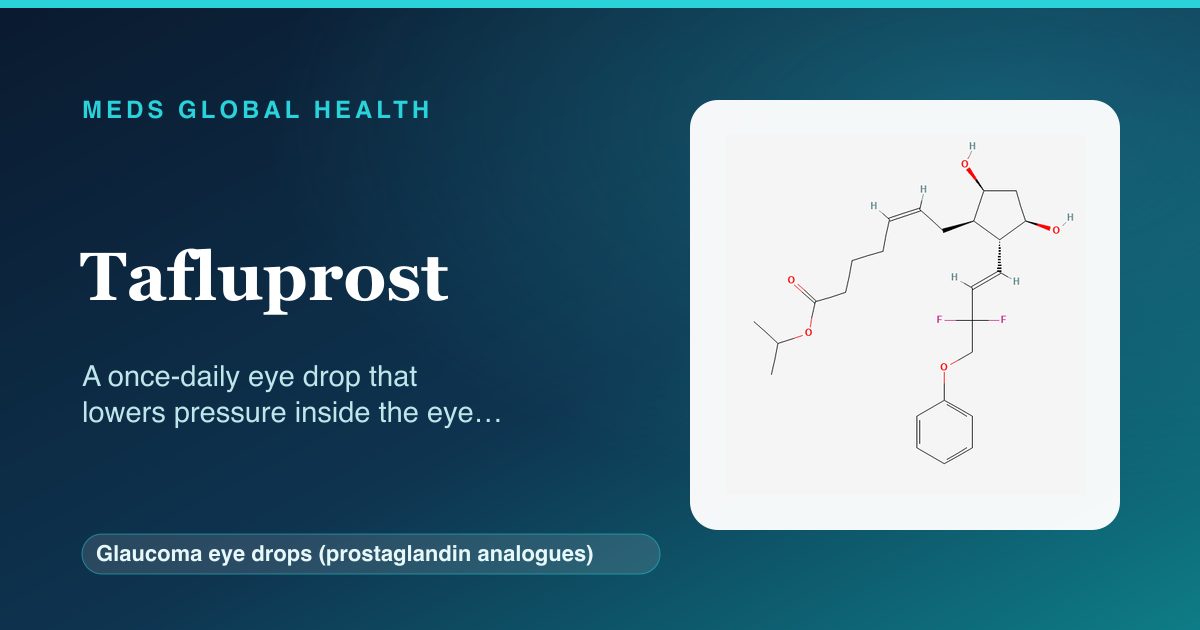
What it is
Tafluprost is an eye drop of a type called a prostaglandin analogue, used to treat glaucoma and ocular hypertension, where the pressure inside the eye is too high. Lowering this pressure helps protect the optic nerve and preserve sight. Prostaglandin analogues are often a first-choice treatment because they are effective and usually used only once a day. Tafluprost is available in a preservative-free form, which can be helpful for sensitive eyes or those using several drops.
How it works
Tafluprost increases the natural outflow of fluid from inside the eye, mainly through a route called the uveoscleral pathway. By helping fluid drain away more easily, it lowers the pressure inside the eye. Reducing this pressure slows damage to the optic nerve, which is what threatens vision in glaucoma.
Company & origin
Originated / developed by: Santen (originator).
A prostaglandin-analogue eye drop used in the UK to lower eye pressure in glaucoma and ocular hypertension.
What it treats
Conditions Tafluprost is used for
Practical use
How to take Tafluprost
General, dose-free guidance — always follow your prescriber's and the leaflet's specific instructions.
- Use one drop in the affected eye(s) once a day, usually in the evening, unless told otherwise.
- After instilling the drop, gently close the eye and press on the inner corner for a short time to reduce the amount absorbed into the body.
- If you use other eye drops, leave several minutes between them so each has time to work.
- Remove soft contact lenses before using preserved drops and wait a while before putting them back; preservative-free forms may differ, so check advice.
- If you miss a dose, skip it and use the next one at the usual time; do not use extra drops to catch up.
Weighing it up
Advantages & disadvantages of Tafluprost
Advantages
- Effective at lowering eye pressure with usually just one drop a day.
- Often a first-choice glaucoma treatment because it is convenient and well tolerated.
- Available preservative-free, which can suit sensitive eyes or people using several drops.
Disadvantages
- Can darken and lengthen the eyelashes and permanently darken the iris.
- Commonly causes eye redness and irritation, especially at first.
- Cosmetic changes around the eye may be uneven if only one eye is treated.
Practical use
Good to know
Prostaglandin-analogue drops like tafluprost can cause cosmetic changes: the eyelashes may grow longer, thicker and darker, the skin around the eye may darken, and the coloured part of the eye (iris) can gradually and permanently darken, which is more noticeable if your eyes are a mixed colour. Eye redness, irritation and a feeling of something in the eye are common, especially at first. To get the most benefit and reduce side effects, gently press on the inner corner of the eye for a short time after instilling the drop, and if you use more than one type of eye drop, leave a gap between them. It is usually used in the evening.
Who should not take it / use with caution
- Anyone who has had an allergic reaction to tafluprost or the drop's ingredients should avoid it.
- Use in pregnancy and breastfeeding should be discussed with your eye specialist.
- People with certain types of eye inflammation should use it with caution under specialist advice.
Monitoring
- Regular checks of eye pressure to confirm it is well controlled.
- Eye examinations to monitor the optic nerve and field of vision over time.
- Watching for eye irritation and the cosmetic changes to lashes and iris.
Side effects
- Eye redness, irritation, itching and a feeling of something in the eye.
- Longer, thicker, darker eyelashes and possible permanent darkening of the iris.
- Darkening of the skin around the eye and, occasionally, blurred vision after instilling.
Key interactions
- Few important whole-body interactions, as little is absorbed into the bloodstream.
- Other eye drops should be separated in time so they are not washed out.
- Tell your specialist about all eye treatments you use, including lubricants.
Available as: Eye drops, available in a preservative-free form.
Answers
Tafluprost: frequently asked questions
Will it change how my eyes look?
It can make the eyelashes longer, thicker and darker, darken the skin around the eye, and gradually and permanently darken the coloured part of the eye (iris).
When should I use it?
It is usually used once a day in the evening; using it at the same time daily helps keep eye pressure steady.
Why press on the corner of my eye?
Gently pressing on the inner corner after instilling the drop reduces how much is absorbed into the body and can lessen side effects.
Can I use it with other eye drops?
Yes, but leave several minutes between different drops so one does not wash the other out before it has worked.
Is it available without preservative?
Yes, tafluprost is available preservative-free, which can suit sensitive eyes or people using several different eye drops.
The wider class
About Glaucoma eye drops (prostaglandin analogues)
Tafluprost belongs to the glaucoma eye drops (prostaglandin analogues) class. For how the class as a whole works, its shared safety principles and monitoring, see the full guide.
Browse by body system
Authoritative sources
- BNF
- NICE CKS
Building a medicines information resource?
We create evidence-led, dose-free drug and formulary references for teams.