A glaucoma eye drop (and dry-mouth medicine)
Pilocarpine
An eye drop used to lower pressure in the eye in glaucoma, with tablets also used to treat a dry mouth.
What is Pilocarpine?
Pilocarpine is a medicine used as eye drops to lower the pressure inside the eye in glaucoma, and also as tablets to treat a dry mouth. The eye drops make the pupil smaller and help fluid drain out of the eye. They can cause blurred or dim vision, especially at night, and a brow ache.
Education and reference only. This is a plain-language guide to Pilocarpine — it deliberately contains no doses. Doses depend on the person, the brand and the reason for treatment, and belong with your prescriber. Always check the BNF, the product labelling (SmPC) and follow medical advice.
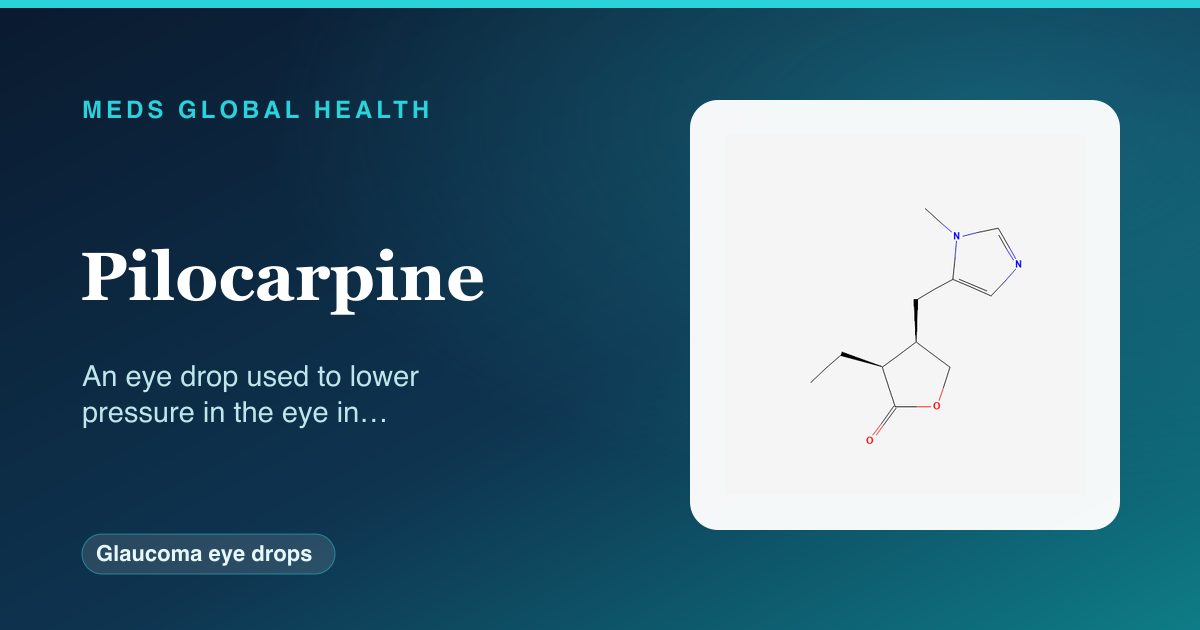
What it is
Pilocarpine is one of the older treatments for glaucoma, given as eye drops to reduce the raised pressure inside the eye that can damage the optic nerve. It is also given as tablets to relieve a persistently dry mouth, for example after radiotherapy or in certain medical conditions. The eye drops make the pupil small (miosis) and are used several times a day. While newer eye drops are often preferred for glaucoma, pilocarpine still has a role.
How it works
Pilocarpine stimulates the muscarinic receptors that the body's 'rest and digest' nerves use. In the eye, this makes the tiny muscles contract, the pupil become smaller and the drainage angle open up, so fluid drains away more easily and the pressure falls. In the salivary glands, the same kind of stimulation increases saliva production, which is how the tablets relieve a dry mouth.
What it treats
Conditions Pilocarpine is used for
Practical use
How to take Pilocarpine
General, dose-free guidance — always follow your prescriber's and the leaflet's specific instructions.
- For the eye drops, wash your hands and tilt your head back, pulling down the lower lid to make a small pocket.
- Put the prescribed number of drops into the eye, then close it gently for a short while.
- Press lightly on the inner corner of the eye afterwards to reduce absorption into the body.
- Use the drops regularly throughout the day as prescribed — glaucoma treatment works only if used consistently.
- If you use more than one type of eye drop, leave a short gap between them.
- If you take the tablets for a dry mouth, take them as directed, usually with or after food.
Weighing it up
Advantages & disadvantages of Pilocarpine
Advantages
- An effective, long-established way of lowering eye pressure in glaucoma.
- Acts directly in the eye, so whole-body side effects from the drops are limited.
- The tablet form offers a useful treatment for a troublesome dry mouth.
- Inexpensive and widely available.
Disadvantages
- Makes vision dim and blurred, particularly at night, because the pupil becomes small.
- Often needs to be used several times a day, which is less convenient than newer drops.
- Can cause a brow ache or headache, especially at first.
- Newer glaucoma drops are usually preferred, so it tends to be used as an add-on or alternative.
Practical use
Good to know
The eye drops make the pupil small, which can make vision seem dim and blurred — this is most noticeable at night and when driving, so take care. Some people get a brow ache or headache when they start. After putting the drops in, gently pressing the inner corner of the eye for a short time and keeping the eye closed reduces how much is absorbed into the rest of the body.
Who should not take it / use with caution
- People with certain types of eye inflammation, such as acute iritis, where making the pupil small is undesirable.
- Used with caution in some forms of glaucoma and in people with retinal problems.
- For the tablets, caution in asthma, heart disease and significant bowel or urinary problems.
- Caution in pregnancy and breastfeeding — discussed with the prescriber.
Monitoring
- Regular checks of eye pressure and the optic nerve by the eye team.
- Vision is reviewed, including any difficulty with night vision.
- For the tablets, heart rate and breathing may be considered in people with relevant conditions.
Side effects
- Blurred or dim vision, most noticeable at night.
- Brow ache or headache, especially when starting.
- Eye irritation, watering and redness.
- With the tablets, sweating, increased saliva, a runny nose and needing to pass urine more often.
- Rarely, a slow heartbeat or breathing problems with the tablets.
Key interactions
- Other eye drops should be spaced apart to avoid washing each other out.
- Medicines with anticholinergic effects can oppose the action of pilocarpine.
- With the tablets, medicines that slow the heart can add to that effect.
- Beta-blockers, including beta-blocker eye drops, may interact with the tablet form.
Available as: Eye drops and tablets.
Answers
Pilocarpine: frequently asked questions
Why does my vision go dim with pilocarpine?
The drops make the pupil small, which lets in less light and can make vision seem dim and blurred, especially at night. Take extra care when driving in the dark.
What is the brow ache I feel after using it?
A brow ache or headache is common when starting, caused by the muscles in the eye contracting. It usually eases as you get used to the drops.
Can pilocarpine be used for a dry mouth?
Yes. As well as the eye drops for glaucoma, pilocarpine tablets are used to increase saliva and relieve a persistently dry mouth.
How do I get the most from the eye drops?
Use them regularly as prescribed, and after each drop close the eye and press gently on the inner corner to keep more of the medicine in the eye.
Can I drive while using pilocarpine eye drops?
Take care, as your vision may be dim or blurred, particularly at night. Do not drive if your sight is affected.
The wider class
About Glaucoma eye drops
Pilocarpine belongs to the glaucoma eye drops class. For how the class as a whole works, its shared safety principles and monitoring, see the full guide.
Browse by body system
Authoritative sources
- BNF
- NICE CKS
Building a medicines information resource?
We create evidence-led, dose-free drug and formulary references for teams.