A short-acting opioid used in anaesthesia
Alfentanil
A strong, fast- and short-acting opioid given in hospital during anaesthesia and procedures to control pain.
What is Alfentanil?
Alfentanil is a strong opioid painkiller used mainly in hospital during anaesthesia, surgery, short procedures and intensive care. It works very quickly and wears off quickly, which makes it useful for controlling pain during operations and procedures. It is given into a vein by anaesthetists or other specialist teams who can monitor breathing closely, because its main danger is slowing or stopping breathing. It is a controlled drug, kept and given under strict rules, and is not a medicine that people take at home.
Education and reference only. This is a plain-language guide to Alfentanil — it deliberately contains no doses. Doses depend on the person, the brand and the reason for treatment, and belong with your prescriber. Always check the BNF, the product labelling (SmPC) and follow medical advice.
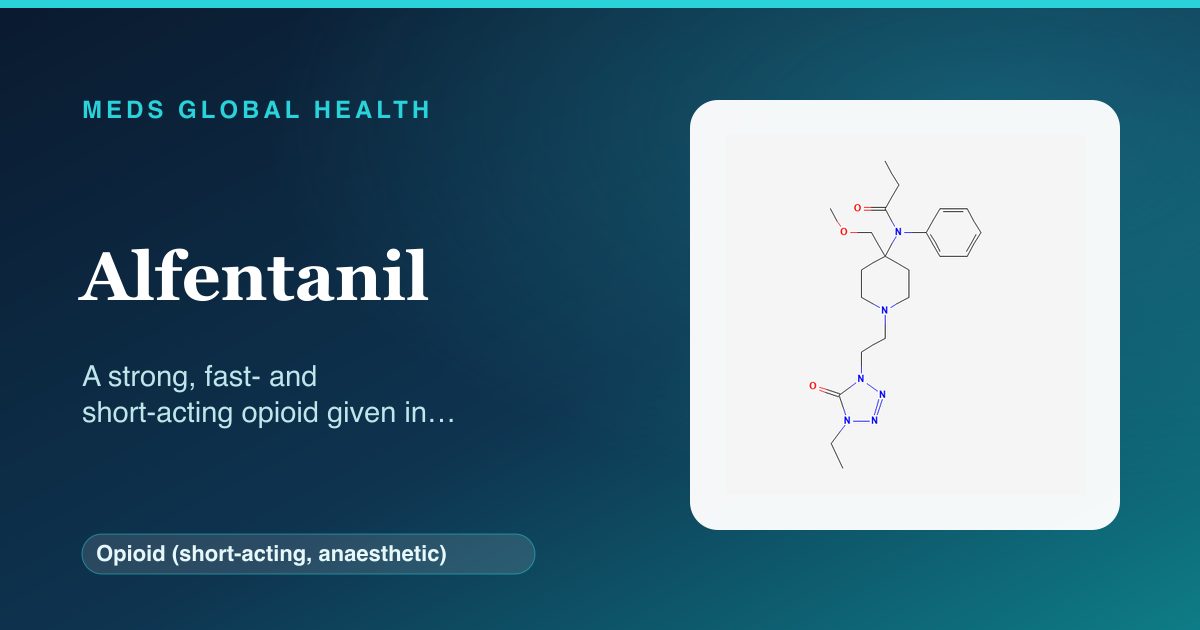
What it is
Alfentanil is a strong opioid medicine related to fentanyl, used during anaesthesia and in intensive care to control pain. It is known for working fast and lasting only a short time, which lets anaesthetists fine-tune pain relief during operations and short, painful procedures. It is given as an injection or infusion into a vein by trained hospital staff in settings where breathing and other vital signs can be watched closely. It is a controlled drug and is not prescribed for use at home.
How it works
Alfentanil attaches to opioid receptors in the brain and spinal cord, blocking pain signals and producing strong pain relief. Because of the way it is built, it reaches the brain quickly and is cleared quickly, so its effect comes on fast and fades soon after it is stopped. This short, controllable action is why it suits anaesthesia and short procedures. The same action on the brain that relieves pain also slows breathing, which is the main reason it is only given where breathing can be supported and monitored.
Company & origin
A strong, short-acting opioid used in UK hospitals during anaesthesia and intensive care, given by anaesthetists and specialist teams.
Practical use
How to take Alfentanil
General, dose-free guidance — always follow your prescriber's and the leaflet's specific instructions.
- It is given in hospital by anaesthetists or specialist teams as an injection or infusion into a vein.
- It is only used where breathing, heart rate and blood pressure can be monitored closely.
- It is not a take-home medicine and is not used for everyday pain relief.
- Tell the anaesthetic team about all your medicines, allergies and any breathing or liver problems beforehand.
- After it is used, you will be watched in recovery until the effects, including any drowsiness, have worn off.
Weighing it up
Advantages & disadvantages of Alfentanil
Advantages
- Works very quickly to control pain, which is useful during anaesthesia and short procedures.
- Wears off quickly, allowing precise, adjustable pain control by the anaesthetic team.
- Given and monitored by specialists who can manage its effects on breathing.
Disadvantages
- Can slow or stop breathing, so it must only be given where breathing can be supported.
- Causes drowsiness, low blood pressure, a slow heart rate, nausea and sometimes muscle stiffness.
- Is a controlled drug used only in hospital, not at home.
Practical use
Good to know
The most important thing to understand about alfentanil is that it is a powerful hospital-only opioid whose main danger is slowing or stopping breathing, which is why it is given by anaesthetists and specialist teams who continuously monitor breathing and can support it if needed. Its fast onset and short duration are its key advantages, allowing precise control during anaesthesia and procedures. Like other strong opioids it can cause drowsiness, low blood pressure, a slow heart rate, nausea and stiff muscles. It is a controlled drug, so it is stored and recorded under strict rules. An opioid-reversing medicine can be used in an emergency if breathing is too suppressed, and it is never a medicine people manage themselves at home.
Who should not take it / use with caution
- People who have had a serious allergic reaction to alfentanil or similar opioids should not be given it.
- It is avoided or used with great caution in people who cannot have their breathing supported.
- It is used with extra care in people with severe breathing problems, very low blood pressure or significant liver problems.
- Doses and use are adjusted carefully in older or frail people and those already taking other sedating medicines.
Monitoring
- Continuous monitoring of breathing, oxygen levels, heart rate and blood pressure while it is given.
- Watching for over-sedation, with an opioid-reversing medicine available if needed.
- Observation in recovery until the effects have worn off after a procedure.
Side effects
- Slowed or shallow breathing, the most important effect, which the team watches for closely.
- Drowsiness, low blood pressure and a slow heart rate.
- Nausea, vomiting and sometimes stiff muscles.
- Rarely, more serious reactions needing immediate treatment in the hospital setting.
Key interactions
- Other sedating medicines, such as benzodiazepines and other opioids, add to its effect on breathing and alertness.
- Some medicines that affect liver enzymes can raise or lower its levels, so the team takes this into account.
- Alcohol and other central nervous system depressants increase the risk of dangerous over-sedation.
Available as: A solution given by injection or infusion into a vein, in hospital.
Answers
Alfentanil: frequently asked questions
What is alfentanil used for?
It is a strong, short-acting opioid used in hospital during anaesthesia, surgery, short procedures and intensive care to control pain.
Why is it only given in hospital?
Its main danger is slowing or stopping breathing, so it is given by anaesthetists and specialist teams who can monitor and support breathing closely.
Why does it act so quickly?
It reaches the brain fast and is cleared quickly, so its pain-relieving effect comes on rapidly and wears off soon after it is stopped, which suits anaesthesia.
Is it a controlled drug?
Yes. Alfentanil is a controlled drug, stored and recorded under strict rules, and it is never a medicine that people use at home.
What happens if it affects breathing too much?
The team watches breathing continuously and can support it, and an opioid-reversing medicine can be given in an emergency if breathing is too suppressed.
The wider class
About Opioid (short-acting, anaesthetic)
Alfentanil belongs to the opioid (short-acting, anaesthetic) class. For how the class as a whole works, its shared safety principles and monitoring, see the full guide.
Browse by body system
Authoritative sources
- BNF
- NICE CKS
Building a medicines information resource?
We create evidence-led, dose-free drug and formulary references for teams.