An ultra-short-acting opioid used during anaesthesia
Remifentanil
An ultra-short-acting opioid given as a drip during anaesthesia to control pain and blunt the body's response to surgery.
What is Remifentanil?
Remifentanil is a very strong, ultra-short-acting opioid used in hospital during anaesthesia and sometimes in intensive care. It is given only as a continuous drip into a vein, controlled by an anaesthetist, to provide pain relief and keep the body settled during surgery. Its effect wears off very quickly once the drip is stopped. Its most important risks are slowing or stopping breathing and causing muscle stiffness (rigidity), so it is used only where breathing can be supported. It is a controlled drug and is never used at home.
Education and reference only. This is a plain-language guide to Remifentanil — it deliberately contains no doses. Doses depend on the person, the brand and the reason for treatment, and belong with your prescriber. Always check the BNF, the product labelling (SmPC) and follow medical advice.
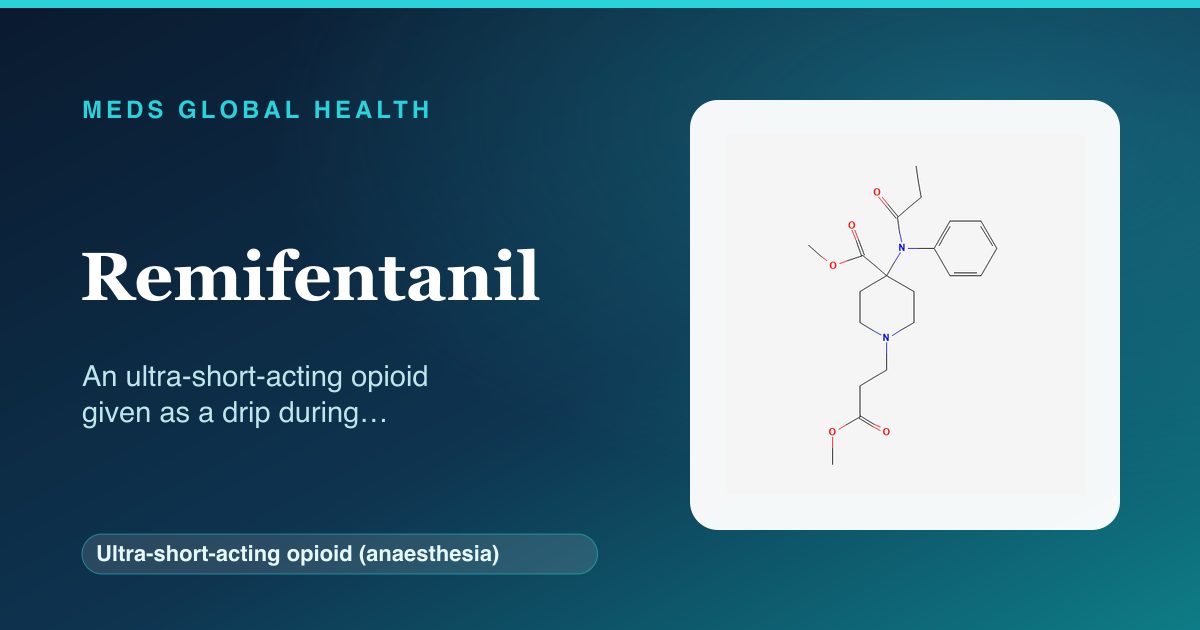
What it is
Remifentanil is a powerful opioid painkiller used only in hospital, mainly as part of general anaesthesia for surgery and sometimes to keep patients comfortable in intensive care. What makes it unusual is how short-acting it is: it works almost immediately and wears off within minutes of the drip being turned off, because the body breaks it down very quickly. It is given as a continuous infusion into a vein, never as a one-off tablet or injection at home, and only by anaesthetists or specialist teams who can manage breathing and monitoring. It is a controlled drug.
How it works
Remifentanil acts on opioid receptors in the brain and spinal cord, the same targets as other strong opioids, to block pain signals and dampen the body's stress response to surgery. Its special feature is that it is broken down by enzymes in the blood and tissues rather than relying on the liver or kidneys, so it clears extremely fast. This means the anaesthetist can adjust the depth of pain control moment to moment by changing the drip rate, and the effect disappears quickly once it is stopped, which is useful during finely controlled anaesthesia.
Company & origin
A specialist hospital opioid used in the UK during anaesthesia and in intensive care, given as a drip into a vein.
Practical use
How to take Remifentanil
General, dose-free guidance — always follow your prescriber's and the leaflet's specific instructions.
- It is given only in hospital as a continuous drip into a vein, controlled by an anaesthetist or specialist team.
- It is always used where breathing can be supported and the patient is closely monitored.
- It is never taken by mouth or used at home, and is handled as a controlled drug.
- The team adjusts the drip rate carefully to control pain and the body's response during surgery.
- Other pain relief is usually arranged for after surgery, as its effect wears off very quickly.
Weighing it up
Advantages & disadvantages of Remifentanil
Advantages
- Provides powerful, finely controllable pain relief during anaesthesia.
- Wears off within minutes of stopping the drip, allowing quick recovery from its effects.
- Broken down in the blood, so it can be used even when the liver or kidneys are not working well.
Disadvantages
- Can slow or stop breathing, so it is only used where breathing can be supported.
- Can cause muscle stiffness, including of the chest, which can make breathing difficult.
- Its pain relief disappears very quickly after stopping, so other pain relief is needed afterwards.
Practical use
Good to know
The most important thing about remifentanil is that it is a hospital-only medicine given by anaesthetists who can fully support breathing, because its dominant risks are slowing or stopping breathing (respiratory depression) and causing stiffness of the muscles, including the chest wall, which can make breathing difficult. For this reason it is always given with airway support and close monitoring available. Its effects come on and wear off very quickly, which is an advantage during anaesthesia but means pain relief can disappear almost as soon as the drip stops, so other pain relief is usually arranged for after surgery. It can also slow the heart rate and lower blood pressure. It is a controlled drug, given and recorded carefully, and is never used outside a supervised hospital setting.
Who should not take it / use with caution
- People who have had a serious allergic reaction to remifentanil or similar opioids should not be given it.
- It is not given outside a supervised hospital setting with airway support and monitoring.
- It is used with great care in people who are already very drowsy, have severe breathing problems or low blood pressure, under specialist judgement.
Monitoring
- Continuous monitoring of breathing, oxygen, heart rate and blood pressure during use.
- Close watching of the depth of anaesthesia and pain control.
- Arranging ongoing pain relief as the medicine wears off after surgery.
Side effects
- Slowed or stopped breathing, which is the main reason it is used only with breathing support.
- Muscle stiffness or rigidity, including of the chest wall.
- A slow heart rate and low blood pressure.
- Nausea, vomiting or shivering as the patient recovers.
Key interactions
- Other medicines that slow breathing or cause drowsiness, such as sedatives and other opioids, add to its effects.
- Anaesthetic agents are deliberately combined with it, which is why doses are carefully balanced by the team.
- Medicines that slow the heart or lower blood pressure can add to those effects.
Available as: A powder made up into a solution given as a drip into a vein in hospital.
Answers
Remifentanil: frequently asked questions
What is remifentanil used for?
It is a powerful, ultra-short-acting opioid used in hospital during anaesthesia, and sometimes in intensive care, to control pain and the body's response to surgery.
Why is it given only by anaesthetists?
Its main risks are slowing or stopping breathing and causing muscle stiffness, so it is used only where breathing can be fully supported and monitored.
Why does its effect wear off so fast?
It is broken down very quickly by enzymes in the blood and tissues, so its effect disappears within minutes of the drip being stopped.
Will I have pain relief after surgery?
Because remifentanil wears off so quickly, other pain relief is usually arranged for after the operation so you stay comfortable.
Can it be used at home?
No. It is a controlled drug given only as a drip in a supervised hospital setting, never by mouth or at home.
The wider class
About Ultra-short-acting opioid (anaesthesia)
Remifentanil belongs to the ultra-short-acting opioid (anaesthesia) class. For how the class as a whole works, its shared safety principles and monitoring, see the full guide.
Browse by body system
Authoritative sources
- BNF
- NICE CKS
Building a medicines information resource?
We create evidence-led, dose-free drug and formulary references for teams.