A mixed agonist-antagonist opioid painkiller
Pentazocine
An older opioid painkiller used for moderate to severe pain, of a type that acts in a mixed way on opioid receptors.
What is Pentazocine?
Pentazocine is an opioid painkiller used for moderate to severe pain. It is a 'mixed agonist-antagonist', which means it acts in a more complicated way on opioid receptors than morphine. An important consequence of this is that it can bring on withdrawal symptoms in people who are dependent on other opioids, so it must be used carefully in anyone already taking strong opioids. It is also more likely than some opioids to cause psychiatric effects such as hallucinations and odd thoughts, and like all opioids it can slow breathing, cause drowsiness and lead to dependence. It is a controlled drug, used under medical supervision and now less commonly than in the past.
Education and reference only. This is a plain-language guide to Pentazocine — it deliberately contains no doses. Doses depend on the person, the brand and the reason for treatment, and belong with your prescriber. Always check the BNF, the product labelling (SmPC) and follow medical advice.
What it is
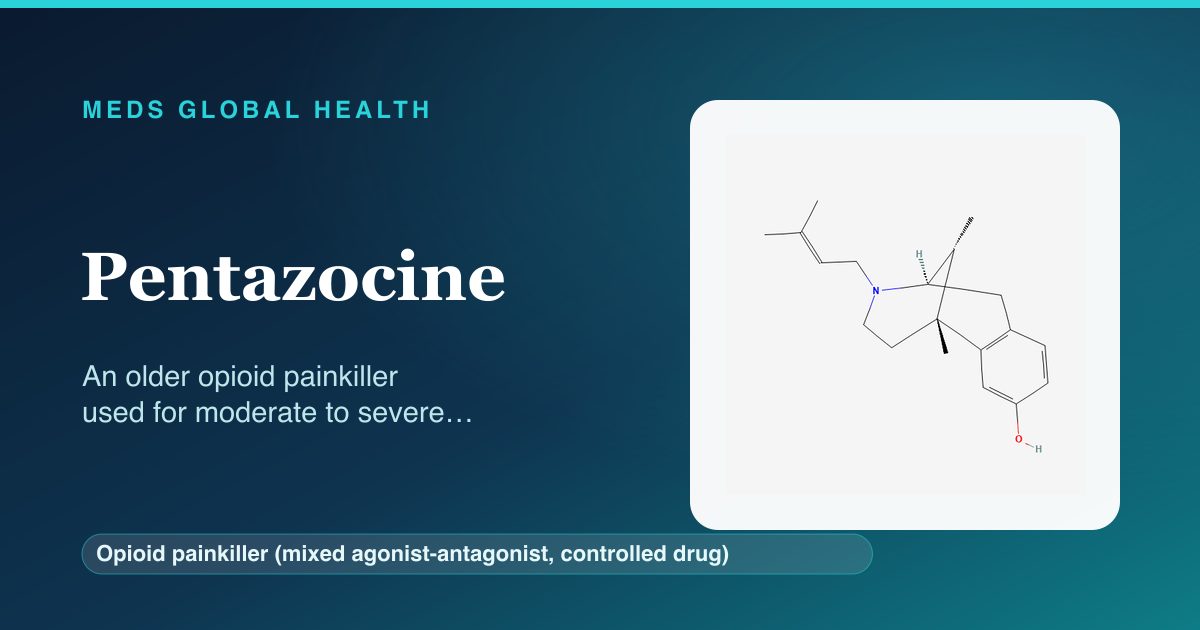
Pentazocine is an opioid painkiller used to relieve moderate to severe pain. Unlike straightforward opioids such as morphine, it is a 'mixed agonist-antagonist': it switches on some opioid receptors while blocking others, which gives it a more complicated effect. This is why it can actually trigger withdrawal in people who are already dependent on other opioids. It is an older medicine, used less often today, and it is a controlled drug because it can cause dependence and other opioid effects. It may be given as a tablet or by injection, under medical supervision.
How it works
Pentazocine works on the opioid receptors in the brain and spinal cord that control pain, but in a mixed way: it activates some receptors to relieve pain while blocking others. Blocking those other receptors is the reason it can precipitate withdrawal in someone whose body is used to a full opioid such as morphine, by partly displacing it. Its particular pattern of action also makes it more likely than some opioids to cause psychiatric effects, such as hallucinations, vivid dreams or feeling strange. Like all opioids, switching on opioid receptors also slows breathing at higher doses and can lead to the body becoming dependent over time.
Company & origin
An older opioid painkiller of the mixed agonist-antagonist type, used for moderate to severe pain.
Practical use
How to take Pentazocine
General, dose-free guidance — always follow your prescriber's and the leaflet's specific instructions.
- Take it exactly as prescribed, as a tablet or by injection, at the lowest effective amount for the shortest time needed.
- Tell the prescriber if you are already taking other opioids, as pentazocine can bring on withdrawal symptoms.
- Do not drive or operate machinery while you feel drowsy or affected by it.
- Do not drink alcohol while taking it, as this adds to drowsiness and the risk of slowed breathing.
- Report any hallucinations, confusion or distressing thoughts to your prescriber, and do not stop it suddenly after longer use.
Weighing it up
Advantages & disadvantages of Pentazocine
Advantages
- Relieves moderate to severe pain.
- Available as a tablet or by injection, giving some flexibility in how it is given.
- A long-established medicine with decades of clinical experience behind it.
Disadvantages
- Can bring on withdrawal symptoms in people already dependent on other opioids.
- More likely than some opioids to cause psychiatric effects such as hallucinations.
- Like all opioids, can slow breathing, cause drowsiness and constipation, and lead to dependence; it is a controlled drug.
Practical use
Good to know
The most important thing to know about pentazocine is that, because of its mixed action, it can bring on withdrawal symptoms in someone who is dependent on other opioids, so it must not be given casually to anyone already taking strong opioids. It is also more likely than many opioids to cause psychiatric effects, such as hallucinations, confusion or unsettling thoughts, which can be distressing and should be reported. As with all opioids, it causes drowsiness (so do not drive while affected), can cause constipation and nausea, and can slow breathing, especially if mixed with alcohol or other sedating medicines. It can lead to dependence with repeated use, which is why it is a controlled drug used for as short a time as needed. It is an older medicine, now used less often, with other opioids usually preferred.
Who should not take it / use with caution
- People who are dependent on other opioids should not normally be given it, as it can bring on withdrawal.
- People with breathing problems such as severe asthma or significant lung disease should not normally use it.
- People who have had a serious allergic reaction to it should not use it.
- It is used with caution in people with a history of mental-health problems, heart problems, or kidney or liver disease, and in older people.
Monitoring
- Watching pain relief, alertness and breathing, especially when it is first used.
- Watching for psychiatric effects such as hallucinations or confusion.
- Reviewing how long it is needed and reducing it gradually after longer use.
Side effects
- Drowsiness, dizziness and a feeling of being muddled.
- Psychiatric effects such as hallucinations, vivid dreams or odd thoughts, which should be reported.
- Constipation, nausea and vomiting.
- Slowed breathing (respiratory depression), which is the most serious risk and needs urgent medical attention.
Key interactions
- Other opioids can be partly blocked by it, which can bring on withdrawal in people who are dependent.
- Alcohol and other sedating medicines, such as sleeping tablets and some anxiety medicines, add to drowsiness and breathing risk.
- Certain medicines acting on the brain, including some antidepressants, can interact, so give a full medicines list.
Available as: Tablets and a solution for injection.
Answers
Pentazocine: frequently asked questions
What is pentazocine used for?
It is an opioid painkiller used for moderate to severe pain, of a type that acts in a mixed way on opioid receptors.
Why can it cause withdrawal?
Because it blocks some opioid receptors as well as activating others, it can partly displace other opioids and bring on withdrawal in someone who is dependent on them.
Can it cause hallucinations?
Yes, it is more likely than some opioids to cause psychiatric effects such as hallucinations, vivid dreams or odd thoughts, which should be reported to your prescriber.
Is it safe with alcohol?
No. Alcohol adds to its sedating effect and increases the risk of dangerous breathing problems, so it should be avoided.
Can I become dependent on it?
Yes, like other opioids it can lead to dependence with repeated use, which is why it is a controlled drug used for as short a time as needed and reduced gradually.
The wider class
About Opioid painkiller (mixed agonist-antagonist, controlled drug)
Pentazocine belongs to the opioid painkiller (mixed agonist-antagonist, controlled drug) class. For how the class as a whole works, its shared safety principles and monitoring, see the full guide.
Browse by body system
Authoritative sources
- BNF
- NICE CKS
Building a medicines information resource?
We create evidence-led, dose-free drug and formulary references for teams.