An opioid painkiller, including a nasal spray, for moderate to severe pain
Butorphanol
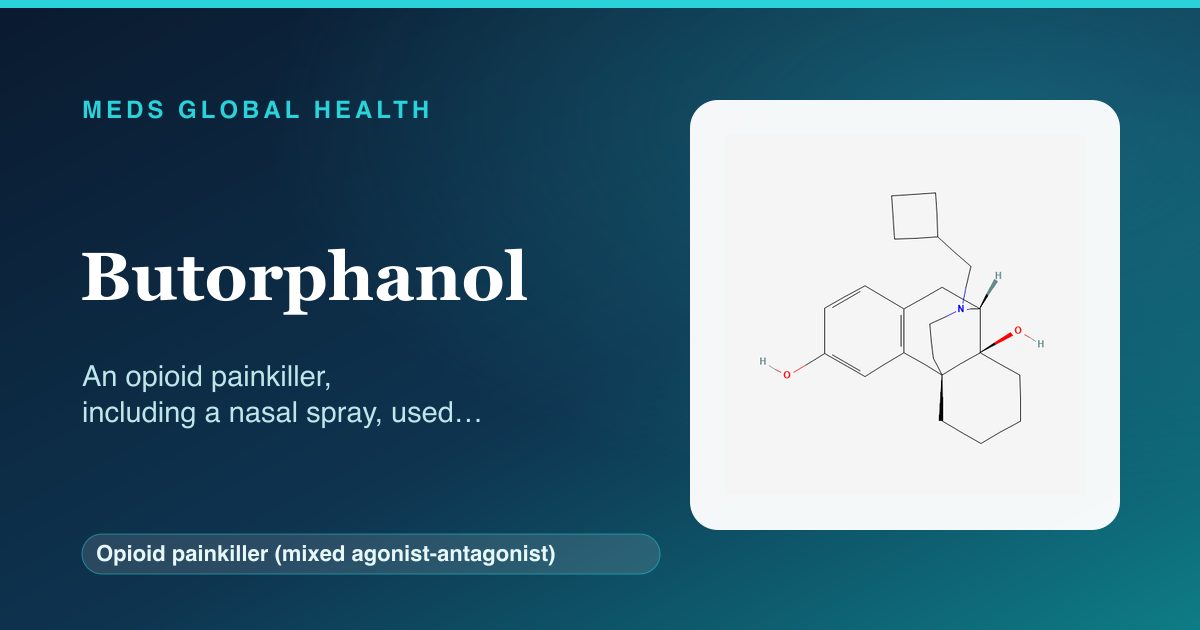
An opioid painkiller, including a nasal spray, used for moderate to severe pain and migraine in some countries.
What is Butorphanol?
Butorphanol is an opioid painkiller used in some countries for moderate to severe pain, including as a nasal spray for migraine. It is a 'mixed agonist-antagonist', meaning it both stimulates and blocks different opioid receptors, which affects how it works and its risks. Like other strong opioids it can cause drowsiness and slow breathing (respiratory depression), and because it partly blocks opioid receptors it can trigger sudden withdrawal in people who are dependent on other opioids. It is a controlled drug and is not a standard treatment in the UK.
Education and reference only. This is a plain-language guide to Butorphanol — it deliberately contains no doses. Doses depend on the person, the brand and the reason for treatment, and belong with your prescriber. Always check the BNF, the product labelling (SmPC) and follow medical advice.
What it is
Butorphanol is a strong opioid painkiller used in some countries to treat moderate to severe pain, including a nasal spray form used for migraine attacks. It belongs to a group called mixed opioid agonist-antagonists, which means it activates some opioid receptors (giving pain relief) while blocking others. It is a controlled drug because, like all opioids, it can be misused. It is not part of routine NHS prescribing in the UK, where other painkillers and migraine treatments are preferred, but it may be encountered in other countries or settings.
How it works
Butorphanol acts on the body's opioid receptors, which are involved in how we feel pain. By stimulating one type of receptor it dampens pain signals, while at the same time it blocks another type, which is why it is called a mixed agonist-antagonist. This dual action provides pain relief but also explains two key features: there is thought to be a ceiling above which extra doses give little more relief, and because it blocks part of the opioid system it can suddenly bring on withdrawal in someone whose body is used to other opioids. The nasal spray form lets it be absorbed quickly through the lining of the nose, which suits sudden pain such as a migraine.
Company & origin
An opioid painkiller used in some countries for moderate to severe pain, including as a nasal spray for migraine; it is a controlled drug and is not a routine treatment in the UK.
What it treats
Conditions Butorphanol is used for
Practical use
How to take Butorphanol
General, dose-free guidance — always follow your prescriber's and the leaflet's specific instructions.
- Use it exactly as prescribed; if using the nasal spray, follow the instructions for spraying into the nose carefully.
- Do not take more than prescribed, as higher doses increase the risk of drowsiness and slowed breathing without much extra pain relief.
- Avoid alcohol and tell your prescriber about other sedating medicines, as together they can dangerously slow breathing.
- Tell your prescriber if you take or are dependent on other opioids, as butorphanol can suddenly trigger withdrawal.
- Do not drive or operate machinery until you know how it affects you, as it can cause drowsiness.
Weighing it up
Advantages & disadvantages of Butorphanol
Advantages
- Provides relief for moderate to severe pain, including a nasal spray option for migraine.
- The nasal spray works quickly, which can suit sudden pain.
- Its ceiling effect may mean a lower risk of breathing problems at higher doses than some pure opioids.
Disadvantages
- Like all opioids, it can cause drowsiness and slowed breathing, especially with alcohol or other sedatives.
- Can suddenly trigger withdrawal in people dependent on other opioids.
- It is a controlled drug with a risk of dependence, and is not a routine treatment in the UK.
Practical use
Good to know
As a strong opioid, the most important safety concerns with butorphanol are drowsiness and slowed breathing (respiratory depression), which are more likely with higher doses or when combined with other sedating medicines or alcohol. A feature specific to this kind of opioid is that, because it partly blocks opioid receptors, it can suddenly trigger withdrawal symptoms in someone who is dependent on other opioids, so a full picture of opioid use is important before it is given. It can also cause a feeling of unreality or odd thoughts in some people. Because it is a controlled drug, it is prescribed and stored carefully and there is potential for dependence with longer use. The nasal spray is used for sudden pain such as migraine, and people should not drive or operate machinery until they know how it affects them.
Who should not take it / use with caution
- People who have had a serious allergic reaction to butorphanol should not use it.
- It is used with great caution, or avoided, in people who are dependent on other opioids, because it can precipitate withdrawal.
- It is used with caution in people with breathing problems, head injury, or severe liver or kidney problems.
- It is generally avoided in pregnancy, breastfeeding and in children unless a specialist advises.
Monitoring
- Checking how well pain or migraine is controlled and whether the dose is right.
- Watching for excessive drowsiness or slowed breathing, especially early on or with other sedatives.
- Reviewing ongoing need, as longer use carries a risk of dependence.
Side effects
- Drowsiness, dizziness and a feeling of being unsteady.
- Nausea, sweating or a dry mouth; the nasal spray can cause nasal irritation or a bad taste.
- A feeling of unreality, confusion or odd thoughts in some people.
- More seriously, slowed or shallow breathing, particularly at higher doses or with other sedatives, which needs urgent attention.
Key interactions
- Alcohol and other sedating medicines (such as benzodiazepines, sleeping tablets and some antidepressants) increase drowsiness and the risk of dangerously slowed breathing.
- Other opioids may be affected by butorphanol's partial blocking action, which can trigger withdrawal or reduce their effect.
- Tell your prescriber about all your medicines, including anything that makes you sleepy.
Available as: A nasal spray and a solution for injection.
Answers
Butorphanol: frequently asked questions
What is butorphanol used for?
It is an opioid painkiller used in some countries for moderate to severe pain, including a nasal spray used for migraine; it is not a routine treatment in the UK.
Why can it cause withdrawal?
Because it partly blocks opioid receptors, it can suddenly bring on withdrawal symptoms in someone whose body is dependent on other opioids, so tell your prescriber about any opioid use.
Is it safe to drink alcohol with it?
No. Alcohol and other sedating medicines add to the drowsiness and can dangerously slow your breathing, so they should be avoided.
Is it addictive?
It is a controlled drug and, like other opioids, can cause dependence with longer use, so it is prescribed and used carefully.
Can it make me feel strange?
Some people get a feeling of unreality, confusion or odd thoughts; tell your prescriber if this happens.
The wider class
About Opioid painkiller (mixed agonist-antagonist)
Butorphanol belongs to the opioid painkiller (mixed agonist-antagonist) class. For how the class as a whole works, its shared safety principles and monitoring, see the full guide.
Browse by body system
Authoritative sources
- BNF
- NICE CKS
Building a medicines information resource?
We create evidence-led, dose-free drug and formulary references for teams.