A strong opioid painkiller
Tapentadol
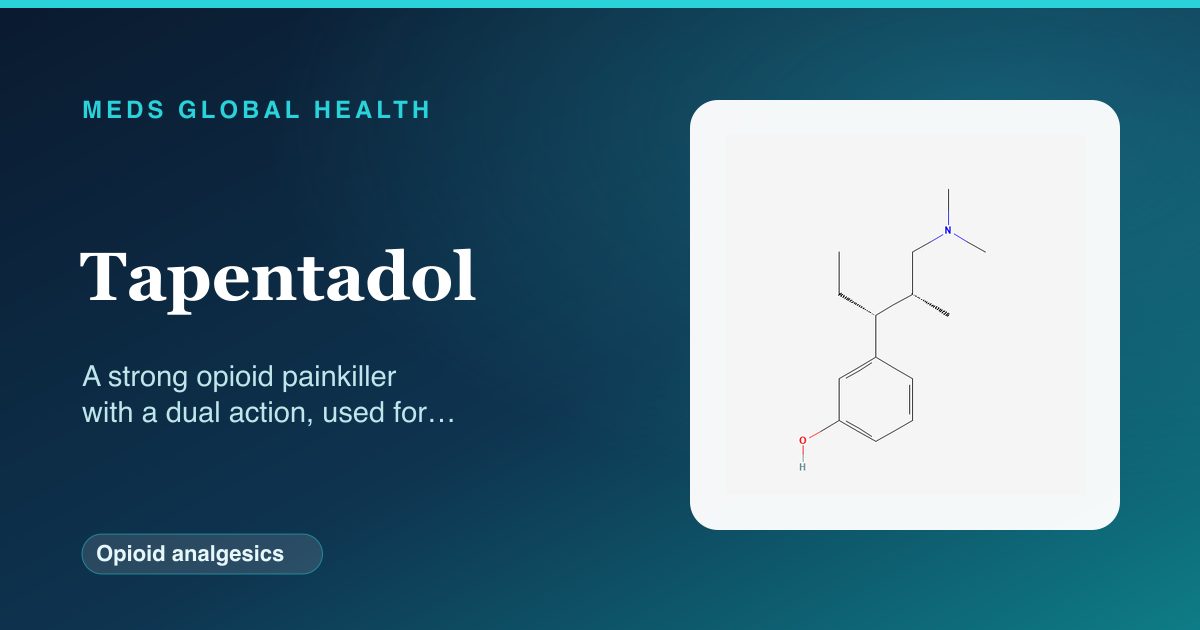
A strong opioid painkiller with a dual action, used for moderate to severe pain when weaker painkillers are not enough.
What is Tapentadol?
Tapentadol is a strong opioid painkiller used for moderate to severe pain when other painkillers have not worked well enough. It works in two ways — like an opioid and by boosting a natural pain-dampening pathway — which can help certain nerve-related pain. Because it is an opioid, it can cause drowsiness, constipation and dependence, so it is used carefully and not stopped suddenly.
Education and reference only. This is a plain-language guide to Tapentadol — it deliberately contains no doses. Doses depend on the person, the brand and the reason for treatment, and belong with your prescriber. Always check the BNF, the product labelling (SmPC) and follow medical advice.
What it is
Tapentadol is a strong opioid painkiller used in the UK for moderate to severe pain, including some types of nerve-related pain, usually when weaker painkillers have not given enough relief. It is unusual among opioids because it works in two ways at once. It comes as ordinary (immediate-release) tablets for short-term or breakthrough pain and as slow-release (modified-release) tablets for ongoing pain. As a controlled drug, it is prescribed and monitored carefully.
How it works
Tapentadol has a dual action. Like other opioids, it acts on opioid receptors in the brain and spinal cord to reduce the perception of pain. At the same time, it boosts a natural pain-dampening pathway by increasing levels of noradrenaline, a chemical messenger that helps the body turn down pain signals. This combination can make it useful for pain that has a nerve-related component, where opioids alone are sometimes less effective.
Company & origin
Originated / developed by: Grünenthal.
Developed by Grünenthal in Germany and introduced from around 2010 as a strong opioid with an additional mechanism, used for moderate to severe pain.
Practical use
How to take Tapentadol
General, dose-free guidance — always follow your prescriber's and the leaflet's specific instructions.
- Take it exactly as prescribed; slow-release tablets are swallowed whole and not crushed or chewed.
- Take ordinary (immediate-release) tablets only for short-term or breakthrough pain as directed.
- Use a laxative as advised, since constipation is very common.
- Do not drink alcohol while taking it, and avoid driving until you know how it affects you.
- Do not stop it suddenly after regular use — the dose should be reduced gradually with your prescriber.
- If a dose is missed, follow the advice for your particular tablets rather than doubling up.
Weighing it up
Advantages & disadvantages of Tapentadol
Advantages
- Effective for moderate to severe pain when weaker painkillers are not enough.
- Dual action can help some nerve-related pain where opioids alone fall short.
- Available as both fast-acting and slow-release tablets for different pain patterns.
- May cause less constipation than some other strong opioids for some people.
Disadvantages
- An opioid, so it carries a real risk of dependence and addiction.
- Causes drowsiness and constipation, and affects driving.
- Cannot be stopped suddenly — needs gradual reduction to avoid withdrawal.
- Risk of serotonin syndrome with certain antidepressants, and dangerous with alcohol.
Practical use
Good to know
Tapentadol causes drowsiness, especially when starting or increasing it, so do not drive or use machinery until you know how it affects you — and be aware of UK drug-driving law, which can apply to prescribed opioids. Constipation is very common and usually needs a laxative. It should not be stopped suddenly after regular use, as this can cause withdrawal; the dose is reduced gradually. Avoid alcohol, which adds to drowsiness and breathing risks. Because it also affects serotonin pathways, there is a risk of serotonin syndrome with certain antidepressants.
Who should not take it / use with caution
- People with severe breathing problems or conditions where breathing can be suppressed.
- People taking certain MAOI antidepressants, or with poorly controlled epilepsy.
- People with a history of opioid dependence or misuse, unless carefully supervised.
- Pregnant or breastfeeding women, except on specialist advice, and used cautiously in liver or kidney disease.
Monitoring
- Review of pain control, side effects and ongoing need at regular intervals.
- Watch for signs of dependence, excessive drowsiness or slow breathing.
- Bowel function should be monitored and laxatives used as needed.
Side effects
- Drowsiness, dizziness, nausea and constipation, especially early on.
- Dry mouth, sweating, headache or feeling generally 'spaced out'.
- With regular use, tolerance and physical dependence can develop.
- Rarely, slow or shallow breathing (an emergency), or serotonin syndrome with certain other medicines.
Key interactions
- Alcohol, sleeping tablets, benzodiazepines and other sedatives add to drowsiness and breathing risk.
- SSRI, SNRI and certain other antidepressants raise the risk of serotonin syndrome.
- MAOI antidepressants must not be combined with tapentadol.
- Other medicines that lower the seizure threshold may increase the risk of fits.
Available as: Ordinary (immediate-release) tablets and slow-release (modified-release) tablets; an oral solution is also available.
Answers
Tapentadol: frequently asked questions
Is tapentadol addictive?
Yes, like all strong opioids it can lead to tolerance and dependence with regular use. It is prescribed as a controlled drug, used at the lowest effective dose for the shortest necessary time, and reduced gradually rather than stopped abruptly.
Can I drive while taking tapentadol?
It can cause drowsiness, and UK drug-driving law can apply to prescribed opioids. Do not drive until you know how it affects you, and never if you feel sleepy or impaired. Carrying your prescription information is sensible.
Can I drink alcohol with it?
No. Alcohol increases drowsiness and the risk of dangerously slow breathing when combined with an opioid, so it should be avoided.
Why does it interact with antidepressants?
Tapentadol affects serotonin pathways, so combining it with SSRIs, SNRIs or especially MAOIs can risk serotonin syndrome. Always tell your prescriber about any antidepressants you take.
What happens if I stop suddenly?
Stopping abruptly after regular use can cause opioid withdrawal symptoms. The dose should be lowered gradually under your prescriber's guidance.
The wider class
About Opioid analgesics
Tapentadol belongs to the opioid analgesics class. For how the class as a whole works, its shared safety principles and monitoring, see the full guide.
Browse by body system
Authoritative sources
- BNF
- NICE CKS
Building a medicines information resource?
We create evidence-led, dose-free drug and formulary references for teams.