An opioid painkiller with extra nerve-pain action
Tramadol
An opioid painkiller for moderate-to-severe pain that also acts on brain chemicals — a controlled drug with risks of seizures, serotonin syndrome and dependence.
What is Tramadol?
Tramadol is an opioid painkiller used for moderate-to-severe pain. As well as acting on opioid receptors, it boosts certain brain chemicals, which means it carries some extra risks compared with other opioids.
Education and reference only. This is a plain-language guide to Tramadol — it deliberately contains no doses. Doses depend on the person, the brand and the reason for treatment, and belong with your prescriber. Always check the BNF, the product labelling (SmPC) and follow medical advice.
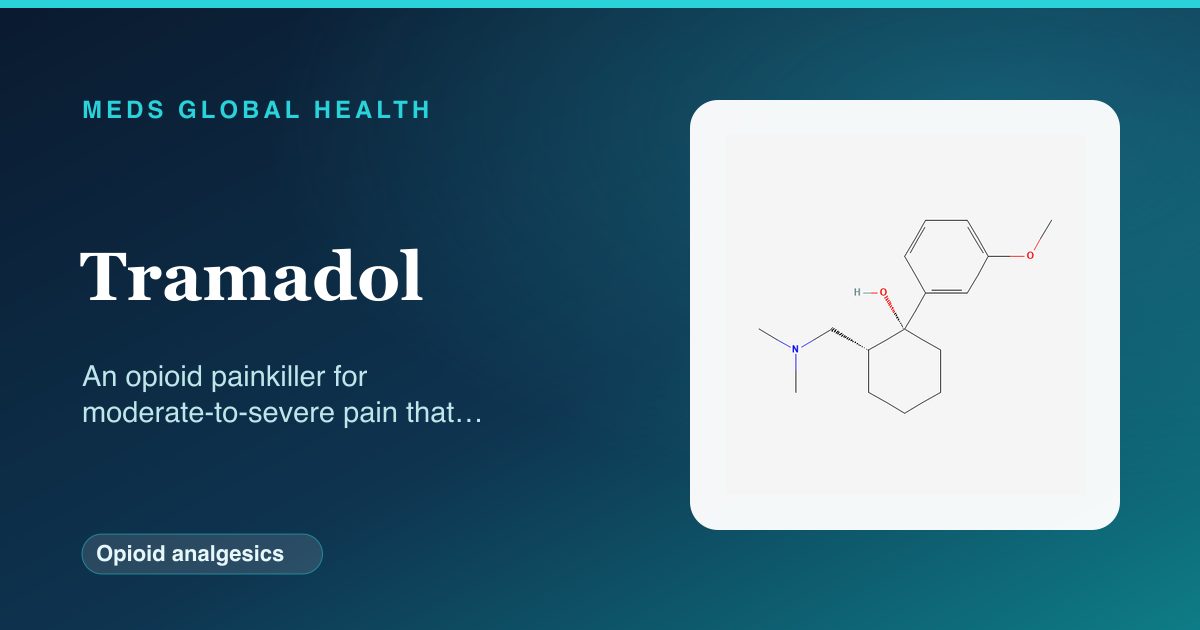
What it is
Tramadol is an opioid painkiller used for moderate-to-severe pain. It is unusual among opioids because, as well as acting on opioid receptors, it boosts two brain chemicals — serotonin and noradrenaline — that are involved in damping down pain. This dual action gives it a place between weaker painkillers and strong opioids, but it also brings extra risks not seen with plain opioids. It is a controlled drug. In the UK it is sold as Zydol (among other brands); in the US the equivalent brand is Ultram.
How it works
Tramadol has two ways of relieving pain. Part of it (and a more active form the liver produces) attaches to opioid receptors in the brain and spinal cord, changing how pain is perceived. At the same time, it increases the activity of serotonin and noradrenaline — chemical messengers the nervous system uses to suppress pain signals. This combination is why it works for some types of pain, but the serotonin effect is also why it can interact dangerously with antidepressants, and the way the liver activates it varies from person to person, so the effect can differ between individuals.
Company & origin
Originated / developed by: Grünenthal.
Tramadol was synthesized in 1962 by the German pharmaceutical company Grünenthal and launched in Germany in 1977 as Tramal; it was introduced to the US market as Ultram in 1995.
Practical use
How to take Tramadol
General, dose-free guidance — always follow your prescriber's and the leaflet's specific instructions.
- Take tramadol only as prescribed, as it is an opioid and can cause dependence if used more than directed or for a long time.
- Avoid alcohol and other sedating medicines, which add to drowsiness and slowed breathing.
- Be cautious about driving, as tramadol can cause drowsiness and dizziness.
- It can rarely trigger seizures, particularly with certain other medicines or in people prone to fits, so tell your prescriber about your full medicine list.
- There is a risk of serotonin-related effects when combined with some antidepressants and other drugs; report agitation, sweating, shivering or a racing heart.
- Do not stop tramadol suddenly after regular use, as withdrawal can occur; reduce it gradually with advice.
Weighing it up
Advantages & disadvantages of Tramadol
Advantages
- Useful step for moderate-to-severe pain when simpler painkillers are not enough.
- Available in immediate and slow-release forms for flexibility.
- May suit some people who do not tolerate other opioids.
- Widely used and familiar to UK prescribers.
Disadvantages
- Carries a risk of dependence and withdrawal, like other opioids.
- Can lower the seizure threshold and trigger fits in susceptible people.
- Risk of serotonin syndrome when combined with certain antidepressants and other medicines.
- Commonly causes nausea, dizziness, drowsiness and constipation.
Practical use
Good to know
Tramadol is a controlled drug used for moderate-to-severe pain. Its serotonin-boosting action means it can interact with antidepressants and other serotonin-raising medicines to cause serotonin syndrome — a potentially serious reaction with agitation, sweating, shaking, fast heartbeat and confusion — so its use with these is approached carefully. It can also lower the seizure threshold, making fits more likely, especially at higher use or with other risk factors. Like all opioids it can cause drowsiness, constipation, dependence, and slowed breathing with sedatives or alcohol. Because people activate it differently in the liver, the effect varies, and it must not be taken with or close to MAOI antidepressants.
Who should not take it / use with caution
- People taking, or who have recently taken, MAOI antidepressants — a dangerous combination to avoid.
- People with uncontrolled epilepsy or a high seizure risk, and those with significant breathing problems.
- Used with caution in reduced kidney or liver function, with other serotonin-raising or sedating medicines, in older people, and in pregnancy and breastfeeding.
Monitoring
- Pain control and effect on daily function
- Drowsiness, breathing and any signs of serotonin syndrome or seizures
- Bowel function and ongoing need for the opioid
Side effects
- Nausea and vomiting, dizziness, drowsiness, constipation and dry mouth.
- Headache, sweating, or a feeling of being "spaced out"; confusion in some people, especially the older or frail.
- More seriously, seizures, serotonin syndrome (agitation, shaking, sweating, fast heartbeat), slowed breathing with sedatives or alcohol, and dependence with longer use.
Key interactions
- Antidepressants and other serotonin-raising medicines (SSRIs, SNRIs, and especially MAOIs) can cause serotonin syndrome — MAOIs must be avoided.
- Alcohol, sleeping tablets, benzodiazepines, gabapentin/pregabalin and other sedatives increase the risk of dangerous breathing problems and drowsiness.
- Medicines that lower the seizure threshold add to the seizure risk, and some medicines change how the liver activates tramadol, altering its effect.
Available as: Immediate-release capsules and tablets, soluble and orodispersible tablets, modified-release tablets and capsules for steady cover, drops, and injectable forms used in hospital.
Answers
Tramadol: frequently asked questions
How is tramadol different from other opioids?
As well as acting on opioid receptors like other opioids, tramadol boosts the brain chemicals serotonin and noradrenaline, which adds to its pain relief. This dual action also gives it extra risks — notably serotonin syndrome with certain antidepressants and a greater tendency to lower the seizure threshold.
Can I take tramadol with my antidepressant?
It depends on the antidepressant. Tramadol raises serotonin, so combined with SSRIs, SNRIs and especially MAOIs it can cause serotonin syndrome, a potentially serious reaction. MAOIs must be avoided altogether. Always tell your prescriber about any antidepressant or mental-health medicine before starting tramadol.
Does tramadol cause seizures?
Tramadol can lower the seizure threshold, making fits more likely, particularly at higher use, in people with epilepsy or other risk factors, or alongside other medicines that do the same. Tell your prescriber if you have ever had a seizure so the risk can be weighed up.
Why does tramadol seem to work differently for different people?
The liver converts tramadol into a more active form, and people vary in how quickly they do this. As a result, some get strong pain relief and others much less, and side effects can vary too. Your prescriber takes this into account when reviewing how it is working for you.
What is the difference between tramadol and Zydol or Ultram?
They are the same medicine — tramadol is the generic (active-ingredient) name, Zydol is a UK brand and Ultram is the US brand. The active ingredient is identical.
The wider class
About Opioid analgesics
Tramadol belongs to the opioid analgesics class. For how the class as a whole works, its shared safety principles and monitoring, see the full guide.
Browse by body system
Authoritative sources
- BNF: Tramadol hydrochloride.
- electronic Medicines Compendium (SmPC): Tramadol (Zydol).
- NICE CKS: Tramadol.
Building a medicines information resource?
We create evidence-led, dose-free drug and formulary references for teams.