A COX-2 selective NSAID
Etoricoxib
A once-daily COX-2 selective NSAID that eases joint pain with less stomach upset than older NSAIDs, but which can raise blood pressure and is avoided in uncontrolled hypertension or heart disease.
What is Etoricoxib?
Etoricoxib is a COX-2 selective anti-inflammatory painkiller (NSAID) used for osteoarthritis, rheumatoid arthritis and gout. It is taken once a day and tends to upset the stomach less than older NSAIDs, but it can raise blood pressure and carries a heart risk, so it is avoided in people with uncontrolled high blood pressure or established heart disease.
Education and reference only. This is a plain-language guide to Etoricoxib — it deliberately contains no doses. Doses depend on the person, the brand and the reason for treatment, and belong with your prescriber. Always check the BNF, the product labelling (SmPC) and follow medical advice.
What it is
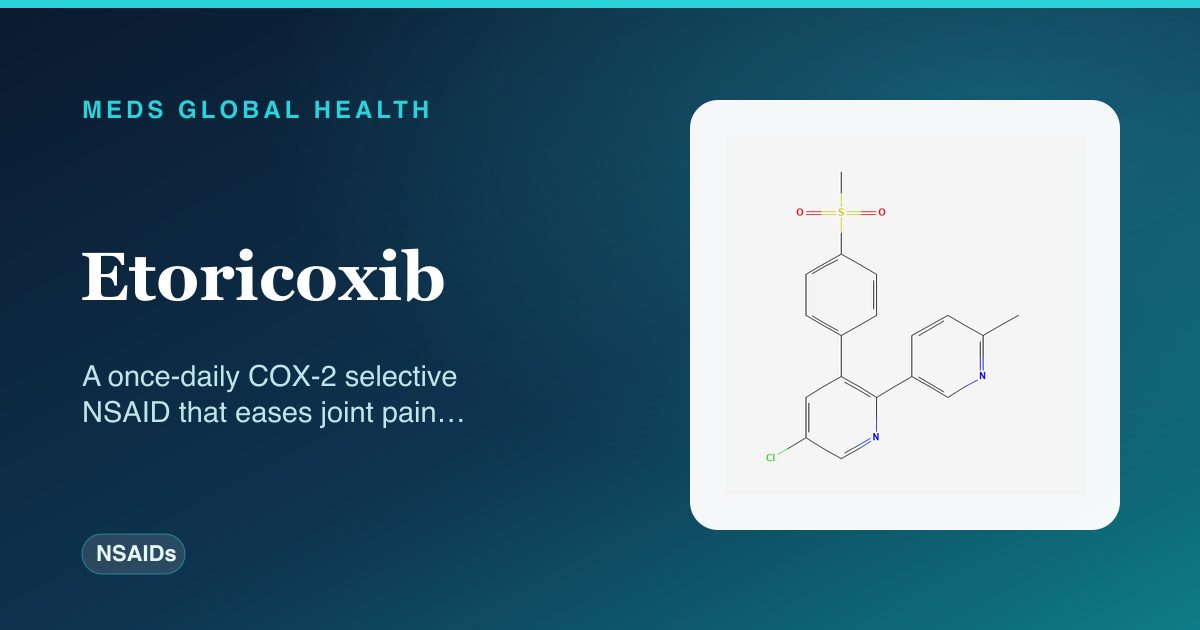
Etoricoxib is a non-steroidal anti-inflammatory drug (NSAID) that selectively targets the COX-2 enzyme. It is used to relieve pain and inflammation in arthritis and acute gout. In the UK it is sold as Arcoxia and as a generic medicine.
How it works
Etoricoxib mainly blocks COX-2, the enzyme that produces the prostaglandins responsible for pain and inflammation, while largely sparing COX-1, which protects the stomach lining. This selectivity means it tends to cause fewer stomach problems than older NSAIDs, but it still affects the kidneys and can raise blood pressure and cardiovascular risk.
Company & origin
Originated / developed by: Developed by Merck (MSD) and sold in the UK as Arcoxia and as generic etoricoxib..
Etoricoxib is a COX-2 selective NSAID developed by Merck and introduced in the early 2000s, used in the UK for arthritis, gout and other painful conditions.
What it treats
Conditions Etoricoxib is used for
Practical use
How to take Etoricoxib
General, dose-free guidance — always follow your prescriber's and the leaflet's specific instructions.
- Take it once a day, at roughly the same time each day.
- It can be taken with or without food, though it may start working a little faster on an empty stomach.
- Swallow the tablet whole with a drink of water.
- Use the lowest helpful strength for the shortest time needed.
- If you miss a dose, skip it and carry on with the next one; do not double up.
- Do not combine it with other NSAIDs or aspirin painkillers unless a doctor tells you to.
Weighing it up
Advantages & disadvantages of Etoricoxib
Advantages
- Convenient once-daily dosing with a long-lasting effect.
- Gentler on the stomach than older non-selective NSAIDs.
- Effective for osteoarthritis, rheumatoid arthritis and acute gout.
- Can be a useful option for people who get indigestion with traditional NSAIDs.
Disadvantages
- Raises blood pressure more than many other NSAIDs, so it is unsuitable in uncontrolled hypertension.
- Carries a risk of heart attack and stroke and is avoided in established heart or circulation disease.
- Can still reduce kidney function and cause fluid retention.
- Needs blood-pressure monitoring, which adds to the burden of treatment.
- Treats symptoms only and does not slow the underlying condition.
Practical use
Good to know
Etoricoxib is taken once a day and is gentler on the stomach than non-selective NSAIDs, but it has a notable effect on blood pressure. Because of this, your blood pressure should be controlled before you start and checked while you take it.
Who should not take it / use with caution
- People with high blood pressure that is not well controlled.
- Anyone with established heart disease, heart failure, previous stroke or peripheral arterial disease.
- People who have had a stomach ulcer or bleeding from the gut, or a reaction to aspirin or another NSAID.
- Those with significant kidney or liver disease.
- Women in the later stages of pregnancy; discuss with a doctor if pregnant, planning pregnancy or breastfeeding.
Monitoring
- Blood pressure should be controlled before starting, checked within the first couple of weeks of treatment, and then regularly — etoricoxib can raise blood pressure.
- Kidney function, particularly in older people or those on blood-pressure medicines.
- Signs of fluid retention such as swollen ankles or breathlessness.
- Regular review of whether ongoing treatment is still needed.
Side effects
- Raised blood pressure and swelling of the ankles from fluid retention.
- Headache, dizziness or tiredness.
- Indigestion, nausea or stomach discomfort, though usually less than with older NSAIDs.
- Serious but less common: heart attack, stroke, stomach bleeding or a severe allergic reaction.
- Seek urgent help for chest pain, breathlessness, sudden weakness, or black or bloodstained stools.
Key interactions
- Other NSAIDs and aspirin, which add to bleeding and kidney risk.
- Blood thinners and anticoagulants such as warfarin, raising bleeding risk and needing closer monitoring.
- Blood-pressure medicines including ACE inhibitors, ARBs and diuretics, whose effect is blunted and whose kidney risk is increased.
- Steroids and SSRI antidepressants, which add to stomach-bleeding risk.
- Lithium and methotrexate, whose levels can rise.
Available as: Tablets.
Answers
Etoricoxib: frequently asked questions
Why does etoricoxib need blood-pressure checks?
Etoricoxib tends to raise blood pressure more than other NSAIDs. Your blood pressure should be well controlled before you start and monitored while you take it.
Is etoricoxib easier on the stomach?
Yes, because it targets COX-2 it generally causes fewer stomach problems than older NSAIDs like ibuprofen, although stomach side effects can still happen.
Can I take etoricoxib if I have heart problems?
It is usually avoided if you have established heart disease, heart failure, a previous stroke or poorly controlled blood pressure, because of the cardiovascular risk. Your doctor will assess this carefully.
Can I use etoricoxib for gout?
Yes, etoricoxib is licensed for the short-term relief of pain and inflammation during an acute gout attack.
Can I take etoricoxib with ibuprofen?
No. You should not combine etoricoxib with other anti-inflammatory painkillers, as this adds to the risk of stomach, kidney and heart problems.
The wider class
About NSAIDs
Etoricoxib belongs to the nsaids class. For how the class as a whole works, its shared safety principles and monitoring, see the full guide.
Browse by body system
Authoritative sources
- BNF
- NICE CKS
Building a medicines information resource?
We create evidence-led, dose-free drug and formulary references for teams.