An anti-inflammatory painkiller (NSAID)
Sulindac
An anti-inflammatory painkiller (NSAID) used to relieve pain and inflammation, including in arthritis and gout.
What is Sulindac?
Sulindac is a non-steroidal anti-inflammatory drug (NSAID) used to relieve pain and inflammation in conditions such as arthritis and gout. It is taken by mouth as a tablet. Like other NSAIDs, its main risks are stomach ulcers and bleeding, effects on the kidneys, and a small increase in heart and circulation problems, so it is used at the lowest effective dose for the shortest time. Rarely it can cause serious skin or liver reactions. It is used with caution, or avoided, in people with stomach ulcers, kidney problems or heart disease.
Education and reference only. This is a plain-language guide to Sulindac — it deliberately contains no doses. Doses depend on the person, the brand and the reason for treatment, and belong with your prescriber. Always check the BNF, the product labelling (SmPC) and follow medical advice.
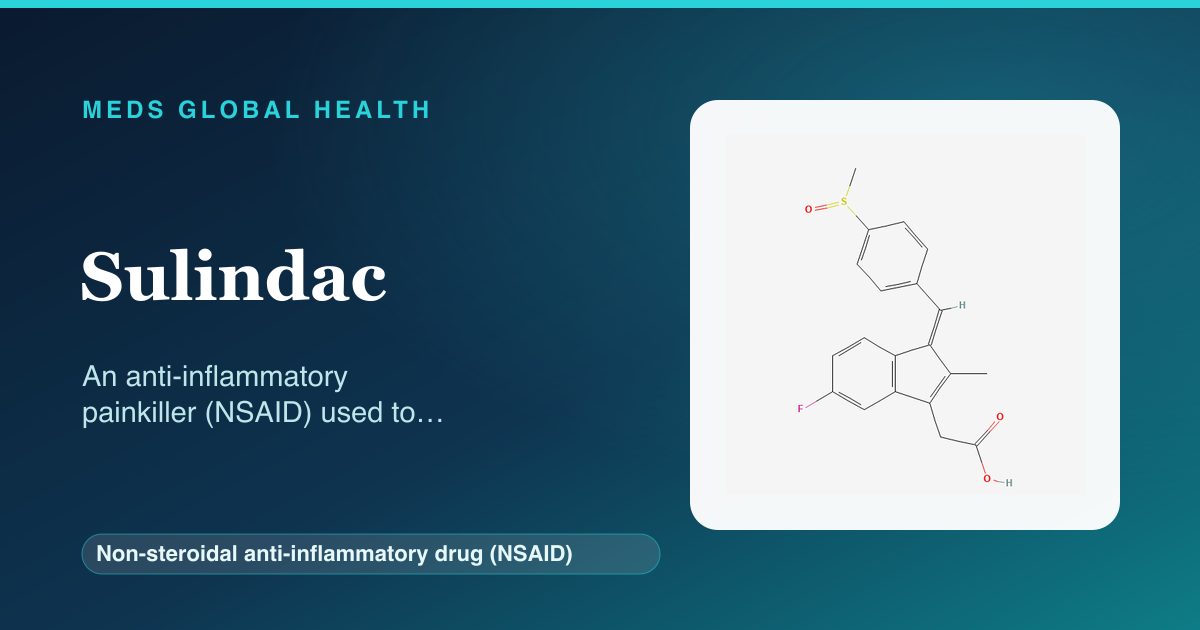
What it is
Sulindac is one of a group of medicines called non-steroidal anti-inflammatory drugs, or NSAIDs. It is used to reduce pain, swelling and stiffness in inflammatory and painful conditions, including different types of arthritis and acute gout. It is taken by mouth as a tablet. Like all NSAIDs, it relieves symptoms rather than curing the underlying condition, and it carries the typical NSAID risks, so it is generally used at the lowest dose that helps for as short a time as possible, and with care in people who are more vulnerable to its side effects.
How it works
Sulindac works by blocking enzymes in the body that produce chemicals called prostaglandins, which drive pain, swelling and inflammation. By lowering these chemicals, it eases pain and reduces inflammation. The same prostaglandins also help protect the stomach lining and support blood flow to the kidneys, which is why reducing them can lead to stomach irritation and ulcers and to effects on the kidneys. This is the reason NSAIDs are balanced carefully against their risks rather than used freely.
Company & origin
An anti-inflammatory painkiller (NSAID) used in the UK for pain and inflammation in conditions such as arthritis and gout.
What it treats
Conditions Sulindac is used for
Practical use
How to take Sulindac
General, dose-free guidance — always follow your prescriber's and the leaflet's specific instructions.
- Take the tablets by mouth, usually with or just after food to reduce stomach upset.
- Use the lowest dose that controls your symptoms for the shortest time needed.
- Avoid taking it with other anti-inflammatory painkillers, including over-the-counter ones, unless advised.
- Stop and seek urgent advice if you notice black stools, vomiting blood, a widespread rash or yellowing of the skin.
- Tell your prescriber if you have stomach, kidney, heart or circulation problems before starting.
Weighing it up
Advantages & disadvantages of Sulindac
Advantages
- Effectively relieves pain, swelling and stiffness in conditions such as arthritis and gout.
- Taken by mouth as a tablet.
- A long-established anti-inflammatory option among the NSAIDs.
Disadvantages
- Can cause stomach ulcers and serious bleeding, especially with higher doses or longer use.
- Can affect the kidneys and carries a small increase in heart and circulation risk.
- Rarely can cause serious skin or liver reactions, so symptoms must be watched for.
Practical use
Good to know
The most important things to understand about sulindac are the typical NSAID risks. It can irritate the stomach and cause ulcers and serious bleeding, which is more likely in older people, with higher doses or longer use, and when combined with other medicines that thin the blood; taking it with food and, where advised, a stomach-protecting medicine can help. It can affect the kidneys, especially in people who are dehydrated or already have kidney problems. It also carries a small increase in the risk of heart attacks and strokes, so it is used with caution in people with heart or circulation problems. Rarely it can cause serious skin reactions or liver problems, so any widespread rash, blistering, yellowing of the skin or feeling very unwell should be reported urgently. It is best used at the lowest effective dose for the shortest time.
Who should not take it / use with caution
- People who have had a serious allergic reaction, asthma attack or wheeze triggered by aspirin or other NSAIDs should not take it.
- People with an active stomach ulcer or a history of bleeding linked to NSAIDs should not take it.
- It is generally avoided in severe heart failure and in significant kidney or liver problems.
- It is avoided in late pregnancy and used with caution at other times only on medical advice.
Monitoring
- Reviewing for signs of stomach upset or bleeding, especially with longer use.
- Checking kidney function and blood pressure in people at risk.
- Watching for any serious skin rash or signs of liver problems.
Side effects
- Indigestion, stomach pain or nausea, helped by taking it with food.
- Stomach ulcers and bleeding, which can be serious.
- Effects on the kidneys, fluid retention or raised blood pressure.
- Rarely but seriously, serious skin reactions or liver problems, which need urgent attention.
Key interactions
- It adds to the bleeding risk of blood thinners such as warfarin and of antiplatelet medicines.
- Combined with some blood-pressure and water tablets, it can reduce their effect and strain the kidneys.
- Taking it with other NSAIDs or with steroids increases the risk of stomach ulcers and bleeding.
Available as: Tablets taken by mouth.
Answers
Sulindac: frequently asked questions
What is sulindac used for?
It is an anti-inflammatory painkiller (NSAID) used to relieve pain, swelling and stiffness in conditions such as arthritis and gout.
Why should I take it with food?
Taking it with or just after food helps reduce stomach irritation, which is one of the main side effects of NSAIDs like sulindac.
Is it safe for my stomach?
Like other NSAIDs it can cause stomach ulcers and bleeding, so it is used at the lowest helpful dose for the shortest time, sometimes with a stomach-protecting medicine, and you should report black stools or vomiting blood urgently.
Can it affect my heart or kidneys?
It can affect the kidneys and carries a small increase in the risk of heart attacks and strokes, so it is used with caution in people with heart, circulation or kidney problems.
When should I seek urgent help?
Seek urgent help if you develop a widespread or blistering rash, yellowing of the skin, black or bloody stools, or you feel very unwell, as these can signal rare but serious reactions.
The wider class
About Non-steroidal anti-inflammatory drug (NSAID)
Sulindac belongs to the non-steroidal anti-inflammatory drug (nsaid) class. For how the class as a whole works, its shared safety principles and monitoring, see the full guide.
Browse by body system
Authoritative sources
- BNF
- NICE CKS
Building a medicines information resource?
We create evidence-led, dose-free drug and formulary references for teams.