An older NSAID now restricted to ankylosing spondylitis
Phenylbutazone
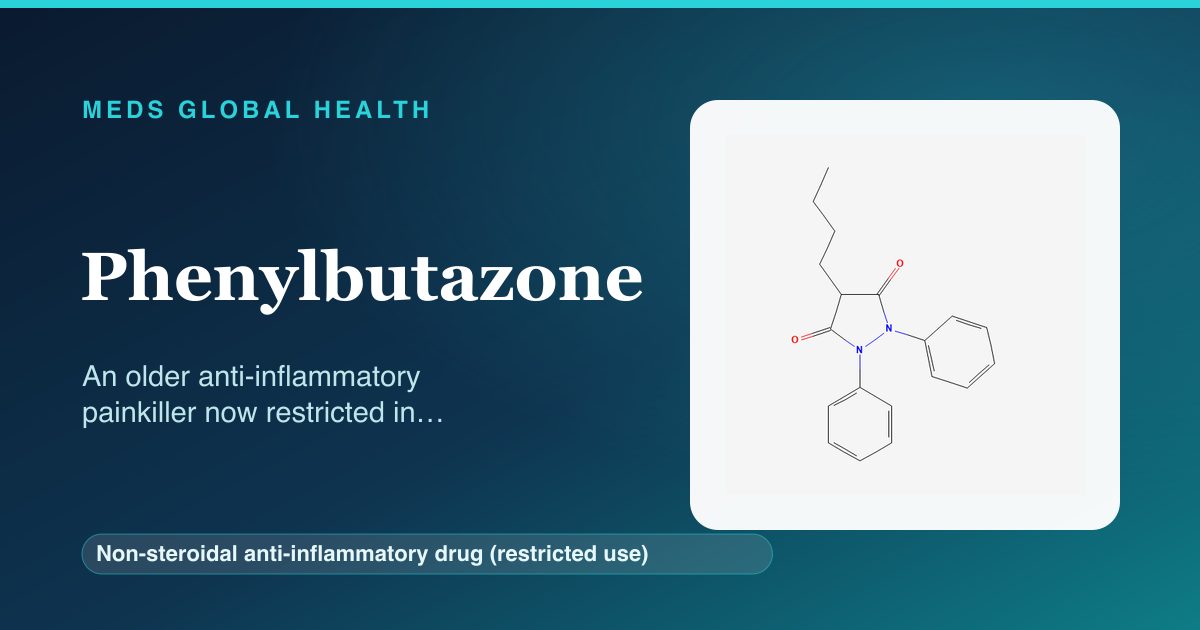
An older anti-inflammatory painkiller now restricted in the UK to ankylosing spondylitis under specialist supervision because of serious blood risks.
What is Phenylbutazone?
Phenylbutazone is an older non-steroidal anti-inflammatory drug (NSAID) that reduces pain and inflammation. Its dominant problem is that it can cause serious blood disorders, including aplastic anaemia and agranulocytosis, where the bone marrow stops making enough blood cells. Because of this, its use in the UK is now restricted to ankylosing spondylitis (a type of inflammatory spine arthritis) and only under hospital specialist supervision when other treatments have not worked. Like other NSAIDs it can also cause stomach ulcers and fluid retention.
Education and reference only. This is a plain-language guide to Phenylbutazone — it deliberately contains no doses. Doses depend on the person, the brand and the reason for treatment, and belong with your prescriber. Always check the BNF, the product labelling (SmPC) and follow medical advice.
What it is
Phenylbutazone is an older medicine from the NSAID group, the same family as ibuprofen and naproxen, which relieve pain and reduce inflammation. It was once used widely for arthritis and pain, but it is now known to carry a serious risk of damaging the bone marrow and causing severe blood disorders. As a result, in the UK its use is tightly restricted: it is reserved for ankylosing spondylitis, a form of inflammatory arthritis affecting the spine, and only under specialist hospital supervision when safer treatments have failed.
How it works
Like other NSAIDs, phenylbutazone works by blocking enzymes (called COX enzymes) that the body uses to make prostaglandins, the chemicals that drive pain, swelling and inflammation. By reducing these chemicals, it eases the pain and stiffness of inflammatory conditions such as ankylosing spondylitis. The same blocking action, however, also reduces protective prostaglandins in the stomach lining, which is part of why NSAIDs can cause ulcers. Its serious effect on the bone marrow is separate and is the main reason its use is now so limited.
Company & origin
An older anti-inflammatory painkiller (NSAID) whose use in the UK is now restricted to ankylosing spondylitis under specialist supervision, because it can cause serious blood disorders.
Practical use
How to take Phenylbutazone
General, dose-free guidance — always follow your prescriber's and the leaflet's specific instructions.
- Take it exactly as your specialist directs, with or after food to reduce stomach irritation.
- Attend all blood-test appointments, as monitoring for serious blood disorders is essential.
- Report sore throat, fever, mouth ulcers, unusual bruising or bleeding straight away, as these can signal a blood problem.
- Report stomach pain, indigestion, black stools or vomiting blood, which can signal an ulcer or bleeding.
- Tell your specialist about all other medicines and any heart, kidney, stomach or blood conditions.
Weighing it up
Advantages & disadvantages of Phenylbutazone
Advantages
- A strong anti-inflammatory effect that can help ankylosing spondylitis when other treatments have failed.
- Taken by mouth.
- A long-established medicine with extensive recorded experience.
Disadvantages
- Can cause serious, potentially life-threatening blood disorders, which is why its use is heavily restricted.
- Like other NSAIDs, can cause stomach ulcers and bleeding and fluid retention.
- Reserved for ankylosing spondylitis under specialist hospital supervision only.
Practical use
Good to know
The single most important thing to understand about phenylbutazone is why it is now so restricted: it can cause serious, sometimes life-threatening blood disorders such as aplastic anaemia (the bone marrow failing to make blood cells) and agranulocytosis (a severe drop in infection-fighting white cells). This is why, in the UK, it is used only for ankylosing spondylitis under hospital specialist supervision after other options have failed, and why anyone taking it needs blood monitoring and must report warning signs such as sore throat, fever, mouth ulcers, unusual bruising or bleeding. On top of this, like all NSAIDs, it can cause stomach ulcers and bleeding, fluid retention and swelling, and affect the heart, kidneys and blood pressure, so it is used with great care.
Who should not take it / use with caution
- People who have had a serious allergic reaction to phenylbutazone or other NSAIDs (including aspirin-triggered wheeze) should not take it.
- People with a history of blood disorders, stomach ulcers or bleeding, or significant heart, kidney or liver disease should not take it.
- It is avoided in pregnancy and is used only under specialist supervision in carefully selected people.
Monitoring
- Regular blood tests to check the blood cells, as serious blood disorders are the main risk.
- Watching for signs of stomach ulcers or bleeding.
- Checking kidney function, blood pressure and for fluid retention.
Side effects
- Serious blood disorders such as aplastic anaemia and agranulocytosis, which can be life-threatening.
- Stomach upset, ulcers and bleeding from the gut.
- Fluid retention and swelling, and effects on the heart, kidneys and blood pressure.
Key interactions
- It interacts with blood-thinning medicines such as warfarin, increasing the risk of bleeding.
- Taking it with other NSAIDs or steroids raises the risk of stomach ulcers and bleeding.
- It can affect medicines for diabetes, epilepsy and the kidneys, so a full medicines list is essential.
Available as: Taken by mouth.
Answers
Phenylbutazone: frequently asked questions
What is phenylbutazone used for now?
In the UK its use is restricted to ankylosing spondylitis, a type of inflammatory spine arthritis, and only under specialist hospital supervision when other treatments have not worked.
Why is its use so restricted?
Because it can cause serious, sometimes life-threatening blood disorders such as aplastic anaemia and agranulocytosis, where the bone marrow stops making enough blood cells.
What warning signs should I watch for?
Report a sore throat, fever, mouth ulcers, unusual bruising or bleeding straight away, as these can be early signs of a serious blood problem.
Is it like ibuprofen?
It is in the same NSAID family and works the same way to reduce pain and inflammation, but it carries a far higher risk of serious blood disorders, hence the restriction.
Can it upset my stomach?
Yes. Like all NSAIDs it can cause stomach ulcers and bleeding, so it is taken with food and any stomach pain or black stools should be reported.
The wider class
About Non-steroidal anti-inflammatory drug (restricted use)
Phenylbutazone belongs to the non-steroidal anti-inflammatory drug (restricted use) class. For how the class as a whole works, its shared safety principles and monitoring, see the full guide.
Browse by body system
Authoritative sources
- BNF
- NICE CKS
Building a medicines information resource?
We create evidence-led, dose-free drug and formulary references for teams.