An HIV antiretroviral (NRTI)
Abacavir
An HIV antiretroviral that needs a genetic test first because of a serious hypersensitivity reaction.
What is Abacavir?
Abacavir is a nucleoside reverse transcriptase inhibitor (NRTI) used as part of combination therapy for HIV. Before it is started, a genetic blood test (HLA-B*5701) is done because some people are at risk of a serious, potentially fatal hypersensitivity reaction. If a reaction is suspected, abacavir must be stopped and never restarted.
Education and reference only. This is a plain-language guide to Abacavir — it deliberately contains no doses. Doses depend on the person, the brand and the reason for treatment, and belong with your prescriber. Always check the BNF, the product labelling (SmPC) and follow medical advice.
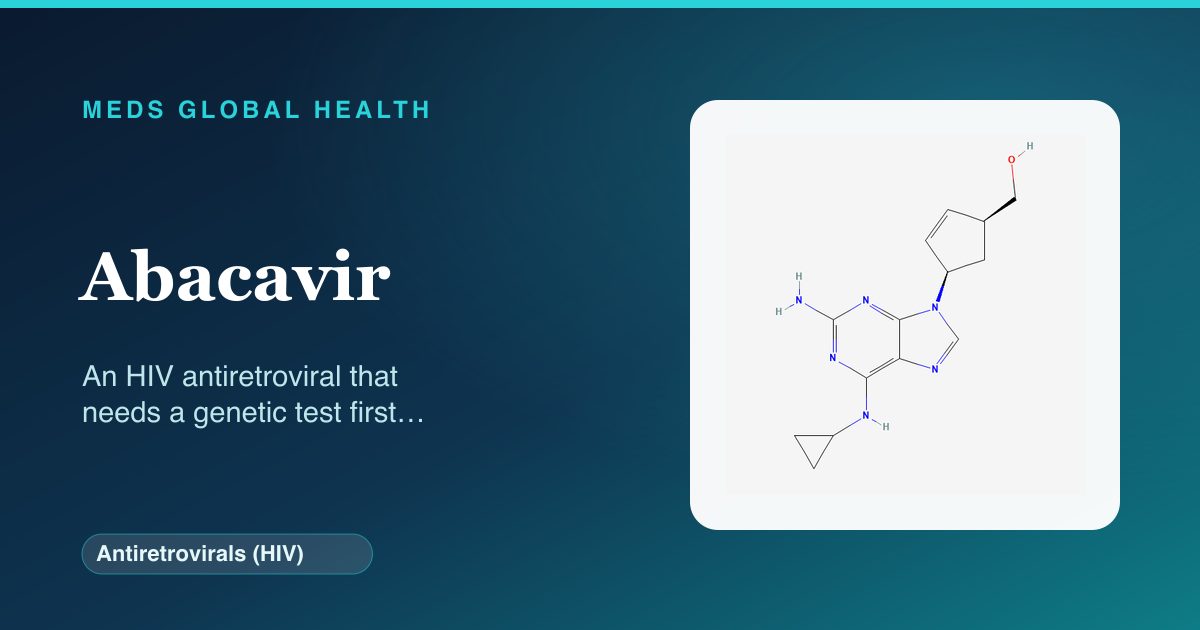
What it is
Abacavir is a nucleoside reverse transcriptase inhibitor (NRTI) used to treat HIV as part of a combination of antiretrovirals. It is often given as part of a fixed-dose combination tablet. The most important thing about abacavir is that a genetic test is carried out beforehand to identify people at risk of a dangerous hypersensitivity reaction.
How it works
HIV uses an enzyme called reverse transcriptase to copy its genetic material. Abacavir acts as a faulty building block: when the virus tries to use it to build new genetic material, the chain stops and the virus cannot reproduce. Used together with other antiretrovirals that block HIV in different ways, it helps drive the virus down to very low levels.
Company & origin
Originated / developed by: Developed and marketed by GlaxoSmithKline; available as a generic medicine..
Developed in the 1990s as a nucleoside reverse transcriptase inhibitor and widely used in UK combination regimens.
Practical use
How to take Abacavir
General, dose-free guidance — always follow your prescriber's and the leaflet's specific instructions.
- Only start it after the genetic (HLA-B*5701) test has been done and discussed with you.
- Take it every day at the same time, alongside your other antiretrovirals.
- It can usually be taken with or without food.
- Carry your abacavir alert card and read the leaflet on hypersensitivity symptoms.
- Stop the medicine and contact your team urgently if you develop fever, rash, severe stomach upset or breathing problems.
- Never restart abacavir after a suspected hypersensitivity reaction, as this can be fatal.
Weighing it up
Advantages & disadvantages of Abacavir
Advantages
- Effective against HIV as part of combination therapy and available in convenient combination tablets.
- Usually taken once a day and does not need dose changes for kidney problems in the way some alternatives do.
- The genetic test means people at risk of the serious reaction can be identified before starting.
Disadvantages
- Carries a risk of a serious, potentially fatal hypersensitivity reaction in genetically susceptible people.
- Requires a genetic test before it can be started, which adds a step.
- Has been linked in some studies to a possible increase in heart risk, so suitability is assessed individually.
Practical use
Good to know
Before starting abacavir, you have a genetic blood test (HLA-B*5701) because people carrying this gene are at risk of a serious hypersensitivity reaction. This reaction can cause fever, rash, stomach upset and breathing problems, and it can be life-threatening. If a reaction is suspected, abacavir is stopped and must never be restarted, as restarting can be rapidly fatal. Carry your alert card and follow your team's advice closely.
Who should not take it / use with caution
- People who carry the HLA-B*5701 gene, because of the high risk of a serious reaction.
- Anyone who has had a previous hypersensitivity reaction to abacavir; it must never be restarted.
- People with significant liver disease, without specialist advice.
Monitoring
- The genetic (HLA-B*5701) test before starting.
- Signs of a hypersensitivity reaction, especially in the early weeks.
- Viral load, immune-cell (CD4) count and liver function over time.
Side effects
- Hypersensitivity reaction with fever, rash, tiredness and stomach upset (uncommon but serious).
- Feeling sick or having an upset stomach.
- Headache.
- Tiredness.
Key interactions
- Alcohol, which can raise abacavir levels in the blood.
- Some other antiretrovirals and medicines handled by the same pathways.
- Always tell your team about all medicines, as combinations are carefully chosen.
Available as: Available as tablets and an oral solution, including fixed-dose combination tablets.
Answers
Abacavir: frequently asked questions
Why do I need a genetic test before abacavir?
People who carry the HLA-B*5701 gene have a much higher risk of a serious hypersensitivity reaction. The test identifies them before treatment so abacavir can be avoided in those at risk.
What is the hypersensitivity reaction?
It is a serious allergic-type reaction that can cause fever, rash, stomach upset, tiredness and breathing problems. It can be life-threatening, so any suspected reaction needs urgent medical attention.
Can I restart abacavir if I stopped it?
No. If abacavir was stopped because of a suspected hypersensitivity reaction, it must never be restarted, as restarting can cause a rapid and potentially fatal reaction.
Does abacavir cure HIV?
No. It controls HIV as part of combination therapy but does not cure it, so you must keep taking your full regimen every day as prescribed.
Can I drink alcohol with it?
Alcohol can raise abacavir levels in your blood. Discuss your usual drinking with your team, who can advise on what is safe for you.
The wider class
About Antiretrovirals (HIV)
Abacavir belongs to the antiretrovirals (hiv) class. For how the class as a whole works, its shared safety principles and monitoring, see the full guide.
Browse by body system
Authoritative sources
- BNF
- NICE CKS
Building a medicines information resource?
We create evidence-led, dose-free drug and formulary references for teams.