An HIV protease inhibitor
Atazanavir
An HIV protease inhibitor used in combination therapy, which can cause harmless yellowing of the skin and eyes.
What is Atazanavir?
Atazanavir is a protease inhibitor used to treat HIV as part of combination therapy, often boosted by another medicine. It can cause a harmless yellowing of the skin and eyes from raised bilirubin. It needs stomach acid to be absorbed, so it interacts with antacids and acid-reducing medicines such as PPIs.
Education and reference only. This is a plain-language guide to Atazanavir — it deliberately contains no doses. Doses depend on the person, the brand and the reason for treatment, and belong with your prescriber. Always check the BNF, the product labelling (SmPC) and follow medical advice.
What it is
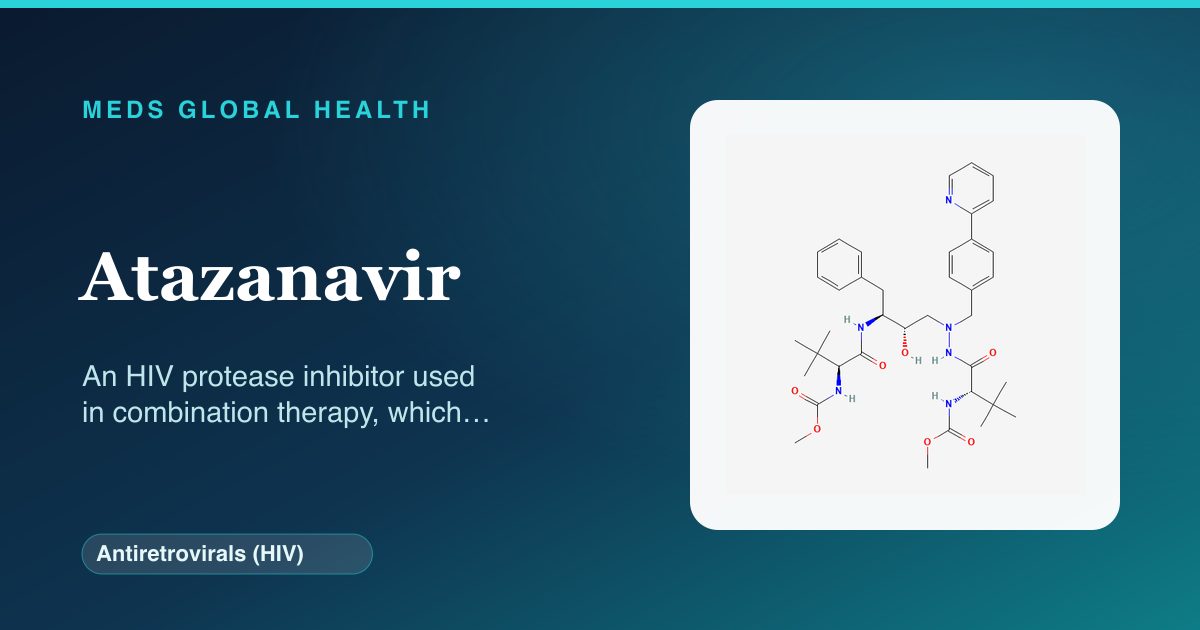
Atazanavir is an HIV protease inhibitor, used together with other antiretrovirals to treat HIV. It is usually taken with a small 'booster' medicine (ritonavir or cobicistat) that keeps its levels high enough to work. A distinctive feature is that it can raise a substance called bilirubin, which sometimes causes a harmless yellowing of the skin or eyes.
How it works
When HIV makes new copies of itself, it relies on an enzyme called protease to cut large proteins into the smaller pieces it needs to assemble new virus particles. Atazanavir blocks protease, so the new virus particles are faulty and cannot infect other cells. Combined with other antiretrovirals, this keeps the amount of virus in the blood very low.
Company & origin
Originated / developed by: Developed and marketed by Bristol-Myers Squibb; available as a generic medicine..
Developed in the United States and approved in the early 2000s as a protease inhibitor for HIV.
Practical use
How to take Atazanavir
General, dose-free guidance — always follow your prescriber's and the leaflet's specific instructions.
- Take it every day with food, which helps it be absorbed.
- Take it together with its booster and your other antiretrovirals as prescribed.
- Keep antacids and indigestion remedies well separated from your dose, as advised by your team.
- Tell your team before starting any acid-reducing medicine such as a PPI, as these can stop it working.
- Drink plenty of fluids, which may help reduce the risk of kidney stones.
- Keep taking it even if your skin or eyes look slightly yellow, unless your team advises otherwise.
Weighing it up
Advantages & disadvantages of Atazanavir
Advantages
- Effective against HIV in combination therapy and usually taken once a day.
- Tends to have less effect on cholesterol and fats than some other protease inhibitors.
- Long experience of use and available as a generic medicine.
Disadvantages
- Often causes a harmless but visible yellowing of the skin or eyes, which some people dislike.
- Needs stomach acid to work, so it interacts with common acid-reducing medicines.
- Can cause kidney stones and gallstones, and must be taken with food.
Practical use
Good to know
Atazanavir controls HIV but does not cure it, so daily adherence is essential to prevent resistance. It commonly raises bilirubin, which can cause a harmless yellowing of the skin or whites of the eyes; this is not the same as liver damage. It needs stomach acid to be absorbed, so antacids, PPIs and H2 blockers must be spaced out or avoided. It can occasionally cause kidney stones and gallstones, so report severe back or tummy pain.
Who should not take it / use with caution
- People who have had a serious allergic reaction to atazanavir.
- People with significant liver disease, without specialist advice.
- People taking certain medicines that interact dangerously, which your team will check.
Monitoring
- Viral load and immune-cell (CD4) count.
- Bilirubin and liver function from time to time.
- Kidney function and any symptoms of kidney or gallstones.
Side effects
- Yellowing of the skin or whites of the eyes from raised bilirubin (usually harmless).
- Feeling sick or having an upset stomach.
- Headache.
- Kidney stones or gallstones in some people.
Key interactions
- Proton pump inhibitors and antacids, which reduce its absorption.
- H2 blockers such as ranitidine-type medicines, which also reduce absorption.
- St John's wort, rifampicin and some other antiretrovirals.
Available as: Available as capsules, including fixed-dose combination tablets.
Answers
Atazanavir: frequently asked questions
Why have my eyes and skin turned slightly yellow?
Atazanavir can raise a substance called bilirubin, which can cause a harmless yellowing of the skin or whites of the eyes. It is not a sign of liver damage, but tell your team if it bothers you.
Can I take indigestion remedies with it?
Atazanavir needs stomach acid to be absorbed, so antacids, PPIs and H2 blockers can stop it working. These must be spaced apart or avoided, so check with your team first.
Does it cure HIV?
No. It controls HIV as part of combination therapy but does not cure it, so you need to keep taking your full regimen every day as prescribed.
Why do I take it with food?
Taking it with food improves how much is absorbed, which helps it keep HIV suppressed. It is also usually taken with a booster medicine.
What should I report straight away?
Tell your team about severe back or tummy pain, which could suggest kidney or gallstones, and any signs of a serious allergic reaction.
The wider class
About Antiretrovirals (HIV)
Atazanavir belongs to the antiretrovirals (hiv) class. For how the class as a whole works, its shared safety principles and monitoring, see the full guide.
Browse by body system
Authoritative sources
- BNF
- NICE CKS
Building a medicines information resource?
We create evidence-led, dose-free drug and formulary references for teams.