An antiretroviral 'booster'
Ritonavir
An antiretroviral used mainly as a 'booster' to make other medicines work better, with a very large number of drug interactions.
What is Ritonavir?
Ritonavir is an antiretroviral medicine that today is used mostly as a 'booster' rather than to fight HIV directly. It works by blocking a liver enzyme that normally breaks down many other medicines, so it makes partner medicines last longer and reach higher levels. It is used in HIV combination treatments and is one of the two parts of Paxlovid for COVID-19. Its most important feature is a very large number of drug interactions, so every other medicine, supplement and herbal remedy you take must be checked carefully.
Education and reference only. This is a plain-language guide to Ritonavir — it deliberately contains no doses. Doses depend on the person, the brand and the reason for treatment, and belong with your prescriber. Always check the BNF, the product labelling (SmPC) and follow medical advice.
What it is
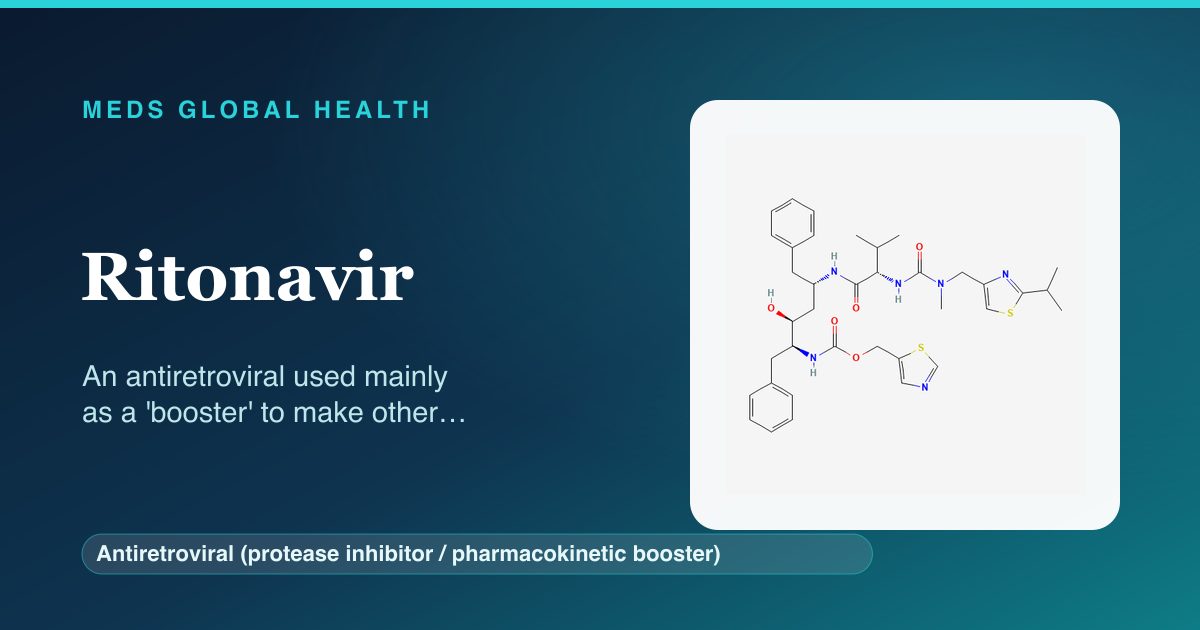
Ritonavir is an antiretroviral medicine first developed for HIV. In practice it is now used mainly as a 'pharmacokinetic booster': a small amount taken alongside another medicine to make that medicine more effective. It is used within HIV combination treatments and is the booster part of Paxlovid, a COVID-19 treatment. It is taken by mouth and is almost always given together with another specific medicine.
How it works
Ritonavir strongly blocks a liver enzyme (called CYP3A4) that the body uses to break down many medicines. By slowing this breakdown, the partner medicine stays in the body longer and at higher levels, so a smaller amount can do the same job. This 'boosting' is useful, but the very same enzyme handles a huge range of other drugs, which is why ritonavir interacts with so many medicines and can dangerously raise their levels.
Company & origin
Originated / developed by: AbbVie.
An antiretroviral used in the UK mainly to 'boost' other medicines, including in HIV combinations and in Paxlovid for COVID-19.
Practical use
How to take Ritonavir
General, dose-free guidance — always follow your prescriber's and the leaflet's specific instructions.
- Take it exactly as prescribed, always together with the medicine it is boosting.
- Take it with food when it is part of HIV treatment, which improves how it is tolerated.
- Give your pharmacist a full list of all your medicines, supplements and herbal remedies before starting.
- Check before adding any new medicine, including ones bought without a prescription, because of interactions.
- Avoid St John's wort, which can stop your treatment working.
- If you miss a dose, follow the advice you were given rather than doubling up.
Weighing it up
Advantages & disadvantages of Ritonavir
Advantages
- 'Boosts' partner medicines so they work better and can be taken in smaller amounts.
- An established part of many HIV combination treatments.
- Provides the booster in Paxlovid, helping its antiviral partner stay effective against COVID-19.
Disadvantages
- Interacts with a very large number of medicines, some dangerously, so careful checking is essential.
- Commonly causes diarrhoea, nausea, stomach upset and taste changes.
- Longer-term use can affect cholesterol and the liver.
Practical use
Good to know
The most important thing about ritonavir is its enormous interaction profile: because it blocks an enzyme that processes many medicines, it can dangerously raise the levels of other drugs, and a few combinations can be life-threatening. Always give your prescriber and pharmacist a full list of everything you take, including over-the-counter medicines, supplements and herbal remedies such as St John's wort, before starting and before adding anything new. It can also cause stomach upset, diarrhoea, nausea and changes in taste, and longer-term use in HIV can affect cholesterol and the liver. It is taken with food when used in HIV treatment. Take it exactly as directed and do not stop or change it without advice.
Who should not take it / use with caution
- People taking certain other medicines that ritonavir can raise to dangerous levels must not combine them.
- It is used with caution, or avoided, in significant liver problems.
- Anyone who has had a serious allergic reaction to ritonavir should not take it.
Monitoring
- A careful, repeated review of all other medicines, supplements and herbal remedies.
- Blood tests for cholesterol and liver function with longer-term use in HIV.
- Checking the treatment it is boosting is working and tolerated.
Side effects
- Diarrhoea, nausea, stomach upset and changes in taste are common.
- Tingling around the mouth, tiredness or headache in some people.
- Longer term, raised cholesterol or effects on the liver, which are monitored.
Key interactions
- Interacts with very many medicines by blocking an enzyme that breaks them down, raising their levels.
- Some combinations are dangerous and must be avoided, so every medicine must be checked.
- It can make hormonal contraception (the pill, patch or implant) less reliable, so an additional method such as condoms may be needed — ask your prescriber.
- St John's wort and certain other products can reduce its effect or cause harm.
Available as: Tablets, capsules and oral liquid taken by mouth.
Answers
Ritonavir: frequently asked questions
What does ritonavir actually do now?
It is used mainly as a 'booster': it blocks a liver enzyme that breaks down other medicines, so partner medicines last longer and work better, including in HIV treatment and in Paxlovid for COVID-19.
Why is the interaction list so important?
Because it blocks an enzyme that processes many drugs, it can dangerously raise their levels, so every medicine, supplement and herbal remedy must be checked before starting or adding anything.
Is it taken on its own?
No. It is almost always given together with the specific medicine it is boosting, such as in HIV combinations or as part of Paxlovid.
Can I take herbal remedies with it?
Some, such as St John's wort, can stop your treatment working, so always check with your pharmacist before taking any herbal product.
Should it be taken with food?
When used as part of HIV treatment it is taken with food, which helps it be better tolerated; follow the instructions you are given.
The wider class
About Antiretroviral (protease inhibitor / pharmacokinetic booster)
Ritonavir belongs to the antiretroviral (protease inhibitor / pharmacokinetic booster) class. For how the class as a whole works, its shared safety principles and monitoring, see the full guide.
Browse by body system
Authoritative sources
- BNF
- NICE CKS
Building a medicines information resource?
We create evidence-led, dose-free drug and formulary references for teams.