An HIV NNRTI, also part of a long-acting injection
Rilpivirine
An HIV NNRTI used, as part of combination therapy, taken with a meal and away from acid-reducing medicines.
What is Rilpivirine?
Rilpivirine is an HIV medicine in the NNRTI group. As a tablet it must be taken with a meal and needs an acidic stomach to be absorbed, so proton-pump inhibitors (strong acid-reducing medicines) must be avoided. It can affect mood, including causing depression, and at high levels can affect the heart's rhythm. It is also available as a long-acting injection given with cabotegravir. It is part of combination therapy, controlling HIV but not curing it, so it must be taken consistently.
Education and reference only. This is a plain-language guide to Rilpivirine — it deliberately contains no doses. Doses depend on the person, the brand and the reason for treatment, and belong with your prescriber. Always check the BNF, the product labelling (SmPC) and follow medical advice.
What it is
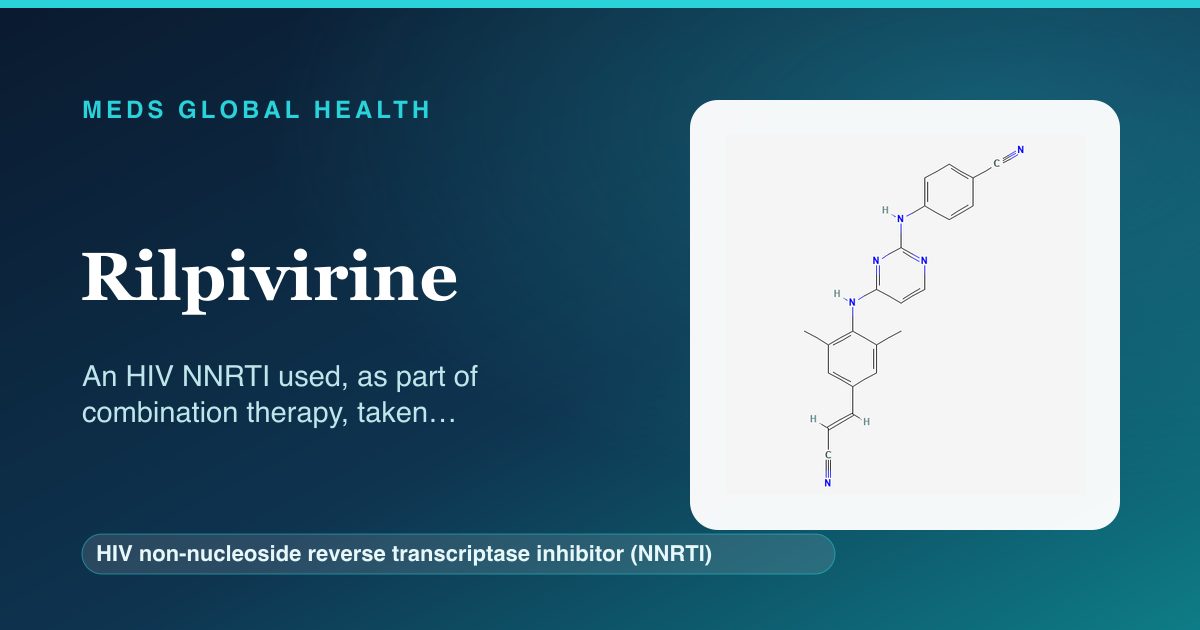
Rilpivirine is an HIV medicine belonging to a group called NNRTIs (non-nucleoside reverse transcriptase inhibitors). It is taken as part of combination therapy, meaning alongside other HIV medicines. As a tablet it is taken once a day with a meal, because food helps it be absorbed, and it needs a normal acidic stomach to work. It is also available as a long-acting injection, given together with cabotegravir, for people whose HIV is already well controlled. It is prescribed and supervised by a specialist HIV team and controls HIV but does not cure it.
How it works
HIV uses an enzyme called reverse transcriptase to copy its genetic material so it can multiply. Rilpivirine attaches to this enzyme and stops it working, so the virus cannot make new copies and the amount of HIV in the body falls. It is taken alongside other HIV medicines so the virus is attacked in more than one way, which helps keep it suppressed and makes resistance less likely. Because the tablet needs to be absorbed properly, it is taken with a meal and away from medicines that strongly reduce stomach acid.
Company & origin
An HIV medicine used in the UK as a daily tablet with a meal, and also as a long-acting injection given with cabotegravir.
Practical use
How to take Rilpivirine
General, dose-free guidance — always follow your prescriber's and the leaflet's specific instructions.
- Take the tablet by mouth once a day with a meal, as food is needed for it to be absorbed.
- Avoid proton-pump inhibitors completely, and carefully time other acid-reducing medicines such as H2 blockers and antacids apart from it.
- Take it consistently and do not skip doses, as missed doses can let the virus become resistant.
- Tell your team promptly about any low mood, depression or thoughts of harming yourself.
- If you have the long-acting injection, keep your clinic appointments so doses are not missed.
Weighing it up
Advantages & disadvantages of Rilpivirine
Advantages
- An effective NNRTI used as part of combination therapy to suppress HIV.
- Available both as a daily tablet and as a long-acting injection (with cabotegravir).
- Generally a small tablet that is well tolerated by many people.
Disadvantages
- The tablet must be taken with a meal and needs an acidic stomach, so proton-pump inhibitors must be avoided.
- Can affect mood, including causing depression, and at high levels can affect the heart's rhythm.
- Controls HIV but does not cure it, so must be taken consistently for life.
Practical use
Good to know
Two practical points are central to the rilpivirine tablet: it must be taken with a meal (not just a snack) to be absorbed, and it needs an acidic stomach, so proton-pump inhibitors must be avoided altogether and other acid-reducing medicines such as H2 blockers and antacids have to be carefully timed apart from it. It can affect mood, including causing depression and, rarely, thoughts of self-harm, so any change in mood should be reported promptly. At higher-than-usual levels it can affect the heart's electrical rhythm. There is also a long-acting injectable form, given with cabotegravir for people whose HIV is already well controlled, which avoids daily tablets but needs regular clinic visits. As with all HIV treatment, it works as part of combination therapy and must be taken consistently to keep the virus suppressed.
Who should not take it / use with caution
- People who have had a serious allergic reaction to rilpivirine should not take it.
- It must not be combined with proton-pump inhibitors, which strongly reduce its absorption.
- It is used with care in people with depression or heart-rhythm problems, under specialist supervision.
Monitoring
- Checking the amount of HIV in the blood (viral load) and the immune cell count (CD4) to see how well it is working.
- Watching for changes in mood, including depression, especially early in treatment.
- Reviewing liver blood tests and, where relevant, the heart's rhythm.
Side effects
- Low mood or depression, and difficulty sleeping or unusual dreams.
- Headache and nausea.
- Changes in liver blood tests.
- Less commonly but importantly, effects on the heart's rhythm at higher levels.
Key interactions
- Proton-pump inhibitors must be avoided, and other acid-reducing medicines must be carefully timed apart from it.
- Some epilepsy and tuberculosis medicines, and the herbal product St John's wort, can lower its levels and should be avoided.
- Medicines that affect the heart's rhythm should be reviewed alongside it.
Available as: Tablets taken by mouth with a meal; also a long-acting injection given with cabotegravir.
Answers
Rilpivirine: frequently asked questions
What is rilpivirine used for?
It is an HIV NNRTI used, as part of combination therapy, to suppress HIV, available as a daily tablet and as a long-acting injection with cabotegravir.
Why must I take the tablet with a meal?
Food is needed for rilpivirine to be absorbed properly, so the tablet must be taken with a meal rather than on an empty stomach or with just a snack.
Why can't I take it with my heartburn medicine?
Rilpivirine needs an acidic stomach, so proton-pump inhibitors must be avoided and other acid-reducing medicines have to be carefully timed apart from it.
Can it affect my mood?
Yes, it can affect mood and cause depression, and rarely thoughts of self-harm, so report any change in mood to your team promptly.
Does it cure HIV?
No. Rilpivirine controls HIV as part of combination therapy but does not cure it, so it must be taken consistently and continued long term.
The wider class
About HIV non-nucleoside reverse transcriptase inhibitor (NNRTI)
Rilpivirine belongs to the hiv non-nucleoside reverse transcriptase inhibitor (nnrti) class. For how the class as a whole works, its shared safety principles and monitoring, see the full guide.
Browse by body system
Authoritative sources
- BNF
- NICE CKS
Building a medicines information resource?
We create evidence-led, dose-free drug and formulary references for teams.