An older HIV medicine (an NRTI), now rarely used
Stavudine
An early HIV medicine no longer recommended, because long-term use caused fat loss and nerve damage.
What is Stavudine?
Stavudine is an older HIV medicine, a type called a nucleoside reverse transcriptase inhibitor (NRTI). It was used as part of combination therapy, always with other HIV medicines and never on its own. It is now rarely used because it can cause significant problems, particularly nerve damage in the hands and feet (peripheral neuropathy), changes in body fat (lipodystrophy), and a serious build-up of acid in the blood (lactic acidosis) with liver problems. Newer NRTIs are safer and are preferred, so stavudine is mostly of historical importance in the UK.
Education and reference only. This is a plain-language guide to Stavudine — it deliberately contains no doses. Doses depend on the person, the brand and the reason for treatment, and belong with your prescriber. Always check the BNF, the product labelling (SmPC) and follow medical advice.
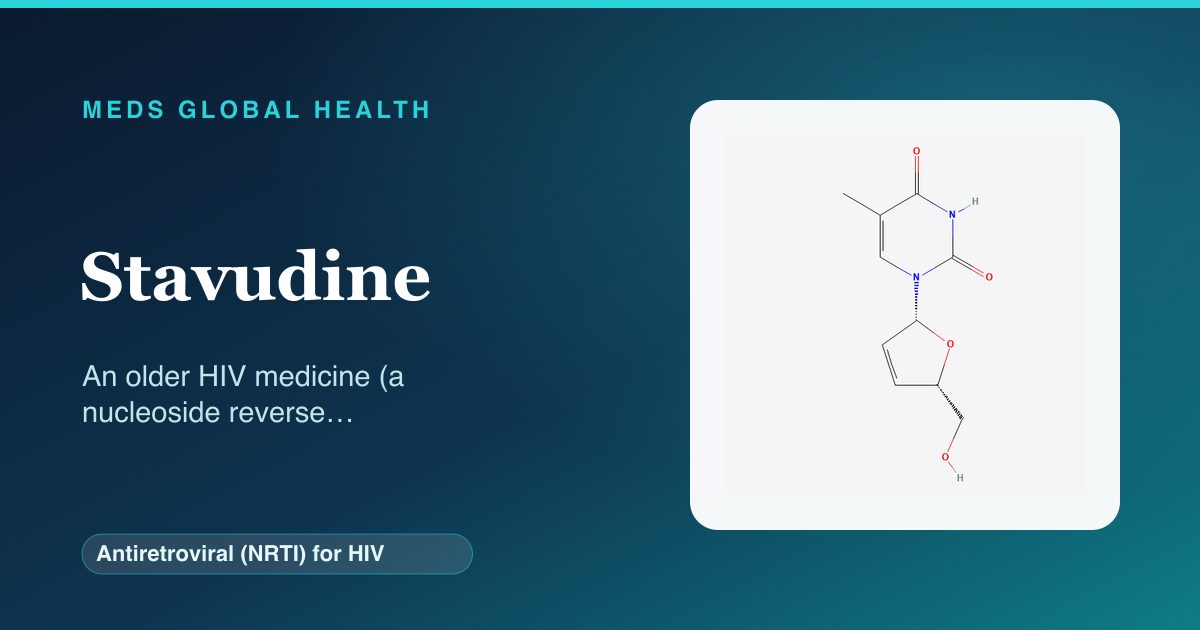
What it is
Stavudine is an antiretroviral medicine used to treat HIV. It belongs to a group called nucleoside reverse transcriptase inhibitors (NRTIs). Like all HIV medicines, it was only ever used as part of combination therapy, meaning together with other antiretrovirals, never alone, because using a single HIV medicine on its own lets the virus become resistant. It is taken by mouth. Today it is rarely used because it tends to cause more side effects than newer NRTIs, so it has largely been replaced by safer, better-tolerated options.
How it works
HIV needs an enzyme called reverse transcriptase to copy its genetic material and multiply. Stavudine is taken up into the process and blocks this enzyme, so the virus cannot reproduce properly and the amount of virus in the body is kept down. Because HIV can quickly become resistant to any single medicine, stavudine works as part of a combination of antiretrovirals that attack the virus in different ways at the same time. Keeping the virus suppressed protects the immune system, but stavudine's long-term effects on nerves, body fat and the body's energy chemistry are why it is now seldom chosen.
Company & origin
An older HIV medicine used in the UK as part of combination therapy in the past; now rarely used because of its side effects, with newer, safer options preferred.
Practical use
How to take Stavudine
General, dose-free guidance — always follow your prescriber's and the leaflet's specific instructions.
- Take it by mouth exactly as prescribed, always together with the other HIV medicines in your combination, never on its own.
- Take it consistently and on time, as missing doses can let the virus become resistant.
- Report any numbness, tingling or pain in your hands or feet promptly, as these can be signs of nerve damage.
- Seek urgent medical help for deep tiredness, nausea, tummy pain or fast breathing, which can signal a serious build-up of acid in the blood.
- Keep all your specialist HIV appointments so your treatment and side effects can be monitored.
Weighing it up
Advantages & disadvantages of Stavudine
Advantages
- An effective HIV medicine in its time, helping suppress the virus as part of combination therapy.
- Taken by mouth.
- Played an important historical role in early HIV treatment.
Disadvantages
- Can cause lasting nerve damage in the hands and feet (peripheral neuropathy).
- Can cause changes in body fat (lipodystrophy) and a rare but serious build-up of acid in the blood with liver problems.
- Now rarely used, as newer NRTIs are safer and better tolerated.
Practical use
Good to know
The most important things to know about stavudine are why it is now rarely used. It can damage the nerves in the hands and feet, causing pain, numbness or tingling (peripheral neuropathy), which can be lasting. It can cause changes in body fat (lipodystrophy), with fat lost from the face, arms and legs and sometimes gained around the middle. Most seriously, it can cause a dangerous build-up of lactic acid in the blood (lactic acidosis) along with liver problems, which is rare but can be life-threatening; warning signs include deep tiredness, nausea, tummy pain and fast breathing, and need urgent medical attention. Because of these risks, newer NRTIs are preferred. As with all HIV treatment, it must be taken consistently and always as part of a combination, and HIV care is provided by a specialist team.
Who should not take it / use with caution
- People who have had a serious allergic reaction to stavudine should not take it.
- It is avoided or used with great caution in people with nerve damage, liver problems or risk factors for lactic acidosis.
- It is not used on its own, and is generally avoided in favour of safer HIV medicines under specialist care.
Monitoring
- Regular blood tests including the amount of virus (viral load), immune cells (CD4 count) and liver function.
- Watching for signs of nerve damage, body-fat changes and lactic acidosis.
- Reviewing the overall HIV combination and considering safer alternatives.
Side effects
- Numbness, tingling or pain in the hands and feet from nerve damage (peripheral neuropathy).
- Changes in body fat, with fat loss from the limbs and face (lipodystrophy).
- Rarely but seriously, a build-up of lactic acid in the blood (lactic acidosis) with liver problems, which needs urgent care.
- Nausea, diarrhoea or headache in some people.
Key interactions
- It should not be combined with certain other HIV medicines, such as zidovudine, which work against it, or didanosine, which adds to nerve and pancreas risks.
- Other medicines that can damage nerves may add to the risk of peripheral neuropathy.
- Tell your specialist about all your medicines, as the HIV combination is chosen carefully to avoid harmful overlaps.
Available as: Capsules and an oral solution taken by mouth.
Answers
Stavudine: frequently asked questions
What is stavudine used for?
It is an older HIV medicine used as part of combination therapy to help keep the virus suppressed; it is always used with other HIV medicines, never alone.
Why is it now rarely used?
It can cause nerve damage in the hands and feet, changes in body fat, and a rare but serious build-up of acid in the blood, so safer newer medicines are preferred.
Can it be taken on its own?
No. Like all HIV medicines it must be part of a combination, because using one HIV medicine alone lets the virus become resistant.
What are the warning signs of a serious reaction?
Deep tiredness, nausea, tummy pain and fast breathing can signal a dangerous build-up of acid in the blood, which needs urgent medical attention.
What should I do about tingling in my feet?
Numbness, tingling or pain in the hands or feet can be a sign of nerve damage, so report it to your specialist team promptly.
The wider class
About Antiretroviral (NRTI) for HIV
Stavudine belongs to the antiretroviral (nrti) for hiv class. For how the class as a whole works, its shared safety principles and monitoring, see the full guide.
Browse by body system
Authoritative sources
- BNF
- NICE CKS
Building a medicines information resource?
We create evidence-led, dose-free drug and formulary references for teams.