An HIV protease-inhibitor antiretroviral
Darunavir
An HIV medicine taken as part of combination treatment, always with a booster, to keep the virus under control.
What is Darunavir?
Darunavir is an HIV medicine from the protease-inhibitor group, taken by mouth as part of combination antiretroviral therapy to keep HIV under control. It is always given with a small booster medicine (ritonavir or cobicistat) that raises its levels so it works properly, and it is taken with food. It controls HIV but does not cure it, so it is taken every day for life and other medicines are taken alongside it. Important points are that it interacts with many other medicines, can cause a rash (it is related to sulfonamides, and serious skin reactions are rare), and can affect the liver, so these are monitored.
Education and reference only. This is a plain-language guide to Darunavir — it deliberately contains no doses. Doses depend on the person, the brand and the reason for treatment, and belong with your prescriber. Always check the BNF, the product labelling (SmPC) and follow medical advice.
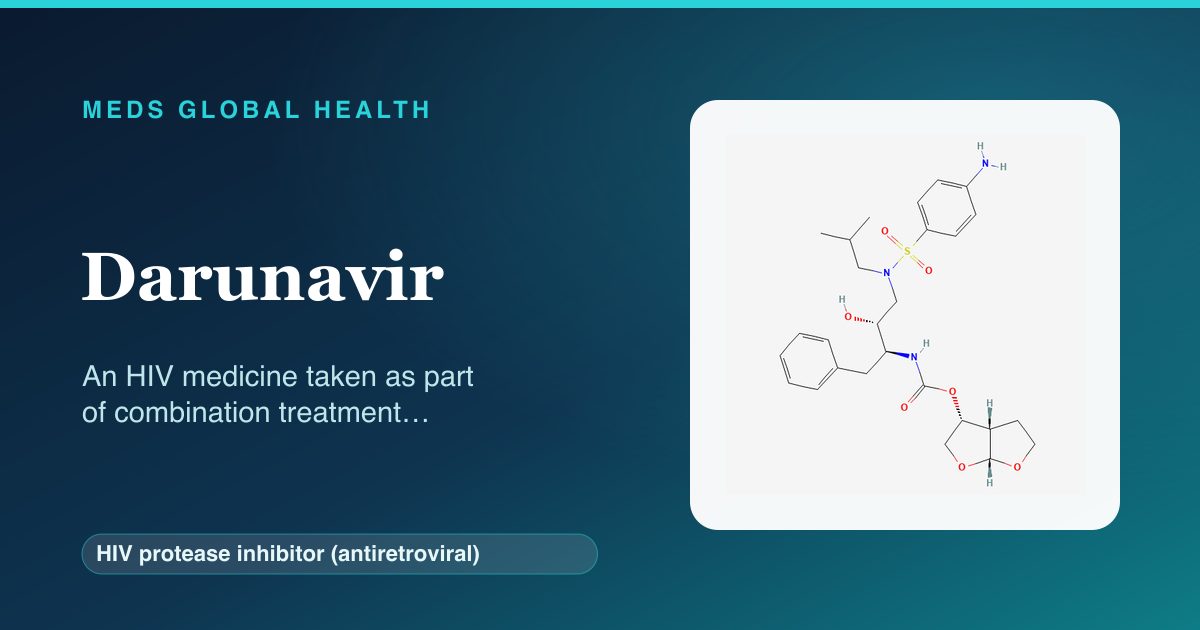
What it is
Darunavir is an antiretroviral medicine used to treat HIV, the virus that affects the immune system. It belongs to a group called protease inhibitors and is always taken with a small dose of a booster medicine, either ritonavir or cobicistat, which raises its levels in the body so it can work effectively. It is taken by mouth, with food, as part of a combination of HIV medicines. It does not cure HIV but keeps it under control so the immune system stays healthy and the virus is not passed on. It is prescribed and supervised by an HIV specialist team.
How it works
HIV needs an enzyme called protease to make new, working copies of itself. Darunavir blocks this enzyme, so the new virus particles cannot mature and become infectious, which keeps the amount of virus in the body very low. Because the body would otherwise break darunavir down quickly, it is given with a booster (ritonavir or cobicistat) that slows this breakdown and keeps levels high enough to work. It is always used with other HIV medicines, because attacking the virus in several ways at once is far more effective and helps stop resistance developing.
Company & origin
A specialist HIV medicine taken as part of combination antiretroviral therapy, always given with a booster.
Practical use
How to take Darunavir
General, dose-free guidance — always follow your prescriber's and the leaflet's specific instructions.
- Take it by mouth with food, every day, exactly as prescribed.
- Always take it with its booster (ritonavir or cobicistat), as it does not work properly without one.
- Take all your HIV medicines together as a combination, every day, without missing doses.
- Give your team a full list of all medicines and supplements, including St John's wort, because of interactions.
- Report any new rash, especially with blistering, fever or mouth sores, straight away.
Weighing it up
Advantages & disadvantages of Darunavir
Advantages
- An effective part of combination treatment that keeps HIV under good control.
- A high barrier to resistance, so it remains useful for many people.
- Available in combination tablets that simplify daily treatment.
Disadvantages
- Must always be taken with a booster and with food to work properly.
- Interacts with a large number of other medicines.
- Can cause a rash (it is related to sulfonamides) and can affect the liver.
Practical use
Good to know
A few things matter most with darunavir. It must always be taken with its booster (ritonavir or cobicistat) and with food, because without these it does not reach the levels needed to work. It interacts with a large number of other medicines, partly because the booster strongly affects how the body handles them, so it is essential to give a full list of everything you take, including herbal products such as St John's wort, which can stop it working. Darunavir is related to the sulfonamide group, so it can cause a skin rash, and although serious skin reactions are rare, any spreading rash with blistering, fever or mouth sores needs urgent attention. It can also affect the liver, so liver blood tests are monitored. Like all HIV treatment, it controls but does not cure HIV, so it is taken every day for life and the virus is kept low by taking the whole combination consistently.
Who should not take it / use with caution
- People who have had a serious allergic reaction to darunavir should not take it.
- It is used with caution in people with a known sulfonamide allergy, because of the rash risk.
- It is used with care in people with liver problems, who need closer monitoring.
- Certain other medicines must not be taken with it because of dangerous interactions.
Monitoring
- Regular checks of how well HIV is controlled, including the amount of virus in the blood.
- Monitoring liver blood tests during treatment.
- Watching for rash and reviewing all other medicines for interactions.
Side effects
- Diarrhoea, nausea or stomach upset.
- A skin rash, as darunavir is related to the sulfonamide group.
- Headache or tiredness in some people.
- Rarely but seriously, severe skin reactions or liver problems, which need urgent attention.
Key interactions
- It interacts with many medicines, partly because its booster strongly affects how the body handles them.
- St John's wort can lower its levels and let HIV escape control, so it must be avoided.
- Always give a full list of medicines and supplements, as some are unsafe to combine with it.
Available as: Tablets taken by mouth, including combination tablets, taken with food.
Answers
Darunavir: frequently asked questions
What is darunavir used for?
It is an HIV medicine taken as part of combination antiretroviral therapy, with a booster, to keep HIV under control and protect the immune system.
Why do I have to take it with a booster?
Without a booster (ritonavir or cobicistat) the body breaks darunavir down too quickly, so the booster keeps its levels high enough for it to work.
Why does my team need my full medicines list?
Darunavir interacts with many other medicines, including herbal products like St John's wort, so a complete list helps keep treatment safe and effective.
Why might I get a rash?
Darunavir is related to the sulfonamide group, so it can cause a rash; most are mild, but report any spreading rash with blistering, fever or mouth sores straight away.
Does it cure HIV?
No. Darunavir controls HIV but does not cure it, so it is taken every day for life along with the rest of your combination of HIV medicines.
The wider class
About HIV protease inhibitor (antiretroviral)
Darunavir belongs to the hiv protease inhibitor (antiretroviral) class. For how the class as a whole works, its shared safety principles and monitoring, see the full guide.
Browse by body system
Authoritative sources
- BNF
- NICE CKS
Building a medicines information resource?
We create evidence-led, dose-free drug and formulary references for teams.