A long-acting HIV integrase inhibitor for treatment and PrEP
Cabotegravir
A long-acting HIV integrase inhibitor given by injection, with rilpivirine for treatment or alone for prevention.
What is Cabotegravir?
Cabotegravir is an HIV medicine in the integrase inhibitor group, given mainly as a long-acting injection by a healthcare professional. With rilpivirine, it treats HIV in people whose virus is already controlled; on its own, it is used for HIV prevention (PrEP) in people who do not have HIV. Its most important features are injection-site reactions and a long 'tail' of medicine that lingers after stopping, which can risk resistance if not covered. As treatment, it is part of combination therapy, controlling HIV but not curing it.
Education and reference only. This is a plain-language guide to Cabotegravir — it deliberately contains no doses. Doses depend on the person, the brand and the reason for treatment, and belong with your prescriber. Always check the BNF, the product labelling (SmPC) and follow medical advice.
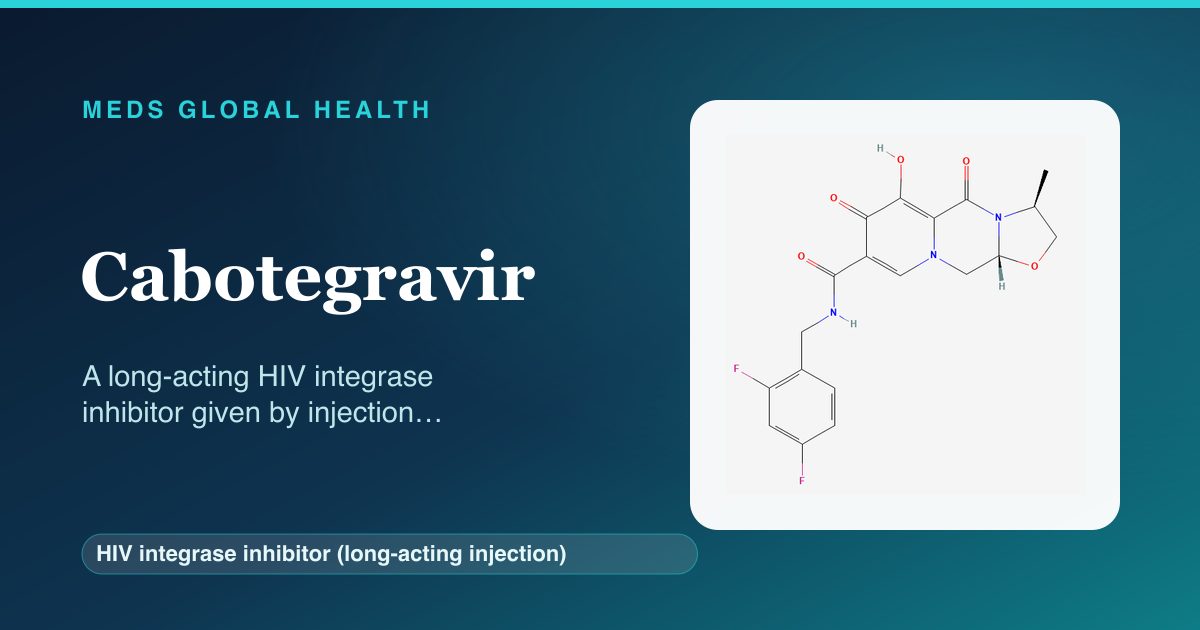
What it is
Cabotegravir is an HIV medicine belonging to a group called integrase inhibitors. It is best known as a long-acting injection given by a healthcare professional every one or two months. Given together with rilpivirine, it is used to treat HIV in people whose virus is already well controlled, as part of combination therapy. Given on its own, it is used as PrEP (pre-exposure prophylaxis) to help prevent HIV in people who do not have the virus. There is also a tablet form, mainly used for a short lead-in. It is prescribed and supervised by a specialist team.
How it works
To make new copies of itself, HIV must insert its genetic material into the DNA of the body's cells using an enzyme called integrase. Cabotegravir blocks this enzyme. As treatment, given with rilpivirine, this keeps an already-controlled virus suppressed without daily tablets. As prevention (PrEP), it keeps a protective level of medicine in the body so that, if the virus is encountered, it cannot establish an infection. Because the injection releases medicine slowly, it lasts for weeks, which is what allows dosing every one or two months.
Company & origin
An HIV medicine used in the UK as a long-acting injection, given with rilpivirine for treatment and on its own for prevention (PrEP).
Practical use
How to take Cabotegravir
General, dose-free guidance — always follow your prescriber's and the leaflet's specific instructions.
- Have the injection given by a healthcare professional on the schedule you are given, usually every one or two months.
- Keep all your appointments, as missing or delaying injections can reduce protection and risk resistance.
- Expect some reaction where the injection is given, such as pain, swelling or a lump, which usually settles.
- If injections are stopped, follow the plan to start other medicines promptly, because the medicine lingers at low levels for months.
- For prevention (PrEP), keep up regular HIV testing as advised, since it is used in people who do not have HIV.
Weighing it up
Advantages & disadvantages of Cabotegravir
Advantages
- A long-acting injection that avoids daily tablets, given every one or two months.
- Used both to treat HIV (with rilpivirine) and to prevent it (PrEP).
- Given by a healthcare professional, which supports consistent dosing.
Disadvantages
- Commonly causes injection-site reactions such as pain, swelling or a lump.
- Leaves a long 'tail' of medicine after stopping, which can risk resistance if not covered.
- Requires regular clinic visits and, for treatment, controls HIV but does not cure it.
Practical use
Good to know
The two most important things to understand about cabotegravir are the injection-site reactions and the long 'tail' of medicine after stopping. Most people get some reaction where the injection is given, such as pain, swelling or a lump, which usually settles. Because the injection releases medicine slowly, low levels can linger in the body for many months after the last dose; if HIV treatment or prevention is not properly continued during this time, the virus could be exposed to low medicine levels and develop resistance, so it is essential to keep appointments and follow the plan for switching to other medicines if injections are stopped. It is given by a healthcare professional, which means regular clinic visits but no daily tablets. As HIV treatment it is always given with rilpivirine and is part of combination therapy; for prevention it is used on its own in people who do not have HIV.
Who should not take it / use with caution
- People who have had a serious allergic reaction to cabotegravir should not use it.
- For prevention, it must only be used by people confirmed not to have HIV, with regular testing.
- It should not be combined with certain medicines, such as some epilepsy and tuberculosis treatments, that strongly lower its levels.
Monitoring
- For treatment, checking the amount of HIV in the blood (viral load) and the immune cell count (CD4).
- For prevention, regular HIV testing to confirm the person still does not have the virus.
- Watching for injection-site reactions and ensuring appointments are kept on schedule.
Side effects
- Reactions where the injection is given, such as pain, swelling, redness or a lump.
- Headache, fever or feeling generally unwell after an injection.
- Tiredness, nausea or muscle aches.
- Less commonly, low mood or sleep problems, and changes in liver blood tests, which should be reviewed.
Key interactions
- Some epilepsy and tuberculosis medicines, and the herbal product St John's wort, can lower its levels and should be avoided.
- Tell your team about all your medicines so possible interactions can be checked.
- When used for treatment it is given with rilpivirine, so that medicine's interactions also apply.
Available as: A long-acting injection given by a healthcare professional; also a tablet, mainly used for a short lead-in.
Answers
Cabotegravir: frequently asked questions
What is cabotegravir used for?
It is an HIV integrase inhibitor given as a long-acting injection, used with rilpivirine to treat HIV and on its own to help prevent HIV (PrEP).
How often is the injection given?
It is given by a healthcare professional every one or two months, depending on the plan, which avoids the need for daily tablets.
Why do appointments matter so much?
Missing or delaying injections can reduce protection, and the medicine lingers at low levels after stopping, which can risk resistance if treatment or prevention is not properly continued.
What is the injection-site reaction like?
Most people get some pain, swelling or a lump where the injection is given; this is common and usually settles on its own.
Does it cure HIV?
No. When used for treatment, cabotegravir controls HIV as part of combination therapy with rilpivirine but does not cure it; for prevention it is used in people who do not have HIV.
The wider class
About HIV integrase inhibitor (long-acting injection)
Cabotegravir belongs to the hiv integrase inhibitor (long-acting injection) class. For how the class as a whole works, its shared safety principles and monitoring, see the full guide.
Browse by body system
Authoritative sources
- BNF
- NICE CKS
Building a medicines information resource?
We create evidence-led, dose-free drug and formulary references for teams.