An HIV integrase inhibitor
Raltegravir
An HIV antiretroviral that stops the virus inserting itself into human cells, used as part of a combination.
What is Raltegravir?
Raltegravir is an integrase inhibitor used to treat HIV, always taken alongside other antiretrovirals. It blocks an enzyme the virus needs to insert its genetic material into your cells. It is generally well tolerated, which is why it is often chosen for people who need a gentler regimen.
Education and reference only. This is a plain-language guide to Raltegravir — it deliberately contains no doses. Doses depend on the person, the brand and the reason for treatment, and belong with your prescriber. Always check the BNF, the product labelling (SmPC) and follow medical advice.
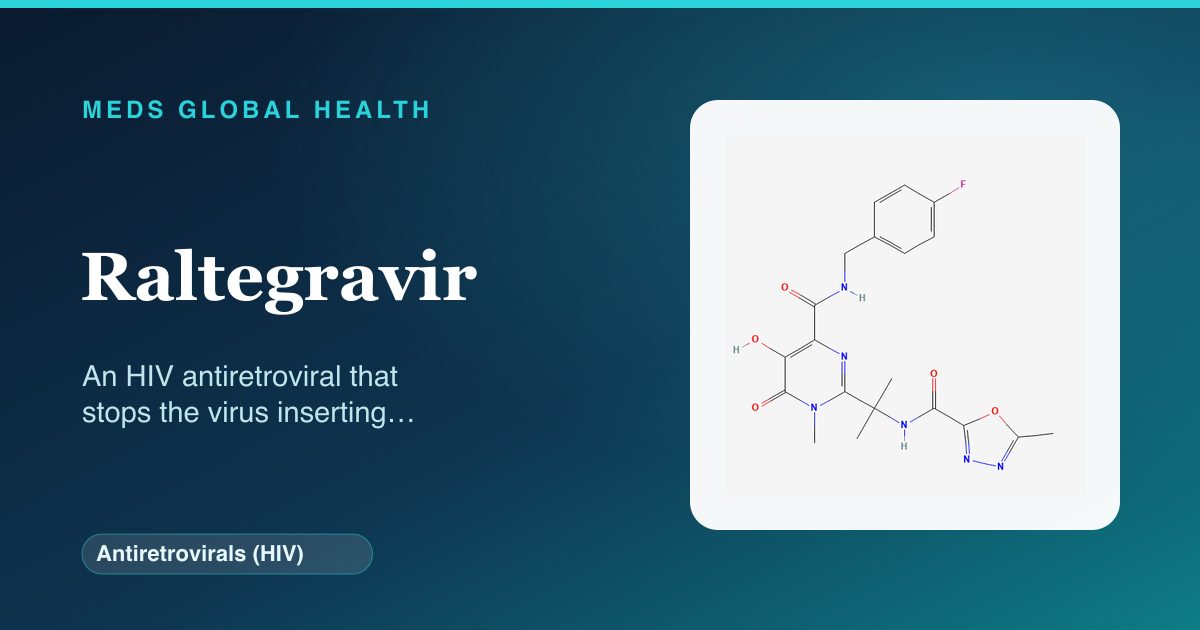
What it is
Raltegravir is an HIV integrase inhibitor, used as part of a combination of antiretrovirals to treat HIV infection. It was the first medicine of its kind and is valued for being generally well tolerated and having relatively few interactions. It is used in a range of people, including those starting treatment and those switching from other regimens.
How it works
After HIV enters a human cell, it uses an enzyme called integrase to stitch its own genetic material into the cell's DNA. Raltegravir blocks integrase, so the virus cannot complete this step and cannot establish a lasting infection in new cells. Combined with other antiretrovirals, this drives the amount of virus in the blood down to very low levels.
Company & origin
Originated / developed by: Developed and marketed by Merck (known as MSD in the UK)..
Developed in the United States and approved in the late 2000s as the first integrase inhibitor for HIV.
Practical use
How to take Raltegravir
General, dose-free guidance — always follow your prescriber's and the leaflet's specific instructions.
- Take it every day at the times your team advises, alongside your other antiretrovirals.
- It can usually be taken with or without food.
- Swallow it with a drink of water; do not crush or chew unless told it is a chewable form.
- Avoid taking it at the same time as antacids that contain aluminium or magnesium, which can stop it being absorbed.
- If you miss a dose, take it when you remember unless your next dose is near, then skip it; never double up.
- Keep taking it even when you feel well, and do not stop without advice.
Weighing it up
Advantages & disadvantages of Raltegravir
Advantages
- Generally very well tolerated, with fewer side effects than some other antiretrovirals.
- Has relatively few drug interactions, making it useful when other medicines are needed.
- Works quickly to lower viral load and suits people who cannot use certain other agents.
Disadvantages
- Some forms are taken more than once a day, which can be less convenient.
- Absorption is reduced by certain antacids, so timing has to be managed.
- Rare but serious muscle problems and severe rashes can occur and need prompt review.
Practical use
Good to know
Raltegravir controls HIV but does not cure it, so it must be taken every day as prescribed to stop the virus becoming resistant. It is usually well tolerated. Antacids containing certain metals can stop it being absorbed properly, so check before using them. Tell your team about any unexplained muscle pain or a new rash.
Who should not take it / use with caution
- People who have had a serious allergic reaction to raltegravir.
- People with a history of muscle problems should be monitored more closely.
- Use in severe liver disease needs specialist assessment.
Monitoring
- The amount of HIV in the blood (viral load) and the immune-cell (CD4) count.
- Any unexplained muscle pain or weakness.
- Liver function from time to time.
Side effects
- Headache.
- Feeling sick or having an upset stomach.
- Trouble sleeping.
- Rash, which is usually mild but rarely serious.
Key interactions
- Antacids containing aluminium or magnesium, which reduce absorption.
- Rifampicin and some other strong enzyme-affecting medicines.
- Certain iron and calcium supplements, depending on timing.
Available as: Available as tablets, including chewable tablets, and as granules for younger patients.
Answers
Raltegravir: frequently asked questions
Is raltegravir well tolerated?
Yes, it is generally one of the better-tolerated HIV medicines, which is one reason it is often chosen. Even so, some people get headaches, an upset stomach or a rash.
Can I take antacids with it?
Some antacids that contain aluminium or magnesium can stop raltegravir being absorbed properly. Check with your pharmacist or HIV team before using indigestion remedies.
Does it cure HIV?
No. It keeps the virus suppressed as part of combination therapy but does not cure it, so you must keep taking your full regimen every day.
What should I report straight away?
Tell your team about any unexplained muscle pain or weakness, or a new or spreading rash, as these need prompt assessment.
Can I take it with food?
It can usually be taken with or without food. Follow the specific advice for your form of the medicine, as chewable tablets and granules can differ.
The wider class
About Antiretrovirals (HIV)
Raltegravir belongs to the antiretrovirals (hiv) class. For how the class as a whole works, its shared safety principles and monitoring, see the full guide.
Browse by body system
Authoritative sources
- BNF
- NICE CKS
Building a medicines information resource?
We create evidence-led, dose-free drug and formulary references for teams.