An HIV medicine taken as part of combination treatment
Etravirine
An HIV medicine taken with other HIV medicines as part of combination treatment, after food.
What is Etravirine?
Etravirine is an HIV medicine taken as part of a combination of medicines to control HIV infection. It belongs to a group called NNRTIs and works by blocking an enzyme the virus needs to copy itself. It is taken by mouth after food, alongside other HIV medicines, and is never used on its own. The most important safety points are the risk of serious skin reactions, which need urgent attention if a rash develops, and a number of interactions with other medicines, so it is important to share a full medicines list.
Education and reference only. This is a plain-language guide to Etravirine — it deliberately contains no doses. Doses depend on the person, the brand and the reason for treatment, and belong with your prescriber. Always check the BNF, the product labelling (SmPC) and follow medical advice.
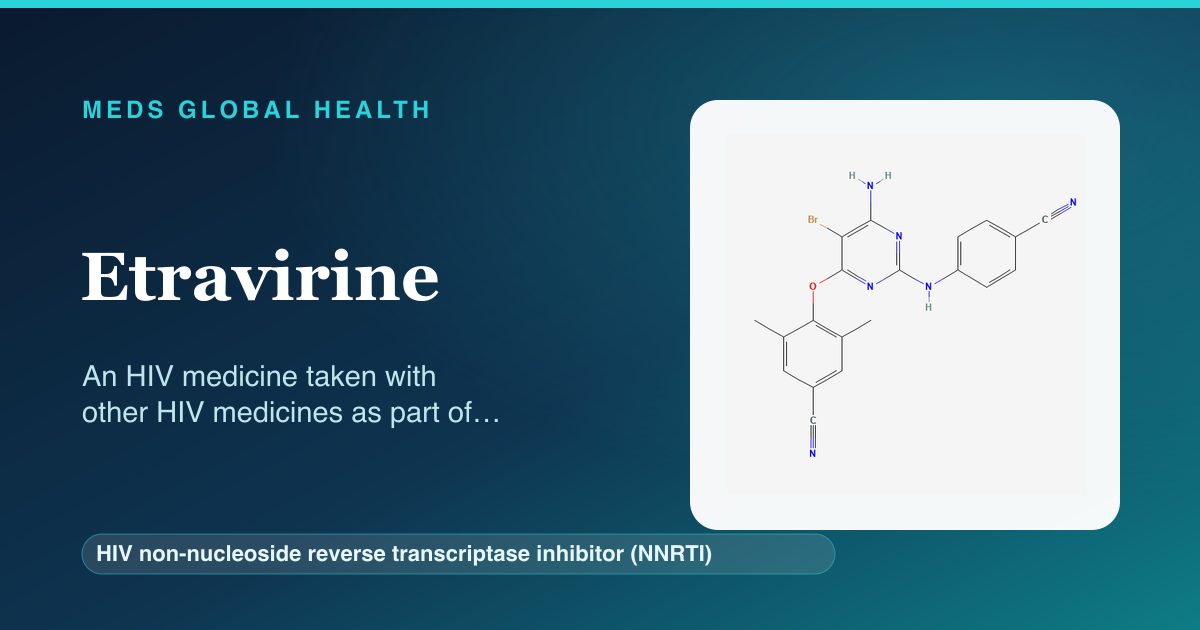
What it is
Etravirine is a medicine used to treat HIV infection. It belongs to a group called non-nucleoside reverse transcriptase inhibitors, or NNRTIs. It is always used as part of combination therapy, meaning it is taken together with other HIV medicines rather than by itself, and it is often chosen for people who have taken HIV medicines before. Taking several medicines together keeps the virus suppressed and reduces the chance of it becoming resistant. It is taken by mouth, after food, and is prescribed and monitored by an HIV specialist team.
How it works
HIV multiplies inside the body by making copies of its genetic material, a step that depends on an enzyme called reverse transcriptase. Etravirine attaches to this enzyme and stops it working, so the virus cannot copy itself effectively. When it is combined with other HIV medicines that block the virus in different ways, the amount of virus in the body can be lowered to very low levels and kept there. Keeping the virus suppressed protects the immune system and reduces the chance of passing HIV on. It is taken after food because this helps the body absorb it properly.
Company & origin
A specialist HIV medicine used in the UK as part of combination treatment, usually for people who have taken HIV medicines before.
Practical use
How to take Etravirine
General, dose-free guidance — always follow your prescriber's and the leaflet's specific instructions.
- Take it by mouth after food, as taking it on an empty stomach reduces how much is absorbed.
- Always take it together with your other HIV medicines, never on its own.
- Take it every day as prescribed, as missing doses can let the virus rebound and become resistant.
- Report any rash urgently, especially with fever, blistering, mouth sores or feeling unwell.
- Give your team a full list of all your medicines, including bought ones and St John's wort, because of interactions.
Weighing it up
Advantages & disadvantages of Etravirine
Advantages
- An effective part of combination HIV treatment, including for people who have taken HIV medicines before.
- Works in a different way from some other HIV medicines, adding to the combination.
- Taken by mouth as part of a daily regimen.
Disadvantages
- Can cause serious skin reactions, so any rash needs prompt attention.
- Must be taken after food and never on its own.
- Interacts with a number of other medicines, so a full medicines list is essential.
Practical use
Good to know
The most important safety point with etravirine is the risk of serious skin reactions. Most rashes are mild, but rarely a rash can become severe and dangerous (such as Stevens-Johnson syndrome or a reaction called DRESS), especially in the first weeks; any rash, particularly with fever, blistering, mouth sores or feeling unwell, should be reported urgently. It is also important to take it after food, as taking it on an empty stomach reduces how much is absorbed. Etravirine interacts with a number of other medicines, both prescribed and bought, including some other HIV medicines, certain heart and cholesterol medicines, and St John's wort, so always share a full medicines list. As with all HIV treatment, taking it consistently every day is essential to keep the virus suppressed and prevent resistance.
Who should not take it / use with caution
- People who have had a serious allergic or skin reaction to etravirine should not take it.
- It is not used with certain other medicines that strongly interact with it, including St John's wort.
- It should only be used under specialist HIV care, as part of a planned combination.
Monitoring
- Regular blood tests to check the amount of virus and the immune system over time.
- Watching for any rash, particularly in the first weeks of treatment.
- Reviewing all other medicines for possible interactions.
Side effects
- Skin rash, which is usually mild but can rarely become a serious reaction.
- Nausea, diarrhoea or tummy upset in some people.
- Headache, tiredness or, less commonly, nerve tingling.
Key interactions
- St John's wort can lower its levels and must be avoided.
- It interacts with some other HIV medicines, and certain heart, cholesterol and anti-seizure medicines.
- Always share a full list of prescribed and bought medicines, as many can be affected.
Available as: Tablets taken by mouth after food.
Answers
Etravirine: frequently asked questions
What is etravirine used for?
It is used as part of a combination of medicines to treat HIV infection, often for people who have taken HIV medicines before, by blocking an enzyme the virus needs to copy itself.
Why must I take it after food?
Taking it after food helps your body absorb it properly; taken on an empty stomach, less of the medicine is absorbed and it may not work as well.
What should I do if I get a rash?
Report any rash urgently, especially if you also have fever, blistering, mouth sores or feel unwell, as rarely a rash can become a serious reaction.
Can I take it on its own?
No. Etravirine is always taken together with other HIV medicines as part of combination treatment, never by itself.
Why does my team need my full medicines list?
Etravirine interacts with many other medicines, including some bought ones and St John's wort, so a full list helps keep your treatment safe and effective.
The wider class
About HIV non-nucleoside reverse transcriptase inhibitor (NNRTI)
Etravirine belongs to the hiv non-nucleoside reverse transcriptase inhibitor (nnrti) class. For how the class as a whole works, its shared safety principles and monitoring, see the full guide.
Browse by body system
Authoritative sources
- BNF
- NICE CKS
Building a medicines information resource?
We create evidence-led, dose-free drug and formulary references for teams.