A local anaesthetic used mainly in dentistry
Articaine
A local anaesthetic used mainly in dentistry to numb a small area before treatment, given by injection.
What is Articaine?
Articaine is a local anaesthetic used mainly in dentistry to numb a small area of the mouth before fillings, extractions and other procedures. It works by temporarily blocking the nerves in that area so you do not feel pain, while you stay fully awake. It is given by injection by a dentist or dental professional, often combined with adrenaline to make the numbness last longer and reduce bleeding. Its effects are mostly local and wear off after a few hours; serious problems are rare but can include numbness or tingling lasting longer than expected.
Education and reference only. This is a plain-language guide to Articaine — it deliberately contains no doses. Doses depend on the person, the brand and the reason for treatment, and belong with your prescriber. Always check the BNF, the product labelling (SmPC) and follow medical advice.
What it is
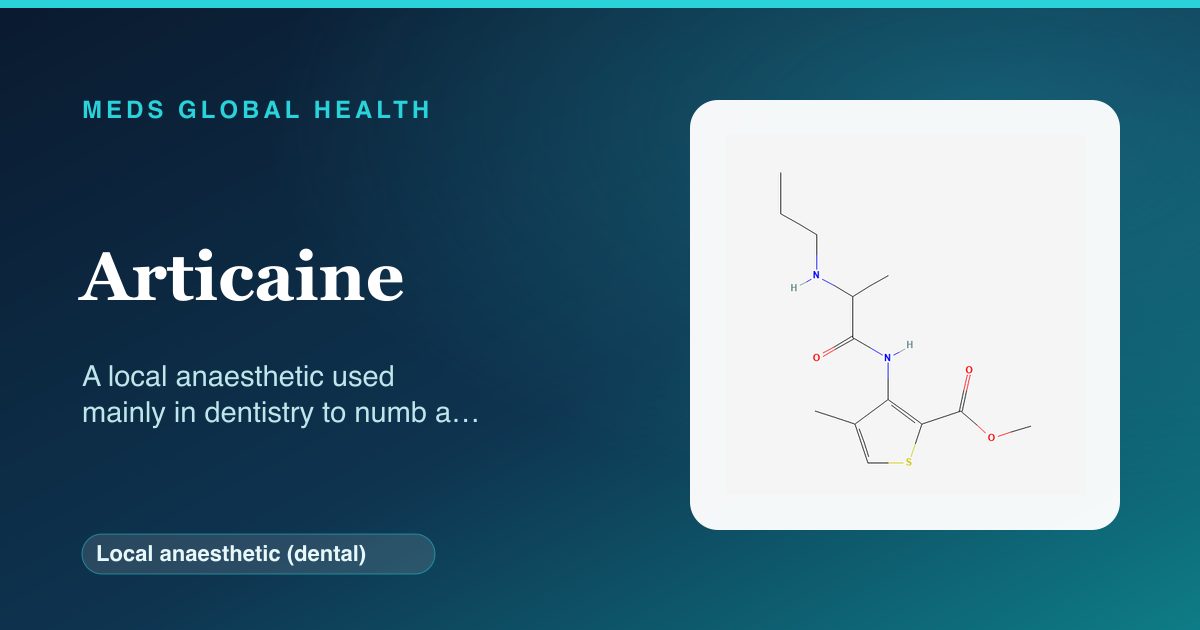
Articaine is a local anaesthetic, a medicine that numbs a specific part of the body so a procedure can be carried out without pain while the person stays awake. It is used mainly in dentistry to numb teeth and the surrounding gum and is one of the most commonly used dental anaesthetics. It is given as an injection into the mouth by a dentist or dental professional, often mixed with a small amount of adrenaline that helps the numbness last and reduces bleeding. It is not something patients use themselves; it is always given by a trained professional.
How it works
Articaine works by temporarily blocking the tiny electrical signals that nerves use to carry pain messages. When it is injected near the nerves supplying a tooth or area of gum, those nerves stop sending pain signals for a while, so the area goes numb and treatment can be done comfortably. The added adrenaline keeps the anaesthetic where it is needed for longer and narrows nearby blood vessels, which reduces bleeding. The effect is temporary and gradually wears off as the medicine is broken down and cleared, with normal feeling returning over the following hours.
Company & origin
A local anaesthetic widely used in UK dentistry to numb part of the mouth before procedures, given by injection by dental professionals.
Practical use
How to take Articaine
General, dose-free guidance — always follow your prescriber's and the leaflet's specific instructions.
- It is given by injection into the mouth by a dentist or dental professional; it is not used by patients themselves.
- Avoid eating, drinking hot liquids or chewing until the numbness has fully worn off, to avoid biting or burning your mouth.
- Tell your dentist about your medical history, heart problems and all medicines before treatment.
- Let your dentist know if you have ever reacted badly to a local anaesthetic before.
- Report any numbness or tingling that lasts much longer than expected after the procedure.
Weighing it up
Advantages & disadvantages of Articaine
Advantages
- Numbs the area effectively so dental treatment can be done without pain while you stay awake.
- Acts quickly and, with added adrenaline, lasts long enough for most dental procedures.
- A widely used and well-understood dental anaesthetic with a long track record.
Disadvantages
- The numbness can linger for hours, making it easy to bite or burn the mouth by accident.
- Must be given by injection by a trained professional, which some people find unpleasant.
- Rarely, can cause prolonged numbness or tingling, and very rarely more serious reactions.
Practical use
Good to know
The most useful thing to know is that the numbness is temporary but can last a few hours after the procedure, so it is easy to bite your lip, cheek or tongue without realising and to burn your mouth on hot food or drink while still numb; it is best to wait until feeling returns before eating. Tell your dentist about your medical history and any medicines you take, as the adrenaline often combined with articaine matters for some heart conditions. A rare but recognised problem is numbness or tingling that lasts longer than expected after a dental injection, which should be reported. Very rarely, local anaesthetics can cause a condition called methaemoglobinaemia, where the blood carries oxygen less well, causing a bluish colour and breathlessness that needs urgent attention. Serious allergic reactions are uncommon.
Who should not take it / use with caution
- People who have had a serious allergic reaction to articaine or similar local anaesthetics should not be given it.
- Versions containing adrenaline are used with caution in people with certain heart conditions, so tell your dentist.
- It is used with care in people with the inherited tendency to methaemoglobinaemia, a rare blood problem.
Monitoring
- The dental professional watches for any immediate reaction after the injection.
- Any prolonged numbness or tingling after the procedure should be reviewed.
- Signs of an allergic reaction or a bluish colour and breathlessness need urgent attention.
Side effects
- Temporary numbness of the lip, cheek or tongue lasting a few hours after treatment.
- Soreness or bruising where the injection was given.
- Rarely, numbness or tingling that lasts longer than expected, which should be reported.
- Very rarely, serious allergic reactions or methaemoglobinaemia, which need urgent medical attention.
Key interactions
- The adrenaline often combined with articaine can interact with some heart and blood-pressure medicines, so tell your dentist what you take.
- Certain antidepressants and other medicines can increase sensitivity to the adrenaline component.
- Tell your dentist about all your medicines so the right preparation can be chosen.
Available as: A solution for injection into the mouth, given by a dental professional.
Answers
Articaine: frequently asked questions
What is articaine used for?
It is a local anaesthetic used mainly in dentistry to numb a tooth and the surrounding area so treatment can be done without pain while you stay awake.
Will I be asleep?
No. Articaine numbs only the area being treated; you stay fully awake. It is different from a general anaesthetic, which puts you to sleep.
How long does the numbness last?
The numbness usually lasts a few hours after the procedure, so avoid eating, hot drinks and chewing until normal feeling returns to avoid biting or burning your mouth.
Why is adrenaline added?
A small amount of adrenaline helps the numbness last longer and reduces bleeding; it is one reason to tell your dentist about any heart conditions you have.
What should I report after a dental injection?
Tell your dentist if numbness or tingling lasts much longer than expected, or seek urgent help for a bluish colour, breathlessness or signs of a serious allergic reaction.
The wider class
About Local anaesthetic (dental)
Articaine belongs to the local anaesthetic (dental) class. For how the class as a whole works, its shared safety principles and monitoring, see the full guide.
Browse by body system
Authoritative sources
- BNF
- NICE CKS
Building a medicines information resource?
We create evidence-led, dose-free drug and formulary references for teams.